The Olmecs: Civilization, Trade & Culture
 Call Kai
 Learn
 Practice Test
 Spaced Repetition
 Match
 Flashcards
1/15

There's no tags or description
Looks like no tags are added yet.
16 Terms
The Mother Culture
A culture that shapes and influences the customs and ideas of later cultures. In Mesoamerica the Olmec were the mother culture.

The Olmec
The earliest-known Mesoamerican civilization, which influenced later societies throughout the region -including the Maya and the Aztec.

1200-400 BCE
When the Olmec civilization flourished.

Mesoamerica
"Middle America" the region extending from modern-day Mexico through Central America

San Lorenzo
One of three major Olmec cities, it was also the first Olmec city lasting from 1200 BCE to 900 BCE when it was deserted and La Venta took over as the center of Olmec life.

Olmec collosal heads
Giant stone representations of human heads sculpted from large basalt boulders. The were up to 11 ft tall and weighed up to 60 tons. Most of the heads are wearing a protective helmet, which was worn by the Olmec during battle and the Mesoamerican ballgame, and it is likely they were originally painted with bright colors.

Tuxtla Mountains
The source of the basalt stone used to make the enormous Olmec head sculptures. The heads had to be transported up to 100 km to reach the cities and it is not known for sure how this was accomplished. (The wheel was not yet invented in this part of the world).
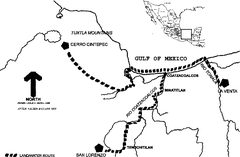
La Venta (Olmec)
The second of the 3 major Olmec cities - it began to flourish as the new Olmec capital around 900 BCE (the same time as the systematic destruction of San Lorenzo was occurring).

Olmec trade
The presence of artifacts made from jade, a semiprecious green stone; obsidian, a glassy, black volcanic rock; and other stones provide evidence for trade with peoples outside the Gulf Coast of Mexico

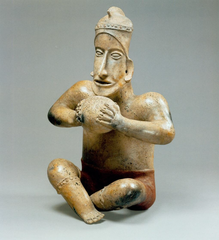
Mesoamerican Ball Game
A game that originated with the Omecs. Extremely popular with the Mayas, and people would try to hit a rubber ball through a ring.

The word Olmac means?
The name Olmec is an Aztec word meaning the rubber people; the Olmec made and traded rubber throughout Mesoamerica.
Olmec religion
Artifacts tell us the Olmec practiced polythesim (worshiped more than one god).

Olmec Gods
Shark Monster, Were-Jaguar, Olmec Dragon, Maize Deity, Bird Monster and Rain Spirit

Were-jaguar
A representation of a supernatural figure that is half jaguar and half human - believed to one of the gods worshiped by the Olmec.

Tres Zapotes
Last dominant Olmec center; rose after La Venta destroyed or collapsed in 600 B.C.E.

Reasons for the end of the Olmec Civilization
The Olmec population declined sharply between 400 and 350 BCE, though it is unclear why. Archaeologists speculate that the depopulation was caused by environmental changes, specifically by the silting-up of rivers, which choked off the water supply.
Another theory is increased volcanic activity in the area.
