HEENT Ear
 Call Kai
 Learn
Learn Practice Test
 Spaced Repetition
 Match
Match Flashcards
 Knowt Play
1/146

There's no tags or description
Looks like no tags are added yet.
Name | Mastery | Learn | Test | Matching | Spaced | Call with Kai | Chat |
|---|
No analytics yet
Send a link to your students to track their progress
147 Terms
you should be able to see through the tympanic membrane indicating a normal tympanic membrane
visualize cone of light
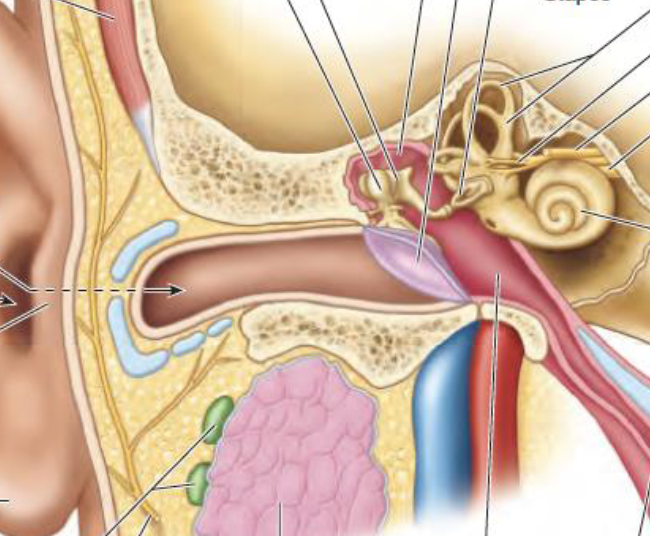
locate the external acoustic meatus


locate the tympanic cavity


locate the Pharyngotympanic tube


identify the internal acoustic meatus

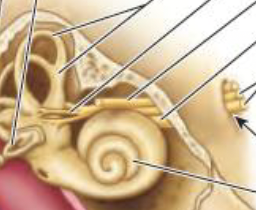
locate the vestibulocochlear nerve CN VIII

locate the cochlear nerve
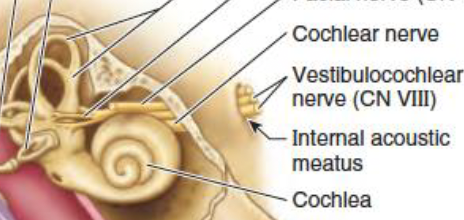
locate the facial nerve

locate the vestibular nerve
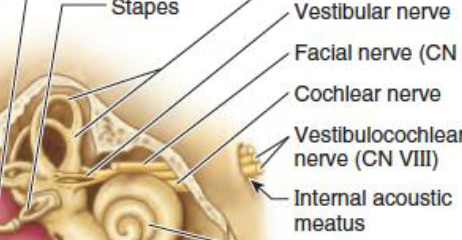

locate the semicircular canals

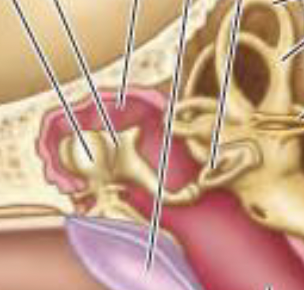
locate the stapes incus and malleus

External Ear
Components:
Auricle (collects sound) - Entire External Ear
Ear canal (______ _______ ______) – conducts ______ to ______ _______
Leads inward through the tympanic part of the temporal bone to the tympanic membrane (TM
Contains ______ & _______ glands → produce cerumen (ear wax)
external acoustic meatus
ceruminous; sebaceous
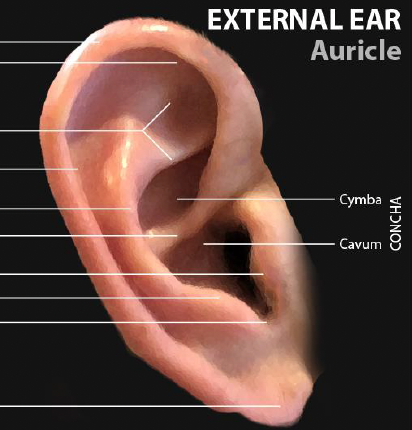
______ = deepest depression
______ = elevated margin
concha
helix
Tympanic Membrane (TM)
~1 cm in diameter, thin, oval, semitransparent membrane
Function
_____ ________: Sound waves strike the TM and cause it to ______.
________: The TM forms a physical ________ between the external auditory canal and the ______ ear, helping protect the middle ear from water, debris, and microorganisms.
sound transmission
vibrate
protection
barrier
middle
Middle Ear Contents
______ _______: malleus, incus, stapes
auditory ossicles
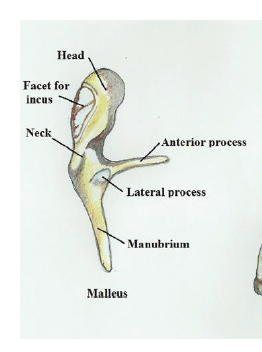
MIDDLE EAR
Malleus (hammer): attached to the _____ ______ ; receives its ______.
tympanic membrane
vibrations

_____ (anvil):acts as the middle ______ bone, transmitting vibrations from the malleus to the stapes.
incus
connecting
_____ (stirrup): its footplate sits in the ____ ________ and transmits vibrations into the fluid of the inner ear.
Stapes
oval window
Middle ear Function: ______ + _______ sound from the _______ ______ to the _____ _______
conduct; amplify
what are the 2 main parts of the internal ear
bony labrinth
membranous labyrinth

INTERNAL EAR
Bony Labyrinth
Hard, outer structure within the temporal bone
Filled with _______
Includes the _____ , _____ , ____ _______
perilymph
cochlea; vestibule, semicircular canal
Membranous Labyrinth
Soft, delicate structure suspended inside the bony labyrinth
Filled with ________
Contains the actual sensory organs for ______ (cochlear duct) and balance (_____, ______, semicircular ____)
endolymph
hearing
utricle, saccule, ducts
SNHL (inner ear): Weber lateralizes to _____ ear
Rinne (mastoid): Normal = ___ > ___
normal
AC;BC
conductive hearing loss (external/middle): Weber lateralized to ______ ear
Rinne (mastoid): ___ > ___
affect
BC> AC
Acute Otitis Externa
PATHOPHYSIOLOGY - Inflammation or infection of the ___ ___ ____.
external auditory canal
Acute Otitis Externa
RISK FACTORS
____ ______ aka "Swimmer’s ear" - excess moisture raises the pH from the normal acidic pH of the ear, facilitating _______ overgrowth
Local _______ _____ (cotton swabs or hearing aids)
Aberrant ear wax (too much or too little).
water immersion
bacterial
mechanical trauma
ACUTE OTITIS EXTERNA
ETIOLOGIES
________ - most common cause of acute otitis externa; especially associated with swimming/water exposure (“swimmer’s ear”).
_______ - another common cause; more likely with trauma or disruption of the external auditory canal, such as from cotton swabs, ____, hearing aids, or _____.
pseudomonas
staph A; scratching; earbuds
Other bacterial causes: Staphylococcus ______, ______ species, ______ species, and _______.
Fungal causes: Aspergillus and Candida; consider with chronic/recurrent symptoms or after prolonged topical antibiotic use.
epidermidis; streptococcus, proteus, anaerobes
ACUTE OTITIS EXTERNA
Fungal causes: Aspergillus and _____; consider with chronic/recurrent symptoms or after prolonged topical _____ use.
candida
antibiotic
CM of ACUTE OTITIS EXTERNA
not painful to the touch
CLINICAL MANIFESTATIONS
Ear pain (otalgia) & erythema; pruritus in the ear canal (may have recent activity of swimming).
________ _________, ear pressure or fullness, hearing impairment or loss.
- canal could be edemitis, swollen
auricular discharge
Physical exam
_____ & ____ on traction of the ear canal or tragus, purulent auricular discharge.
Otoscopy; External auditory canal erythema of skin, edema, discharge, &/or debris.
edema
pain
Acute Otitis Externa
Management
Clean the ear canal to remove debris and ____ topical medication to _____.
Keep the ear ____ and avoid swimming or inserting objects into the canal.
______ therapy should provide coverage against Pseudomonas aeruginosa and Staphylococcus aureus.
allow; penetrate
dry
topical
Tx for Acute Otitis Externa
Mild
Acetic acid–hydrocortisone
_____
Neomycin–polymyxin B–hydrocortisone otic (cortisporin otic)
Moderate
______–______, (steroid-Abx) Ciprofloxacin–hydrocortisone
ofloxacin
ciprofloxacin dexamethasone
ACUTE OTITIS EXTERNA if there is Severe/ Significant Canal Edema
Same topical antibiotic options as _____
____ ___ if canal edema prevents adequate penetration of drops
_______ as needed
ear wick
analgesia
Acute Otitis Externa
______ should Not used if tympanic _______ is suspected or if the TM cannot be visualized bc the are _____.
aminoglycosides
perforation
ototoxic
_______ (necrotizing) Otitis Externa
Invasive infection of the external auditory canal and skull base (temporal bone, soft tissue, and cartilage).
Pseudomonas aeruginosa >___% of cases.
Risk factors: immunocompromised states, elderly, diabetics, high-dose glucocorticoid therapy, chemotherapy, post-transplant
malignant
95
Malignant Necrotizinf Otitis Externa
CLINICAL MANIFESTATIONS
Severe auricular pain, persistent otorrhea. Cranial nerve palsies (eg, CN ?? ?? ?? ) if ____.
May radiate to temporomandibular joint - pain with _____.
Physical examination: severe auricular pain on ____ of the ear canal or tragus.
6 7 9 ; osteomyelitis
chewing
traction
DIAGNOSIS - Malignant Otitis Externa
Otoscopy: _____ of the external auditory canal with erythema, discharge, ______ _____ at the bony cartilaginous junction of the ear canal floor, frank ____ of the ear canal skin.
___ or ____ to confirm the diagnosis.
_____ is the most accurate test
High ____ & ____.
edema; granulation tissue
necrosis
CT MRI
Biopsy
ESR, CRP
MANAGEMENT of MALIGNANT NECROTIZING OTITIS EXTERNA (VERY dangerous)
• ______ + IV Antipseudomonal antibiotics - __ ______ first-line antibiotic.
o Alternatives - Piperacillin-tazobactam (_____), Ceftazidime, or Cefepime.
Admission; IV Ciprofloxacin
Zosyn
Buzzword for Malignant Otitis Externa on otoscopy
granulation tissue - confirm with imaging
risk factors for Malignant Otitis Externa
immunotherapy
HIV/AIDS
high dose glucocorticoids
AGE

what are we looking at
Acute Otitis Media
ACUTE OTITIS MEDIA
Pathophysiology
Viral uri --> blockage of the ________ tube --> infection of the ______ ear

eustachian
middle
ACUTE OTITIS MEDIA
Organisms - _______ ________, H influenzae, Moraxella catarrhalis
streptococcus pneumoniae
ACUTE OTITIS MEDIA
Clinical manifestations
____
Ear ______ in infants
fever
tugging
ACUTE OTITIS MEDIA
Physical exam - absent cone of light reflex
Tympanic membrane findings
o ______, loss of _____ landmarks
o Color – _____ – can be erythematous, opacified, pale or yellow
bulging
bony
varies
ACUTE OTITIS MEDIA
Diagnosis
_____
______ ________ – Gold standard
o Decreased TM mobility
clinical
pneumatic otoscopy
what is more important than the color of the ear drum?

bulging - more likely an inner ear infection
acute otitis media is typically unilateral true or false
false
you always treat Peds acute otitis media with what?
amoxicillin - can exceed adult dosing
if there is a PCN allergy you could Rx what for acute otitis media
azithromycin
2nd line option for acute otitis media
_____-_____ ____ ___mg BID, cefuroxime, cefdinir, cefpodoxime
amoxicillin-clavulanic acid 875
if a child has recurrent otitis media what is the procedure based treatment
__________ with tympanostomy tube insertion
Myringotomy
easier to get an ear infection as the ET is _____ for an infant
horizontal

Eustachian Tube Dysfunction
The Eustachian tube (________ tube) connects the _______ ear to the ________ and has three major functions:
pharyngotympanic
middle
nasopharynx
The Eustachian tube (pharyngotympanic tube) has three major functions:
pressure equalization
drainage
protection
Pressure equalization: Equalizes air pressure between the _______ ear and the _______, allowing the tympanic membrane to _______ normally.
middle
atmosphere
vibrate
ET functions: Drainage: Allows middle-ear ________ and fluid to drain into the ________.
secretions
nasopharynx
Eustachian Tube Dysfunction
Occurs when the eustachian tube does not ______ properly.
Often follows viral URI or allergic rhinitis sinusitis, tumors. Often precedes ____ ____ _____.
close
acute otitis media
EUSTACHIAN TUBE DYSFUNCTION
CLINICAL MANIFESTATIONS
Ear ______, pressure, or pain; popping of the ears with swallowing or yawning, underwater feeling, disequilibrium, discomfort with barometric pressure change, fluctuating conductive hearing loss, tinnitus, delayed _____ in children.
fullness
speech
ET Dysfunction PHYSICAL EXAM - Otoscopic findings usually normal but may reveal tympanic membrane ______ or _____ behind the TM (Serous otitis media).
retraction
fluid
ET dysfunction
DIAGNOSIS - Clinical diagnosis
MANAGEMENT
Treating the _____ cause & symptom management is the mainstay of treatment.
Auto insufflation eg, swallowing, yawning, blowing against a slightly-pinched nostril.
_________ for congestive symptoms: Pseudoephedrine, Phenylephrine, Oxymetazoline nasal.
o Patients should be counseled not to exceed 3 days of nasal decongestant use in order to prevent nasal mucosal ______ and Rhinitis medicamentosa (rebound congestion).
• Intranasal corticosteroids if sinonasal inflammation is present.
• Refractory: ______ tube.
underlying
decongestant
dependency
tympanostomy
_______
Damage to the tympanic membrane that can occur when ______ __________ in the middle ear & the external environment due to sudden pressure changes _______ the tympanic membrane [eg, ____- (most common, especially descent), rapid descent, diving, decompression, hyperbaric oxygen, blast injuries].
barotrauma
pressure difference
stretch
flying
Barotrauma
Stretching of the tympanic membrane TM may cause _____ of, bleeding into, or ____ of the TM.
•May be associated with Eustachian tube dysfunction resulting in inability to _____ the barometric pressure on the middle ear; the pressure difference can damage the tympanic membrane.
bruising
rupture
equalize
Barotrauma
PHYSICAL EXAMINATION:
______ to the tympanic membrane: Tympanic membrane visualization may reveal rupture, _____, serous or bloody _____.
May have ______ auricular discharge if traumatic.
Damage
petechiae
effusion
bloody
MANAGEMENT - BAROTRAUMA
________ is the best treatment: i.e., avoidance of flying with a cold.
_____ _______ eg, swallowing, yawning, chewing gum.
Decongestants, ____ (eg, 1% ______ or Oxymetazoline nasal spray) or oral (Pseudoephedrine), may be administered prior to descent and before arrival to alleviate or prevent symptoms.
______ may be used for severe or refractory cases.
avoidance
auto insufflation
topical; phenylephrine
myringotomy
Acute ______ - any time you have an untreated ear infection you can develop, as the infection works its way into mastoid
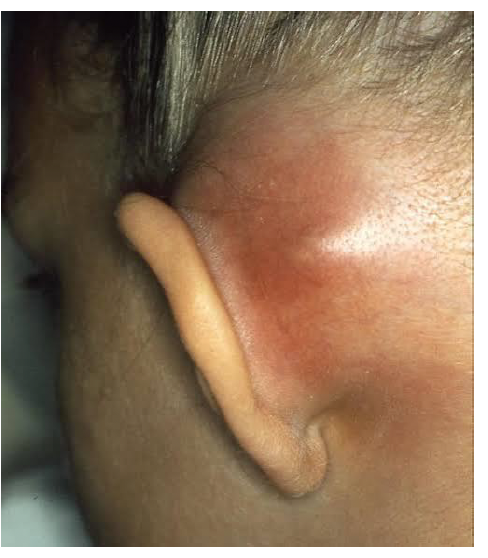
Mastoiditis
Acute Mastoiditis
______ of the mastoid air cells of the _____ ___. Largely a disease of childhood (esp. <__ years). Causes external ear to be displaced

infection
temporal bone
2
ACUTE MASTOIDITIS
ETIOLOGIES
Usually a complication of _____ _____ ____ (accumulation of _____ material in mastoid ___).
Streptococcus pneumoniae and Streptococcus _____ common pathogens.

Acute otitis media
purulent; cavity
pyogenes
ACUTE MASTOIDITIS
CLINICAL MANIFESTATIONS
____ ear pain (usually worse at ____), ____, fussiness, lethargy, malaise, pulling at ear.
deep
night
fever
PHYSICAL EXAMINATION- ACUTE MASTOIDITIS
______ (ear pain), fever, signs of Otitis _____ (bulging & erythematous tympanic membrane).
Mastoid (_______) tenderness, edema, erythema, &/or fluctuance (subperiosteal abscess).
______ of the auricle. Narrowed auditory canal. _____ nerve _____ if complicated.
otalgia; media
post auricular
protrusion; facial; plasy
DIAGNOSIS - ACUTE MASTOIDITIS

Clinical diagnosis
____________ is generally the first-line imaging study when imaging is needed.
MRI with contrast is particularly useful when _______ or ________ complications are suspected.
CT Temporal w/ IV contrast
intracranial; soft-tissue
MANAGEMENT - ACUTE MASTOIDITIS
_______
IV _____ (eg, IV _____-_______) + middle ear or mastoid drainage (______) +/- tympanostomy tube placement.
Piperacillin-tazobactam if recent ____ use.
Severe: IV ______ + either Ceftazidime or ______ or Piperacillin-tazobactam
Tympanocentesis can be performed to get cultures
admissions
ABx - ampicillin sulbactam
myringotomy
ABx
Vancomycin
cefepime
any infection it’s best to do imaging with _____
contrast
ACUte mASTOIDITIS Refractory or complicated: _________ (surgery).
mastoidectomy
Chronic Otitis Media
Recurrent or persistent infection of the ____ &/or ____ cell system in the presence of _______ _________ ________
middle ear
mastoid
tympanic membrane perforation > 6 weeks
Can also be a Complication of recurrent Acute otitis media, trauma, or Cholesteatoma.
Chronic Otitis Media
Rupture TM - fluid will ____ and you would see auricular discharge
leak
ETIOLOGIES CHRONIC OTITIS MEDIA
• _________ most common. S. aureus, gram-negative rods (eg, Proteus), anaerobes, Mycoplasma.
• Purulent ______ can become worse after a URI or after water enters the ear.
pseduomonas
otorrhea
CLINICAL MANIFESTATIONS - CHRONIC OTITIS MEDIA
[1] _______ tympanic membrane + [2] _______ or recurrent _______ _______ (often painless) >6 weeks, ear fullness, & [3] varying degrees of ______ _____ ____.
• May have a primary or secondary Cholesteatoma. Usually no pain, fever, or signs of systemic infection.
Perforated
persistent; purulent otorrhea
conductive hearing loss
MANAGEMENT for what???
Removal of infected debris + topical ____ drops first-line (eg, Ofloxacin or _______).
In patients with a tympanic membrane rupture, avoid water, moisture, drying agents (eg, alcohol, acetic acid), & topical ________ in the ear (they are ototoxic).
______ antibiotics reserved for severe cases.
Surgical: tympanic membrane ______ or reconstruction.
Chronic Otitis Media
Abx; ciprofloxacin
aminoglycosides
systemic
repair
Serous Otitis Media
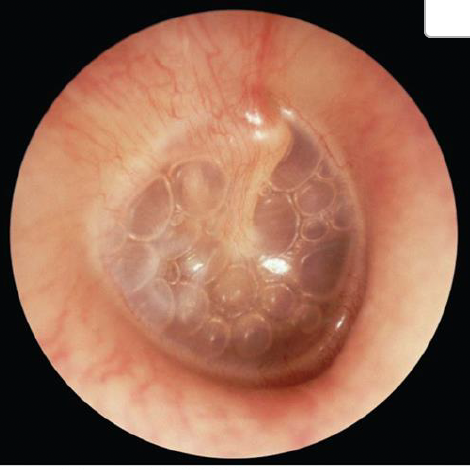
Middle ear fluid + no signs or symptoms of ______ ______ or _______ (no fever, no ear pain, & no marked erythema or bulging of the TM). Often as a result of a viral ____.
May be seen after resolution of Acute otitis media or in patients with ___ dysfunction.
•Most are ________. The most common symptoms are decreases in sound conduction & hearing, aural fullness, or a popping sensation. Tinnitus.
•Children with ____ may exhibit impaired language development or communication difficulties.
acute inflammation; infection
URI
ET
asymptommatic
OME
DIAGNOSIS - Serous Otitis Media
Otoscopy: gray, amber, blue, or _____ ______ (air fluid levels or bubbles behind a cloudy membrane), loss of light reflex, retracted or flat (______) tympanic membrane hypomobile with insufflation.
Workup may include audiometry, tympanometry, measurement of auditory brainstem ______
colorless effusion
neutral
responses
MANAGEMENT - SEROUS OTITIS MEDIA
________ (watchful waiting) in most - usually spontaneously resolves within 4-6 weeks.
Significant symptoms: ________, oral decongestants, and/or nasal corticosteroids.i
Persistent or complicated: ______ with _______ tube for drainage - eg, children with hearing impairment; speech, language, or learning delays; or specific conditions.
observation
antihistamine
myringotomy
tympanostomy

whats this
Tympanic Membrane Perforation
Tympanic Membrane Perforation
Etiology
_____ (barotrauma, foreign body, blast injury)
_____ _____ _____ → rupture from pressure buildup
trauma
acute otitis media
Clinical Features - TM PERFORATION
______ ear pain, sometimes relief if otitis media ______
Hearing loss (conductive)
Tinnitus
______ bloody or purulent otorrhea
sudden
ruptures
possible
Diagnosis - TM PERFORATION
________: visible defect in tympanic membrane
Assess hearing loss (Weber/Rinne, audiometry if needed)
otoscopy
Management - TM PERFORATION
Most heal spontaneously within weeks
Keep ear ____ (no _____ entry)
AVOID ________ ear drops (e.g., aminoglycosides) if TM not _____
dry
water
ototoxic; intact
Indication for ENT referral - TM PERFORATION
Large ______
______ infections
Persistent > __ months
perforation
recurrent
2
Cerumen function
_______ secretion of ______ ear canal
Canal is normally self-______ → no hygiene needed
protective
outer
cleansing
Etiology - CERUMEN IMPACTION
Most often ____-______ (cotton-tip applicators, digital trauma)
self induced
Treatment - CERUMEN IMPACTION

Patient self-care: ______ ear drops - 3% ______ _______ or 6.5% carbamide peroxide
Irrigation with _____-_________ water - Direct stream at _____ _____ wall &Only if tympanic membrane _____
detergent
hydrogen peroxide
body-temperature
posterior canal
intact
Precautions - CERUMEN IMPACTION
Avoid jet irrigators (e.g., _____) → risk of TM _____
Thoroughly dry ______ afterward - Hair dryer on low-power or Isopropyl alcohol drops
WaterPik; perforation
canal
Indication for Referral - CERUMEN IMPACTION
Frequently recurrent impaction
Failure of routine measures
Tympanic membrane _______
_____ _____ _____
perforation
chronic otitis media
Foreign Bodies the EAC
Can occur at any age but is most common in children ≤__ years of age.
The most common site of foreign body impaction is the ____ __________ ______ where the external auditory canal narrows
6
bony cartiliginous junction
why wouldn’t you want to leave foreign body in the ear?
skin starts to break down
CLINICAL MANIFESTATIONS
Patients with foreign bodies of the EAC are often asymptomatic or present with ear pain and/or discharge as the ear canal becomes inflamed. Ear fullness or hearing loss may occur.
With insects, acute onset of ____ ___ may occur, usually with the sensation of something moving in the ear. Nausea or vomiting.
If the foreign body has been retained for a prolonged period, the patient may present with _____ ___ ______and an auricular _____ (may be foul smelling); EAC erythema &/or edema.
extreme pain
Acute otitis externa
discharge
DIAGNOSIS - FOREIGN BODIES IN EAC
Diagnosis is confirmed by _____ visualization with otoscopy. The other ear and both _____ should be examined to assess for any additional foreign bodies. In patients with insects in the ear, a thorough examination of the external auditory canal should be performed after insect removal.
direct
nostrils