Professor Messor 2.4 | Wireless Encryption
 Call Kai
 Learn
 Practice Test
 Spaced Repetition
 Match
 Flashcards
 Knowt Play
1/5

There's no tags or description
Looks like no tags are added yet.
6 Terms
Cellular networks
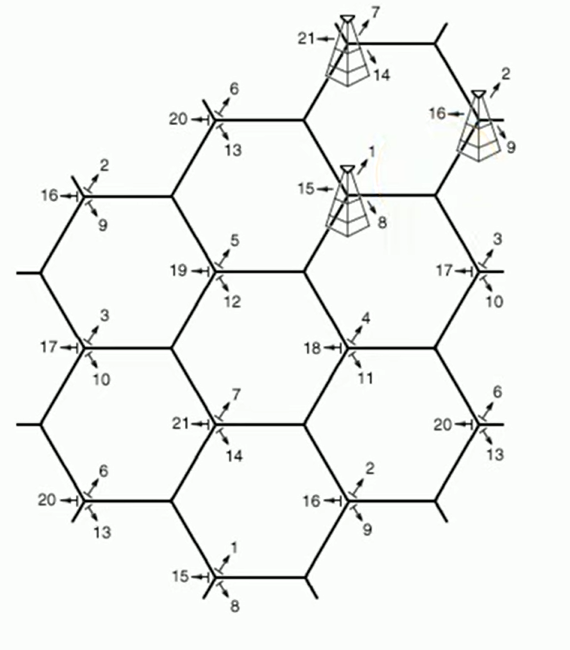
Mobile devices, often called "cell" phones, operate by dividing a geographic area into "cells," each covered by an antenna using specific frequencies. Early 2G networks introduced GSM (Global Systems for Mobile Communications) and CDMA (Code Division Multiple Access). These networks were designed primarily for voice communication with poor data support. They originally used circuit-switching, though minor upgrades allowed for some packet-switching capabilities.
GSM (Global System for Mobile Communications
Is a widely adopted mobile networking standard, covering 90% of the market. Initially developed as a European Union standard, it now offers worldwide coverage and is used by AT&T and T-Mobile in the United States. A key feature is the ability to move your SIM card (Subscriber Identity Module) from one phone to another. The original standard employed time-division multiplexing, allowing multiple users to communicate with a single tower by giving each user a small time slice on the shared frequency.
CDMA (Code Division Multiple Access)
Allows multiple users to communicate simultaneously by assigning each call a unique code. These codes are used to filter and separate calls on the receiving end. Is used by Verizon and Sprint in the United States and requires handsets to be controlled by the network provider. Has seen limited adoption outside of these regions.
3G technology
Introduced in 1998 to upgrade data connectivity from 2G. It brought incremental improvements in speed, typically achieving several megabits per second. This bandwidth enhancement enabled new functionalities such as GPS, mobile television, video on demand, and video conferencing.
4G technology & LTE (Long Term Evolution)
Introduced in 2009 as a convergence of GSM and CDMA standards. LTE, based on GSM and EDGE (Enhanced Data Rates for GSM Evolution), supports download rates up to 150 Mbit/s. LTE Advanced (LTE-A) further enhances this, with support for download rates up to 300 Mbit/s.
5G
Launched worldwide in 2020, brought significant performance improvements, especially at higher frequencies. It aims to reach speeds up to 10 gigabits per second, though slower speeds range from 100-900 Mbit/s. Has a substantial impact on the Internet of Things (IoT), enabling data transfer rates comparable to those of internal wired networks. This enhancement reduces bandwidth constraints, allowing for larger data transfers, faster monitoring and notifications, and increased cloud processing capabilities.