13. performance indicators (copy)
 Call Kai
 Learn
 Practice Test
 Spaced Repetition
 Match
 Flashcards
 Knowt Play
1/67

There's no tags or description
Looks like no tags are added yet.
68 Terms
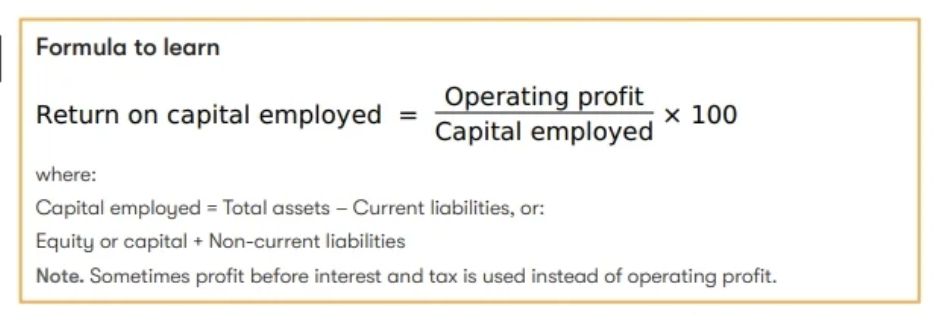
return on capital employed (ROCE)
(profitability indicator)
profit of the year/capital + non-current liabilities
OR
profit of the year/total assets - current liabilities
gross profit margin
(profitability indicator)
gross profit / revenue x100
shows the gross profit for the period as a percentage of sales
factors which affect gross profit
changes in the selling price of goods
changes in the mix of the goods sold
changes in the price of the production cost
improves when: increased selling price, decreasing cost of sales
operating profit margin
(profitability indicator)
operating profit / revenue
operating profit margin is profit before ___ ____ and ____
avoids distortion when comparisons when one company is heavily financed by loans, and the other by share capital
finance costs
tax
____ sales volume is one way of improving the operating profit margin, especially if the operating overheads of the business are mostly ___.
improving
fixed
exp/revenue percentage
specified expense / revenue x100
if sales and production are increasing over accounting periods:
the percentage change in variable costs should _____ in line with the percentage change in the volume of production and sales
the percentage change in fixed costs should _____ as fixed costs are spread over more productions volume.
increase
decrease
asset turnover =
revenue / net assets
net assets = total assets - current liabs
net assets =
total assets - current liabs
working capital cycle =
inventory days + receivable days - payable days

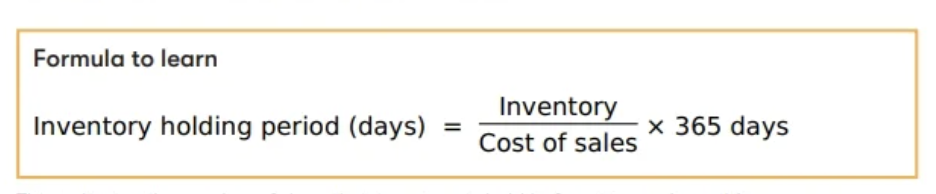
inventory holding period (days)
inventories / cost of sales x 365
should be low
trade receivables collection period (days)
trade receivables / revenue x 365
over time should reduce

trade payables payment period (days)
trade payables / cost of sales or purchases x 365

avg inventory =
opening inv + closing inv / 2

working capital cycle period
period between the point at which cash leaves the business for production and the collection of cash from the customer
impact of learning effect
when the staff learn how to make something the first time, so there is a reduction in time taken to make the next units as they have learnt from experience.
= reduces labour time per unit = increase gross profit margin and operating profit margin
impact of economies of scale
when the organisation pays less per unit for inputs bc increasing the quantities purchased
e.g. bulk buy discount
Why are comparators needed when using financial indicators?
Financial indicators alone are meaningless; they must be compared to similar organisations or periods. Finding suitable comparators is difficult and differences in accounting policies can distort ratios.
How does inflation limit financial performance indicators?
Figures may need adjustment to a consistent price level. Not adjusting for inflation/deflation can distort ratios.
Why might financial indicators use unrepresentative figures?
Ratios often use year-end data which may not reflect average or future performance
Why do financial indicators ignore other important factors?
They only reflect financial information, not operational issues like customer satisfaction, quality, or staff performance.
How can financial indicators encourage short-termism?
Managers may focus on short-term profit targets instead of long-term success.
limitations of financial performance indicators (5)
comparator needed
inflation
representative figures
other facotrs
short-termism
What behavioural problem can financial performance indicators create?
They may cause managers to act in a dysfunctional, non–goal-congruent way, prioritising their division over the company as a whole.
What is the purpose of non-financial performance indicators?
They capture important factors ignored by financial measures and help explain performance more fully.
What are the four categories of non-financial performance indicators?
Profitability, efficiency, productivity, quality.
What do profitability indicators measure?
Wider organisational performance beyond financial ratios.
What do efficiency indicators measure?
How well inputs are converted into outputs.
What do productivity indicators measure?
Workforce output (e.g., units per employee, hours spent, customers served/hr).
What do quality indicators measure?
How well the product or service meets customer needs.
costs of quality (4)
prevention costs
appraisal costs
internal failure costs
external failure costs
What are prevention costs?
Costs to prevent defects (e.g., design improvements, training, equipment maintenance).
What are appraisal costs?
Costs of inspection/testing to ensure quality.
What are internal failure costs?
Costs from defects found before goods reach customers (rework, scrap, re-inspection).
What are external failure costs?
Costs from defects found after customer delivery (recalls, warranty claims, lost reputation).
Give examples of financial quality indicators.
Cost per customer, % value of returns, unit cost of returned goods, rework cost %.
Give examples of non-financial quality indicators.
Number of goods returned, warranty claims %, customer complaints %, defect rates.
Value added =
Sales value - cost of purchased materials and bought-in services.

What does value added measure?
Extra value created by employees’ work.
labour activity ratio =
(Standard hours to make output / Hours budgeted) × 100

production volume ratio =
(Actual output / Budgeted output) × 100

Formula for labour efficiency ratio.
(Standard hours to make output ÷ Actual hours taken) × 100

Formula for labour capacity ratio.
(Actual hours worked ÷ Hours budgeted) × 100

Relationship between ratios (key formula).
Activity/Production volume ratio = Efficiency ratio × Capacity ratio
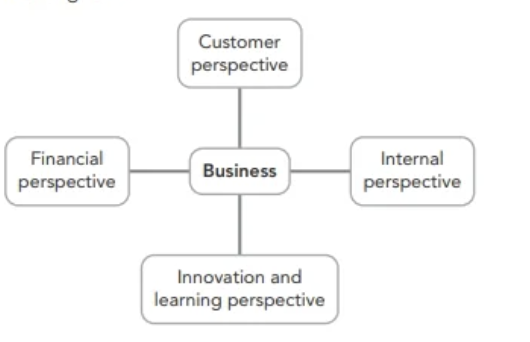
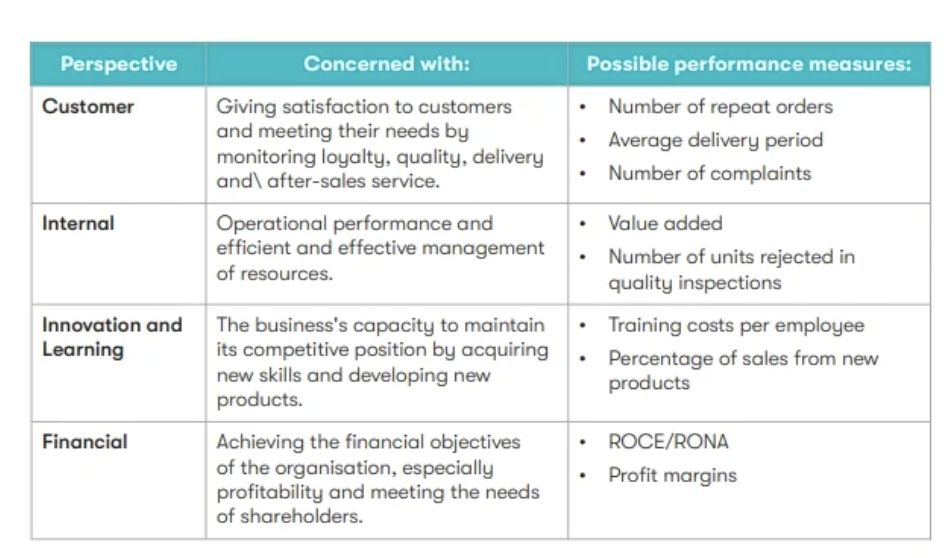
What is the balanced scorecard?
A framework for evaluating performance from four perspectives: customer, internal, innovation & learning, and financial.
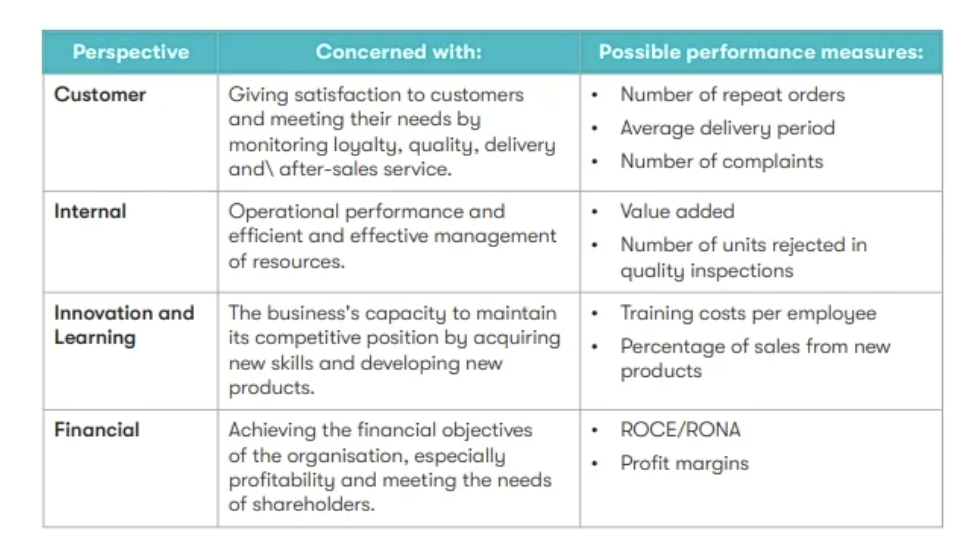
Customer perspective concerns what?
Satisfaction, loyalty, delivery, after-sales.
Measures: repeat orders, delivery time, complaints.
Internal perspective concerns what?
Operational performance and resource management.
Measures: value added, rejected units.
Innovation & learning perspective concerns what?
Skills, new products, long-term competitiveness.
Measures: training cost/employee, % sales from new products.
Financial perspective concerns what?
Profitability and meeting shareholder needs.
Measures: ROCE/RONA, profit margins.
behvaior of managers aiming to achieve a target can be affected by (2)
ethical code of practice
commercial consideration
What ethical issues arise in competitive markets?
Cutting corners, unfair supplier payments, low wages, lack of employee development.
What ethical risks exist in government agencies?
Budgets set for political motives, decisions based on cost instead of effectiveness, incentives for inexperienced staff.
What ethical issues affect subsidiaries?
Unfair budgets, unfair bonus allocations, tax planning pressures.
What do performance indicators summarise?
Productivity, profitability and resource utilisation. They can be financial or non-financial.
What does the gross profit margin measure?
Profitability of the trading element of a business.
What do operating and net profit margins measure?
Profitability after deduction of expenses.
What does return on capital employed (ROCE) measure?
Operating profit relative to capital invested, showing return to providers of capital.
How is ROCE broken down?
Asset turnover × Operating profit margin.
What does asset turnover show?
Revenue earned for each £1 invested.
How can working capital be controlled?
By monitoring inventory holding period, receivables collection period, and payables payment period.
How can productivity be measured?
Units produced per hour or per employee; also value added per employee.
What are the three control ratios used to measure productivity?
Efficiency ratio, capacity ratio, and activity ratio.
Why must performance indicators be interpreted carefully?
Because comparative figures are needed to understand results.
What costs are included in the costs of quality?
Prevention costs, appraisal costs, internal failure costs, external failure costs.
What is the purpose of the balanced scorecard?
To combine multiple performance indicators across different perspectives important to the business.
How can manager behaviour affect performance measures?
Managers’ behaviour can influence whether targets are met and whether actions are goal-congruent