Collin College, A&P 2401 Lab Practical 2 Study Guide
 Call Kai
 Learn
 Practice Test
 Spaced Repetition
 Match
 Flashcards
 Knowt Play
1/418

There's no tags or description
Looks like no tags are added yet.
419 Terms
suspensory ligaments
Identify C

cornea
Identify

fovea centralis
Identify A

optic disk
Identify B

macula lutea
Identify (yellow)

inferior oblique muscle
Identify.

lacrimal gland
Identify.

lens
Identify A.

vitreous body
Identify B.

medial rectus muscle
Identify.

medial rectus muscle
Identify A

inferior rectus muscle
Identify B

superior rectus muscle
Identify C

optic nerve
Identify.

sclera
Identify A

pupil
Identify A

iris
Identify B

ciliary body
Identify C

sclera
Identify C

choroid
Identify B

retina
Identify A

retina
Identify B.

choroid
Identify C

ciliary muscles
Identify B.

oculomotor nerve
What cranial nerve innervates B?

contract; relax; rounded
In order to focus on close objects, B will ____, C will _____, and the lens will become ____.

relax; contract; flattened
In order to focus on far objects, B will ____, C will _____, and the lens will become ____.

The pupils will dilate.
What happens when A contracts?

The pupils will constrict.
What happens when B contracts?

left
The right visual field is seen on the ____ sides of each eye.
right
The left visual field is seen on the ____ sides of each eye.
left occipital lobe
The right visual field is processed and interpreted in the which lobe of the brain?
right occipital lobe
The left visual field is processed and interpreted in the which lobe of the brain?
optic chiasm
The nasal retinal fibers from each eye cross-over at the ________.
You would be blind in the left eye.
How would damage to both types of fibers in the left optic nerve affect vision?
You would lose the right field of vision in your left eye.
How would damage to the temporal retinal fibers in the left optic nerve affect vision?
optic chiasm
Damage to the _____ would result in tunnel vision. You would lose all peripheral vision.
right optic tract
Damage to the _______ would result in loss of your left field of vision in both eyes.
inferior oblique muscle
What extra-ocular muscle elevates the eye & turns it laterally?
superior oblique muscle
What extra-ocular muscle depresses the eye & turns it laterally?
lateral rectus muscle
What extra-ocular muscle moves the eye to the side?
medial rectus muscle
What extra-ocular muscle moves the eye to the midline?
superior rectus muscle
What extra-ocular muscle moves the eye up and turns it medially?
inferior rectus muscle
What extra-ocular muscle moves the eye down and turns it medially?
III
Cranial nerve ___ innervates all of the labeled muscles.

IV
Cranial nerve ___ innervates the labeled muscle.

lateral rectus muscle
Identify.

VI
Cranial nerve ___ innervates the labeled muscle.

pupillary radial muscle; dilates the pupils
Identify A. What is its function?

pupillary sphincter muscle; constricts the pupils
Identify B. What is its function?

iris
Collectively, A and B are components of the _____.

vestibule
Identify 26

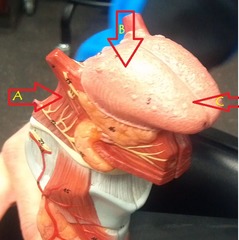
vagus nerve (CN X)
Gustatory information is carried to the brain from which cranial nerve from structure labeled A?

hypoglossal nerve (CN XII)
What cranial nerve controls movements of this structure?

auditory tube
Identify A

external acoustic canal or external auditory meatus
Identify B

pinna or auricle
Identify C

cochlea
Identify D

tympanic membrane
Identify E

superior semicircular canal responsible for sensing rotation around a sagittal plane
Name and give function of A?
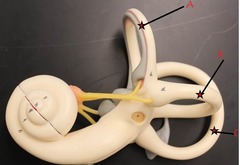
lateral semicircular canal responsible for sensing rotation around a transverse plane
Name and give function of B?

posterior semicircular canal responsible for sensing rotation around a coronal plane
Name and give function of C?

organ of Corti (spiral organ)
Identify 20

basilar membrane
Identify 19

tectorial membrane
Identify 18

cochlea
This is a model of a section through what structure in the inner ear?

tympanic duct (scala tympani)
Identify 16

vestibular duct (scala vestibuli)
Identify 15

cochlear nerve
Identify 1

stapes
Identify 2

malleus
Identify 3

vestibular nerve
Identify 4

semicircular canals
Identify 5

incus
Identify 6

malleus
Identify 30

incus
Identify 31

stapes
Identify 32

glossopharyngeal nerve (CN IX)
Gustatory information is carried to the brain from which cranial nerve from structure labeled B?

facial nerve (CN VII)
Gustatory information is carried to the brain from which cranial nerve from structure labeled C?
olfactory tract
Identify 11

olfactory bulb
Identify 12

olfactory nerve (CN I)
Identify 13

auditory ossicles
The malleus, incus, and stapes are collectively referred to as the ________.
external
The pinna and external auditory meatus are components of the ____ ear.
middle
The malleus, incus, stapes, and tympanic cavity are components of the ____ ear.
inner
The semicircular canals, cochlea, and vestibule are components of the ____ ear.
static equilibrium
The saccule and utricle are structures involved in what special sense?
dynamic equilibrium
The semicircular canals are structures involved in what special sense?
organ of Corti
What is the sensory receptor for hearing?
perilymph
The vestibular and tympanic ducts are filled with ____.
equilibrium
Sensory information concerning ____ is carried along the structure labeled 27.

hearing
Sensory information concerning ____ is carried along the structure labeled 28.

utricle
Identify 29

saccule
Identify 30

endolymph
The cochlear duct is filled with what fluid?
cochlear duct (scala media)
Identify 17

endolymph
What fluid is found in the labeled structure?

15, 16
Perilymph is found in what labelled structure(s)?

17
Endolymph is found in what labelled structures?

posterior semicircular canal
What structure in the inner ear contains the sensory organ involved in sensing rotation around a coronal plane?