(1) adapted from ryanef123: OMFS 1 - OMFS Health Status Evaluation & Principles of Uncomplicated Exodontia (Dr. Stephens)
 Call Kai
 Learn
Learn Practice Test
 Spaced Repetition
 Match
Match Flashcards
 Knowt Play
1/137

There's no tags or description
Looks like no tags are added yet.
Name | Mastery | Learn | Test | Matching | Spaced | Call with Kai | Chat |
|---|
No analytics yet
Send a link to your students to track their progress
138 Terms
What is the order of taking a structured medical history?
Demographic information
Chief complaint
History of Present Illness
Past Medical History
Past Surgical History
Family History
Social History
Medications
Allergies
Review of Systems
What is a one sentence summary in the patients own words?
Chief complaint
Define the following:
Includes information gathered by your questioning of patient regarding their chief complaint
History of Present Illness (HPI)
When recording a History of present illness, what nuemonic can help you gather all important information?
OLD CARTS
- Constitutional symptoms (fever, chills, lethargy, etc) should also be included
The O in OLD CARTS stands for:
Onset
The L in OLD CARTS stands for:
Location/radiation
The D in OLD CARTS stands for:
Duration
The C in OLD CARTS stands for:
Character
The A in OLD CARTS stands for:
Aggravating factors
The R in OLD CARTS stands for:
Relieving factors
The T in OLD CARTS stands for:
Timing
The S in OLD CARTS stands for:
Severity
What has the following characteristics?
Sequential, comprehensive method of eliciting patient symptoms on an organ system basis
May reveal undiagnosed medical conditions unknown to the patient
Should be guided by pertinent answers obtained from the history
Review of systems
If IV sedation or GA is planned, what (three) systems should be reviewed?
Cardiovascular
Respiratory
Nervous systems
Dentists are expected to perform a quick review of what on every patient?
Head
Ears
Eyes
Nose
Mouth
Throat
What are the organ systems that should be reviewed during review of systems?
Cardiovascular
Respiratory (Pulmonary)
Nervous
Musculoskeletal
GI
Endocrine
Urinary
Reproductive
Immune
Lymphatic
Integumentary
What information is gathered after the patient history is complete?
Physical exam and Radiographs
ID the ASA status:
mild systemic disease,no functional limitations, well-controlled conditions:
current smoker, social alc use
pregnancy
class I obesity: BMI 30-40
well controlled DM/HTN
mild lung disease
aka A Patient with Mild Systemic Disease: Mild Asthma, Controlled Hypertension, Anemia, Controlled Seizure, Early NIDDM
ASA II
ID the ASA status:
severe systemic disease, some functional limitations, poorly controlled:
poorly controlled DM/HTN, COPD
Class II morbid obesity: BMI ≥ 40
active hepatitis
alc dependence/abuse
implanted pacemaker
moderate ↓ ejection fraction (EF 30-50%)
ESRD: require dialysis or kidney disease
aka A Patient with Severe Systemic Disease Which Limits Activity: Angina Pectoris, Prior MI, COPD, IDDM, Advanced NIDDM
ASA III
ID the ASA status:
which ASA status?
severe systemic disease, constant threat to life
recent <3mo serious conditions
ongoing cardiac ischemia
severe ↓ ejection fraction (EF <30%)
sepsis
DIC
ARDS
ESRD not on dialysis
aka A Patient with Incapacitating Disease that is a Constant Threat to Life: Congestive Heart Failure, End Stage Renal Disease, Advanced COPD, Hepatic Failure
ASA IV
which ASA status?
moribund pt, not expected to survive w/o operation: ruptured aneurysm, massive trauma, intracranial bleed w mass effect, ischemic bowel, or multiple organ/system dysfunction
V
which ASA status?
declared brain-dead pt, organ donation
VI
What has the following characteristics?
Energy cost of physical activity (measure the amount of energy your body uses during physical activity compared to when you are resting)
Defined as the ratio of metabolic rate during activity to reference metabolic rate (3.5ml O2)/(kg x min)
1 MET = 1 kcal/(kg x h)
Metabolic Equivalents (METS)
if pt has < 4 METs what needs to be done?
further testing to eval cardio reserve and health before procedure
What vitals information should be gathered during the physical exam?
Blood pressure
Pulse
Respiratory rate
O2 saturation
Temperature
What part of the physical exam...
Notes any asymmetries, swellings, abnormal lesions such as moles or ulcers
Palpates the face and neck to note any pain on palpation, swellings, etc.
If maxillary sinus is involved, percussing the maxillary sinus area may be warranted
Head and neck exam
What part of the physical exam...
Examine the dentition
Note any swellings, pain on palpation, firmness of the floor of the mouth, deviation of the uvula, etc.
Note any pathologies including ulcers, pigmentations, or raised lesions
intraoral exam
What type of radiograph should be taken for single teeth (except 3rd molars)?
PA radiograph
What type of radiograph should be taken for...
Overview of the maxilla and the mandible
Good for bony pathologies, 3rd molars, dentoalveolar or trauma to the mandible and maxilla
Panoramic radiograph
What type of radiograph should be taken for...
Detailed 3 dimensional view of the facial skeleton and soft tissue
Good for maxillofacial trauma, severe infection, maxillofacial pathology, implant planning, etc.
CT scan
What has the following characteristics?
A summary of your findings
Differential diagnosis can be included in this section
E.g. 30 y/o M who presented with pain associated with #3. The patient is being treated for asthma, but is controlled with albuterol
Assessment in SOAP note
What has the following characteristics?
Stepwise treatment for the patient
Include type of anesthesia
E.g. the plan is to extract #3 under local anesthesia
Plan in SOAP note
Do we get clearance from medical doctors to go forward with a treatment?
NO! It is a consult, NOT clearance; we still have skin the game
What type of note?
To be completed at initial visit (150 exam completion in UG clinics) to TUSDM clinics including consultation visits to specialty departments.
New Patient History and Physical Note
What type of note?
To be completed for patients who are new to TUSDM (do not have established providers) and are having a procedure performed. Details of the procedure may be recorded under the section "Record of Procedure". This template includes components of both the New Patient note and the Procedure Note.
Emergency Procedure Note
What type of note?
To be completed when a procedure is performed on an established patient who has already had a New Patient note completed. Details of the procedure may be recorded under the section "Record of Procedure".
Procedure Note
What type of note?
To be completed during follow up visits after a procedure or other situations outside of those outlined in the above templates. This template is in the SOAP format.
Follow Up Note
A ________ is found in either Procedure Note or Emergency Procedure Note. This is where you document what you did during a particular procedure
"Record of Procedure"
What are the five elements of informed consent?
Disclosure of information
Patient competency
Voluntary decision-making
Reasonable alternatives with risks
Assessment of understanding
Consent involves a discussion of the risks, benefits, and alternatives of a procedure
What has the following characteristics?
To be completed before all irreversible procedures
The individual signing the time out must see you identify the tooth with an instrument and obtain the patients agreement
Time Out

ID the tool (yellow arrow):
Periapical curette

ID the tool (orange arrow):
No. 9 Molt periosteal elevator
What is typically one of the first instruments used when starting an extraction?
No. 9 Molt Periosteal Elevator
separate gingiva and periosteum from underlying bone
sharpey’s fibers: thick bundles of strong type I collagen fibers that anchor the periosteum to underlying bone
What is typically one of the last instruments used after an extraction?
Periapical curette

ID the tool:
Minnesota retractor

ID the tool (orange arrow):
Bone file

ID the tool (yellow arrow):
Root picks

ID the tool (blue arrow):
Seldin Retractor

ID the tool (blue arrow):
Syringe
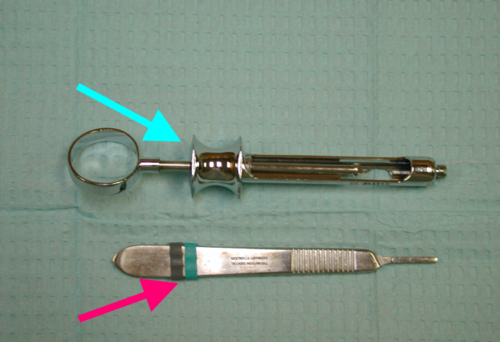
ID the tool (pink arrow):
Scalpel Handle
What number scalpel blades is most commonly used in dentistry?
#15
What tool should you use to connect a #15 blade to a scalpel handle?
Hemostat
How do you attach a surgical blade?
Hold blade handle in gloved hand
Grasp dull side of blade with needle driver
Align beveled end of blade with beveled edge of handle
Slide blade onto handle end until it engages with a "click"

ID the tool:
"Sweetheart" tongue retractor
- Common for procedures under anesthesia
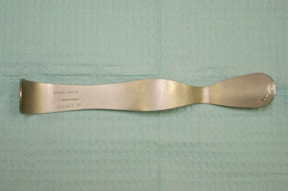
ID the tool:
Bishop retractor (cheek and tongue retractor)

ID the tool:
Side cutting rongeur (can cut bone)

ID the tool:
End cutting rongeur (can cut bone/smooth it down)

ID the tool (blue arrow):
Suture Scissors
most common dental anesthesia techniques?
long buccal, IAN, infiltration

ID the tool (pink arrow):
Needle holder

ID the tool:
Tissue forceps

ID the tool:
Small curved hemostat
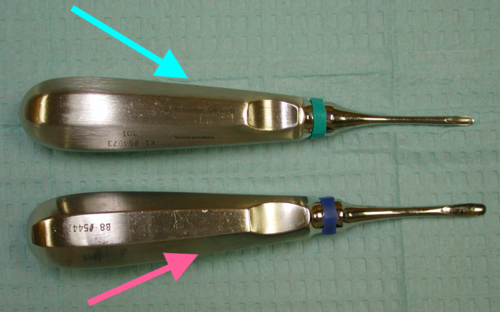
ID the tool (blue arrow):
Small straight elevator (used 1st and helps make teeth mobile)

ID the tool (pink arrow):
Large straight elevator (helps make teeth mobile)
What are the parts of a straight elevator:
Blade
Shank
Handle
What type of simple machine is the straight elevator?
As type 1 LEVER and WEDGE
Wedge first, then lever
What direction of pressure do you apply with the straight elevator?
Apical
which side of the curve of the elevators is the working side (CW and CCW)?
the one closest to you (which ever area of the tooth MD or side of the mouth you are on)
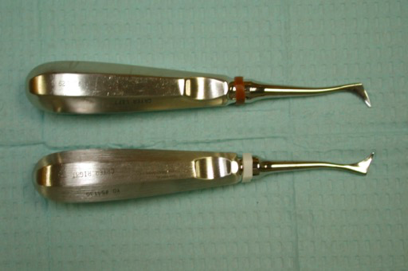
ID the tools:
Cryer Elevators OR East / West Elevators
*Uses a wheel and axel mechanics

ID the tools:
Miller elevators

ID the tool:
Crane pick

ID the tool:
Universal Maxillary Extraction Forceps (#150)

ID the tool:
Universal Mandibular Extraction Forceps (#151)
What are the components of a forceps? (3)
Beak
Hinge
Handle

ID the tool:
Root Tip Forceps (286) /Bayonet forceps

ID the tool:
Straight Maxillary Anterior Forceps (#1)

ID the tool:
Cowhorn Forceps #23
*used for furcation (esp. mandibular molars)

ID the tool:
Ash Forceps (English Style)
*used for bicuspids/anterior teeth

ID the tool:
Proximators
*used to make space for elevator use & retractora

ID the tools:
Proximators
*used to make space for elevator use & retractora
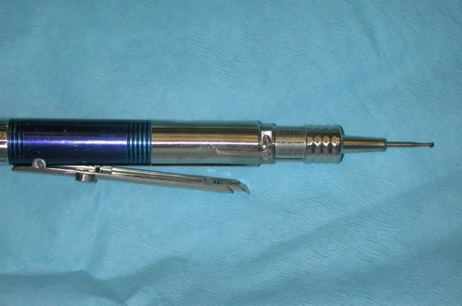
ID the tool:
Hall Drill
*lots of torque, thick bone
What is the benefit of using a Hall drill vs. a traditional handpiece?
Lower risk of air emphysema
What are 3 types of absorbable suture material?
Plain Gut
Chromic Gut
Vicryl
All of the following are types of non-absorbable suture material EXCEPT:
A. Silk
B. Polypropylene
C. Polyester
D. Nylon
E. Gut
E - this is absorbable
What suture material do we use at TUFTS?
Chromic gut
The numbers of a suture material denote the thickness of the
material. A higher numbers mean _________ material
Thinner
What type of suture material?
Absorbable suture material
Derived from bovine intestine with chromic salts to slow absorption (vs plain gut)
6-10 days of tensile strength
Most commonly used intraoral suture
Chromic gut
What type of suture material?
Absorbable braided synthetic material
Holds tensile strength for ~14 -21 days
Vicryl
Which absorbable suture absorbs the quickest?
Plain Gut
Chromic Gut
Vicryl
Plain Gut
Which absorbable suture absorbs the slowest?
Plain Gut
Chromic Gut
Vicryl
Vicryl
In terms of chair position, you should put the seat higher and a more reclined position when extracting ______ teeth
Maxillary
In terms of chair position, you should put the seat lower and a more upright position when extracting ______ teeth
Mandibular
When doing an extraction, if you are right handed, you should stand to the front and to the _____ side of the patient
Left
When doing an extraction, if you are left handed, you should stand to the front and to the _____ side of the patient
Right
ID the procedure:
- Extraction, erupted tooth or exposed root (elevation, and/or forcep removal)... routine removal of tooth structure, minor smoothing of socket bone and closure as necessary
Simple extraction: D7140
ID the procedure:
- Requiring removal of bone and/or sectioning of tooth, and including elevation of mucoperiosteal flap if indicated
Surgical extraction: D7210
For a simple extraction, detach soft tissue off of the tooth ___________
Circumferentially
For a simple extraction, luxate the tooth in the ___________ direction to create space with elevator
Mesio-distal
For a simple extraction, luxate the tooth ___________ with forceps to create space/overcome the undercuts for the tooth to be removed
Bucco-lingually (primarily buccal)
How does aging/degeneration generally affect the mechanical strength of bone?
Decreases strength