Econmics IGCSE Microeconomics (paper 1)
 Call Kai
 Learn
Learn Practice Test
 Spaced Repetition
 Match
Match Flashcards
 Knowt Play
1/91

Earn XP
Description and Tags
Name | Mastery | Learn | Test | Matching | Spaced | Call with Kai | Chat |
|---|
No analytics yet
Send a link to your students to track their progress
92 Terms
1.1 The economic problem
Unlimited wants, limited resources
1.1 Opportunity cost
The benefit lost when choosing the next best alternative
1.1 Causes of economic growth
(4)
Education and Training
become more efficient
New technology
increase productivity
More efficient
productivity
New resources
increase output potential
1.1 PPC
Productive possibility curve: measure of the potential output of two goods in a country when employing all resources
1.1 Causes of negative economic growth
(4)
Run out of resources
Natural disaster/weather/war
Worker emigration out of country
1.2 Economic assumptions
(2)
Consumers always aim to maximise their benefits
Firms always aim to maximise their profits
1.2 Reasons why consumers act irrationally
(3)
Habit/addiction
Herd behaviour/influence
Calculation errors/inability to calculate best option
1.2 Reasons why businesses don’t maximise profits
(3)
Aim different: to complete charitable work/caring for consumers
Unable to: nature of market/competition requires low prices to remain competitive
Managers that focus on sales or revenue instead
1.3 Demand definition
The quantity of a good/service willing and able to be bought at a given price at a given time
1.3 supply definition
The quantity of a good/service provided by supplier willing and able to be sold at a given price at a given time
1.3 factors affecting demand
(6)
Trend/tastes
Demographic (changes)
Income
Advertising
Price of substitutes
Price of compliments
1.3 factors affecting supply
(4)
Natural factors
Indirect taxes—profitability
Subsidies —profitability
(New) technology
1.4 PES definition
The responsiveness of supply to a change in prices
1.4 PED definition
The responsiveness of demand to a change in prices
1.4 factors affecting PES
(4)
Storage capacity —space
Time — time taken to produce
Availability of stock
Factors of production; raw mats, labour, machinery access
1.4 factors affecting PED
(4)
Proportion of income
Time—able to look for substitutes if longer time
Degree of necessity
availability of substitutes
PES/PED = 1
Unitary elastic
PES/PED>1
Elastic
PES/PED<1
Inelastic
PES/PED= 0
Perfectly inelastic (Only exists with supply)
PES/PED= ∞
Perfectly elastic
1.5 definition of mixed economy
Economy with both private sector and public sector providing goods and services
1.5 public sector definition
Goods and services provided by the government, all have access to the goods/services + run by the gov
1.5 private sector definition
Goods and services provided by firms run by individuals
1.5 aims of public sector
(2)
Improve quality of services
Minimise costs and be efficient
1.5 aims of private sector
(2)
Profit maximisation
(Growth)
1.5 benefits of public sector
(2)
Provide public goods
Provide goods that benefit society
1.5 drawbacks of public sector
(2)
Opp cost for gov
Not as efficient and less choice, don’t focus on profits
[Free rider problem]
1.5 definition of free rider problem
Consumer (rational) will wait until someone has payed for public good, then all can benefit from it, not profitable so market failure can occur
1.5 definition of public good
A good that is non-excludable (once produced can be used by anyone) and non-rivalrous (doesn’t reduce availability for one if used by another)
1.5 benefits of private sector
(3)
Efficient use of resources, as focus on profit maximisation
Innovation, quality choice to satisfy consumer demands
High competition encourages lower prices, innovation, quality and choice
1.5 drawbacks of private sector
(3)
Does not consider negative externalities
May lead to monopolies
Not all necessary (public) goods will be provided if run by mainly (or only) priv., as private firms don’t produce public goods
1.5(.5) market failure definition
Inefficient allocation of resources
1.5(.5) causes of market failure
(4)also reasons for no completely free markets
Lack of profit motive: result of lack of competition
Externalities after over production
Missing markets: public goods aren’t provided by free markets
Lack of info: result in the wrong goods being produced/purchased—need for gov intervention
Privatisation definition
Transfer of public resources/firms into the private sector
Impact of privatisation on workers
Priv firms aim to maximise profits so may make redundant
Impact of privatisation on businesses
(2)
Change in motives: become focused on profits and may less focus on quality, but also might have more competition
Often diversify into new areas
Customer wants
Investors/gov fund difference
Impact of privatisation on the government
(3)1 drawback, 2 good
Revenue generated from sale of business
Opp cost, can focus/spend on other areas
Advertising the business can be an opp cost, also used tax revenue
Impact of privatisation on consumers
(2) 1 good 1 bad
Risk of monopoly—higher prices
Profit maximisation: more efficient, lower prices passed on
1.6 external costs
The negative spillover effects on 3rd parties as a result of production/consumption (of a good/service)
1.6 external benefits
The positive spillover effects on 3rd parties as a result of production/consumption (of a good/service)
1.6 social costs
The costs of an economic activity to society as well as an individual/firm (private + external)
1.6 social benefits
The positive effects of an economic activity to society as well as an individual/firm (private + external)
1.6 Examples of external benefits
Healthcare
Education
Vaccinations
1.6 Examples of external costs
pollution
Traffic
Resource depletion
Overcrowding
2.1 factors of production
(4)
Land
Labour
Capital
Enterprise
2.2 productivity definition
The amount of goods/services produced relative to the time and resources inputed
2.2 factors of productivity
(3)
Quality of land
Training and migration
New technology
2.2 Division of labour
when the production process is broken down into small parts with each worker allocated a specific task
2.2 DOL impacts on businesses
(2 drawbacks, 2 benefits)
Workers are more efficient, repeating one same task become skilled
Production time reduced—don’t waste time moving from one task to another
Repetitive, may become demotivated and less productivity, higher staff turnover
Less flexibility—production disrupted if one missing, others don’t have same skills
2.2 DOL impact on Employees
(2 drawbacks, 2 benefits)
More employable in same field jobs—more skilled
More job satisfaction if highly skilled at one task
Repetitive, boring, less satisfied
Struggle to find jobs in other fields —only able to do one task
2.3 (internal) economies of scale definition
As a firm grows in size it average costs fall
2.3 external economies of scale definition
When avg costs fall for individual firms as the entire industry grows
2.3 diff economies of scale
(6)
Risk bearing
Wider range of products so to not rely on one in case it fails
Financial
able to negotiate lower interest rates for large loans
Technical
able to buy better, specialist machines/technology, more efficient
Bulk-buying (purchasing)
negotiate discounts on large orders
Marketing
more units, ads cost same, decrease avg costs
Managerial
more efficient—more production same costs
2.3 external economies of scale
(4)
Skilled labour
buildup of skilled labour, less training needed so cheaper
Infrastructure
particular industry in a region may have railways, roads, buildings, etc., shaped to fit the industry’s needs
Shared costs
industry is specific area with many firms, can cooperate to share costs which will reduce overall
Access to suppliers
suppliers may locate in the area, reduces transport time
2.3 diseconomies of scale definition
Avg costs increase due to being too large
Causes of DEoS
(4)
Bureaucracy
Many departments, administration costs and paperwork, spend too much time on admin, not efficient and higher avg costs
Communication
many branches and overseas offices, lead to language barriers, cultural and time differences—not efficient
Distance between staff and floor
workers may feel alienated and demotivated from lack of regular communication
Lack of control
large businesses are difficult to control and coordinate, many employees and factories, need more supervisors and manager — higher costs
2.3 long run average cost diagram
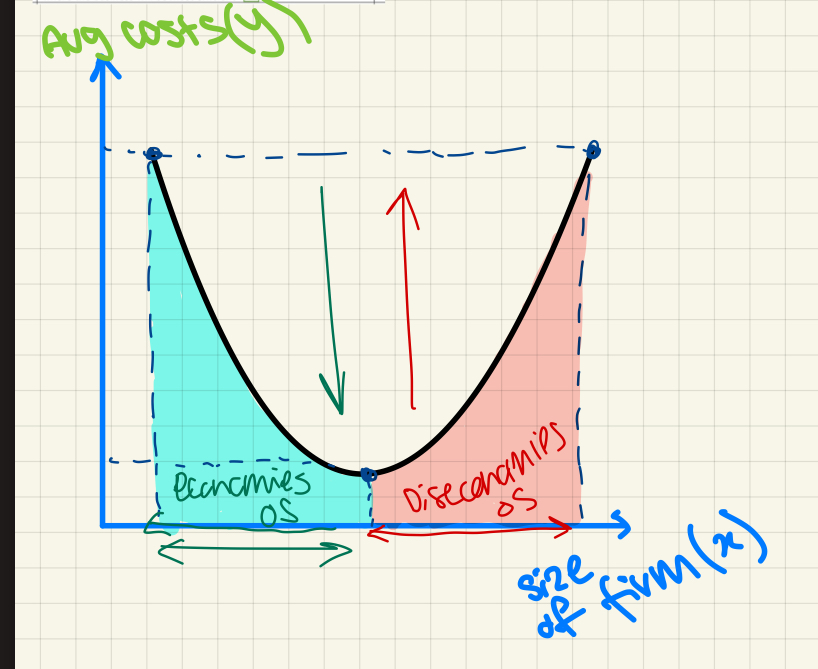
2.4 local monopoly definition
When one business supplies and entire local market
2.4 natural monopoly definition
More efficient to only have one firm in the market
2.4 (pure) monopoly
One dominant firm in the market
2.4 features of a monopoly
(4)
Price maker
One large dominant firm
Unique product
High start up costs/barriers to entry
2.4 benefits of a monopoly
(3)
Might be more efficient with one firm running
Economies of scale, lower prices, competitive in foreign markets
Innovation: high profits from market domination, new products and technology
2.4 drawbacks of a monopoly
(4)
Less choice for consumers
Higher prices, price makers—can control and unfairly increase prices as there is no substitute
Less efficient, no competition or need for lower avg costs so not efficient: incur unnecessary costs/resources wasted
Lack of innovation—no incentive/competition
2.4 barriers to entry
(5)
Patents:
allowing production of a design/product, need to be bought or not allowed at all
Legal:
for certain firms, need to allowed legal entrance into market, gov descision for contract to supply certain services
Start-up costs:
high costs, eg: rolls Royce expensive jet engines, difficult for new firm to develop such products
Marketing budget:
monopolists/alr dominant firms will have strong brand image and large budgets, difficult to enter/make own image for new firms
Technology;
large firms can afford better more efficient technology and benefit from EOS; difficult to compete
2.5 competition definition
Rivalry between firms when trying to sell goods/services in a particular market
2.5 impacts of competition on consumers
(3 pos, 2 neg)
Lower prices (price wars)
More choice
More quality
Less profits may mean less innovation/quality sacrificed long term
Some firms shut down as unprofitable/inability to compete, inconvenience to loyal customers
2.5 features of competitive markets
(4)
Large amount of buyers and sellers
Low barriers to entry
Little control over prices
Products sold are close substitutes of eachother
2.5 impact of competition on firms
Encourage efficiency
Quality services—more customer satisfaction and sales
Lower profits; lower prices,
more innovation and
costs on quality goods needed to be competitive
2.5 competition impact on economy
Beneficial;
encourages efficiency and allocation of resources,
Innovation and quality, choice: better SOL
But
firms may shut down due to inability to compete which may lead to unemployment
2.4 oligopoly definition
A few large firms dominate a market
2.4 oligopoly features
(6)
Collusion between firms
/price fixing, output restriction, etc,.
Few large firms dominate
Some barriers to entry
Non-price competition
Price competition
Product differentiation
2.4 oligopoly benefits
(4)
More choice
More quality
Lower prices
both EOS and price wars
Innovation
2.4 drawbacks of oligopoly
(2)
Collusion
Long term lower quality from price wars
2.5 Labour demand factors
(3)
Final product demand (derived demand)
Availability of substitutes (machines)
Productivity
2.5 Labour supply factors
(9)
Population size
Migration
Age distribution
Retirement age
School leaving age
Female participation
Skills/qualifications
Geographical mobility
Occupational mobility
2.6 Subsidies as gov intervention definition ton
Gov offer firms subsidies as incentive to reduce external costs
2.6 subsidies as gov intervention impacts
Increase output and decrease price of MERIT GOODS, more affordable and external benefits
But some firms may become too reliant on the subsidy and become Inefficient, only use subsidy to cover the cost of being inefficient instead of aim
Opp cost for gov, long run higher taxes to make up
2.6 fines as gov intervention
Imposed on those who cause negative externalities
2.6 impacts of fines as gov intervention
May not be effective if not high enough
Encourage not to damage environment
Money gained can be used to internalise externalities
2.6 pollution permits
Gov-issued document allowing firm to dispose of certain quantity of pollution into environment
(Can be traded and sold)
2.6 pollution permits impacts
Cost of buying permits as higher prices
Firms can just move countries to avoid the cost (also cause job losses)
Limits amount of pollution
Incentive for firms to invest in clean technology, then can sell permits as don’t need and profit
2.6 taxes regulation
Will increase production costs and decrease supply, or increase prices so decrease demand
2.6 effects of taxes
Decrease output+ consumption of demerit goods
Tax revenue internalisation externalities
Demand inelastic
regressive tax
Consequences: cross-border shopping illegal smuggling and affect police
2.6 gov intervention impacts
Limits firms negative externalities
Gov needs to monitor firms abiding; OPP cost and time
Regulatory capture
2.6 labour market regulation (minimum wage) def
Legal entitlement minimum amount/hr a worker can be paid
2.6 labour market regulation (minimum wage) Effects
Increases equality and fairness amongst disadvantaged workers: higher SOL
More income tax
Motivation
Decrease demand for labour: USE GRAPH
Higher prices—higher labour costs firms
2.6 competition regulation methods
Promote competition: subsidise small firms , lower barriers to entry, anti-competitive legislation
Limit monopoly power: org set up to monitor monopolies
Protect consumer interests: consumer legislation ensures goods fit intended purpose
Control mergers/takeovers; gov monitors potential mergers or takeovers and can block
2.5 benefits and drawbacks of small firms
(4 good, 3 bad)
Flexibility: more customer satisfaction
Personal service: willing to pay higher prices
Lower wage costs: usually don’t belong to trade unions+ negotiating power weaker, also less workers overall
Better communication: less employees=more efficient
Higher costs: can’t benefit from EoS—also less competitive as a result
Lack of finance: usually have less funding
Hard to get high quality staff: may not be able to attract or afford or train
2.5 benefits and drawbacks of large firms
(1 bad, 3 good)
Diseconomies of scale if too large
Benefit from EoS—lower average costs, lower prices= more competitive
Able to win large scale contracts over small firms
Market domination: stronger brand image= able to charge higher prices
2.5 factors influencing the growth of firms—don’t confuse with staying small
(5)
Access to finance: may not be able to afford expansion
EoS: encourage growth to benefit from EoS
government regulation: prevent mergers/monopolies
Desire to spread risk: branch out to lower risk/ enter new markets
Desire to take over competition: removes competition and gains monopoly power
2.5 why firms stay small—dont confuse with growth
(4)
Aims of entrepreneur: may want to stay small—risk diseconomies
Nature of market: niche—wont benefit from growing as only small part of market
Size of market: some markets are too small to sustain large firms—lack of customers
No finance