Research Methods Midterm
 Call Kai
 Learn
 Practice Test
 Spaced Repetition
 Match
 Flashcards
 Knowt Play
1/178

There's no tags or description
Looks like no tags are added yet.
179 Terms
What is the empirical approach
using quantitative methods to research political science. It assumes that there is a lot of uncertainty and it does not exclude qualitative data per se, since it is not as exact a science as the hard sciences. But the empirical approach uses science that is the most reputed in political science
information is made public so that other people can critique, replicate, and it adds to the social discourse
easily replicable
inference shines through based on empirical information
capable of being verified or disproved by observation or experiment
problems with documents
bias: might not paint full picture, could be a distorted account
selectivity: what is available might not representative of all accounts
Distinguish empirical and normative claims
An empirical claim asserts something about observable reality—it can, in principle, be tested, confirmed, or refuted through evidence.
A normative claim expresses a value judgment about what is good, bad, desirable, or just—it cannot be settled by data alone because it depends on ethical, moral, or ideological commitments.
Explain what it means to “make inferences”
To make conclusions on content that is beyond what the data can prove, to make inferences about the politics or society
The very abstract, even unrealistic nature of statistical models makes the rules of inference shine through
Describe the major assumptions, strengths, and limitations of the empirical approach
assume that social constructs and institutions are reality, there is value to quantifying political science and it can keep track of patterns
-helps to have a process of coming up with an idea to examine, make a hypothesis, make sure you are defining things properly, figure out how you will collect data, what can be quantified, and see if hypothesis is supported
Limitations are that there are aspects like values that are difficult to quantify
what are the 4 characteristics of scientific research?
the goal is inference
procedures are public
conclusions are uncertain
the content is the method
What are the differences between nonempirical and empirical research?
Nonempirical
Goals: to understand behavior to interpret actions
Assumptions: social facts are “constructed;” institutions are social creations observation is not generally possible because our very senses are affected by culturally defined and imposed prior beliefs, totally value-free research is impossible
qualitative
methods: qualitative analysis (ethnography, content and document analysis, study of discourse)
empirical
causal explanations and predictions of individual and institutional behaviors, general theory and laws, information of practical use, value-free knowledge
What does the Johnson et al reading say
Describe the characteristics of good research questions
are researchable
are interesting
move beyond WHAT to the WHY and HOW
often center on puzzling variation
Name some common ways why research questions would be considered bad?
weaker questions might be too narrow, broad, predictive, or difficult to answer empirically
research questions might be not researchable, uninteresting, or don’t move past the “what” question to the “why” and “how”
Why is this a bad question: Will the US still exist in 500 years?
Not researchable b/c we cannot answer the question using existing data or methods. it is speculative and unbounded in time
How would you fix the question, will the US still exist in 500 years?
reframe to something empirically observable: what factors explain the longevity of constitutions in democratic states?
Why is the question a bad question: why does my hometown mayor support public parks
it is uninteresting: the answer only matters to a handful of people, does not connect to broader debates in political science
How do you fix the question Why does my hometown mayor support public parks?
broaden the scope: reframe to something empirically observable: why do some mayors prioritize public spending on parks while others cut it?
Why is this a bad question: How many women are there in the Colombian legislature?
Descriptive “what” question
answerable with single statistic
better to ask why as well: why did women’s representation in the Colombian legislature increase following the adoption of gender quota laws?
why is this a bad question: why do authoritarian regimes use repression?
no real variation, no real puzzle
points to something obvious, not puzzling
fix: why do some authoritarian regimes rely primarily on cooptation, while others rely primarily on violent repression? - regimes with same type of government diverge in their rools of control is puzzling
Explain the importance of variation in empirical research
Variation is the differences in the thing we want to explain
Political outcomes often vary across people, places, across time, across otherwise similar cases gives us something to explain
Variation gives us something to explain
What does the Firebaugh 2008 reading say
What does the King, Keohane, and Verba 1994 reading say
Explain what it means for a study to make a scholarly contribution
it answers the question, “so what” why does answering the question matter”
a question deserves to be studied when it contirnbutes to what sholars already know
a contribution explains what we learn from a study that we did not know before
Describe common ways a particular project can contribute to existing knowledge
build on what others have found
challenge existing findigns or explanations
ask questions that existing scholarship has overlooked
bring new evidence to unresolved questions
disappearance test: if some article had never been written, what would political science people not know had it not been published
Identify the central contribution of a published political science article (Pager)
starting point: we know race and incarceration separately affect employment. We know less about how they interact
EXTENDS: combines the considerations of race and a felony in job applications
stakes: shows the consequences of incarceration cannot be understood separately from race, helping to explain reproduction of racial inequality
How can you evaluate whether a proposed research question has the potential to make a meaningful contribution
Round 1: what does your article contribute?
Disappearance test: if some article had never been written, what would political science people not know had it not been published
Round 2: compare contributions
stakes/so what — why does knowing matter?
what does fearon and laitin say 2003
starts with ethnic divisions are thought to drive civil war
as an intervention, it CHALLENGES: redirect explanation to conditions that favor insurgency
stakes: changes how we explain civil war — away from ethnic division and toward conditions that make insurgency feasible
what does geddes say 1999
the starting point is that existing democratization findings don’t generalize
it CLARIFIES in order to distinguish types of authoritarian regime
stakes: helps explain otherwise inconsistent findings about how and why authoritarian regimes break down
Explain the purpose of a literature review in political science research (3)
job 1: it establishes the contribution
argumentative, establishes a claim and support it by synthesizing important literature
establishes what we know
establishes what remains
establishes your contribution
job 2: Establishing what remains
what scholarship has and has not established
critically assess evaluative strengths, limitations, implications of existing scholarship
job 3: how you can contribute
explain how your proposed research will contribute to existing scholarship
LR should make the need for it clear
Differentiate between a literature review and a simple summary of readings
a lit review should synthesize important literature
they have a proper structure of grouping existing scholarship
assess what a body of scholarship accomplishes and what is left unresolved
use citations
argue for the author’s case for future research
ex “Scholars generally agree that ___ but offer several explanations for why it occurs”
recognize common structures of lit reviews
some ways you can organize a lit review is
what scholars generally agree on
competing explanations for why
an important limitation of existing evidence
what remains unsolved
What does Howard 2017 say
What does Feldman and luna 2022 say
*Distinguish between a concept and a measure (?)
Concept:
do not stipulate definitions
think about real cases that exemplify the concept and build your definition in reference to cases
aim for a definition that correctly covers as many cases as possible
Measure:
indirect measures of a concept
we must think about visible manifestations of the concept and instead measure them
we cannot measure democracy directly, democracy is an abstraction and therefore invisible
*Develop a clear conceptual definition
entails precise articulation of meaning
to define a concept, think about real cases that exemplify the concept, build your definition in reference to the cases
aim for a definition that correctly covers as many cases as possible
if one or two cases “escape” your definitino, that is okay
ex: In class we talked about what is democracy
some possibilities were competitive elections, full suffrage, political righs and freedoms, majoritarianism, protection of minorities
scholars don’t agree on the definition of democracy
Explain validity and evaluate whether a measure captures the intended concept
A valid measure accurately represents the underlying concept
A reliable measure repeatable and consistent
applying the same measurement to the same case or observation will produce identical results
What makes for a good measure?
Accuracy = clarity + validity + reliability
A valid measure accurately represents the underlying concept
A reliable measure is repeatable and consistent
applying the same measure to the same case or observation will produce identical results
what does it mean when a measure is accurately representing the underlying concept
validity
What is it called when a measure is repeatable and consistent?
reliability
What makes a measure accurate?
clear, valid, reliable
*What is face validity?
*What is content validity?
*What is construct validity?
What does Kellstedt and Whitten 2009 say
What does Gladwell 2011 say
What are the 4 levels of precision aka measurement scales?
Categorical
Nominal
Ordinal
Numerical
Interval
Ratio
Explain the nominal measurement scale
variable where values denote unordered categories
ex: voter turnout 1 - voted, 0 - did not vote
race 1 - white 2 hispanic 3 asian 4 native american
electoral system proportional, first past the post, mixed member proportional
What is the measurement scale that denotes unordered categories?
nominal measurement scale
What is the ordinal measurement scale?
Variable where values denote ordered categories
ex: political ideology 1 -very liberal 2 liberal 3 modest 4 conservative 5 very conservative
presidential approval (highly disapprove-highly approve), perceived corruption (very corrupt - very clean)
What measurement scale denotes ordered categories?
ordinal
what is the interval measurement scale?
variable where the differences between values are meaningful and consistent
ex: political knowledge score on a test (0-100)
put yourself on a scale of 0-10 how conservative are you, thermometer politics
What measurement scale denotes differences between values that are meaningful and consistent
interval
what is the ratio measurement scale
variable where the differences between values are meaningful and consistent, and 0 denotes the absence of the variable
ex: consecutive years of democracy, count variables: diplomatic incidents, militarized conflicts, homocides
anything that can be counted
variable where the differences between values are meaningful and consistent, and 0 denotes the absence of the variable
ratio measurement scale
Explain what additional information we gain as measurement becomes more precise
a measure is more precise when it allows us to make finer distinctions between observations
T/F: a more precise measurement means it is a more accurate measurement
false
what is the difference between categorical and numerical variables
nominal and ordinal variables are both categorical variables
interval and ratio are both numerical
both nominal and ordinal variables are…
categorical variables
both interval and ratio variables are …
numerical variables
What is random error?
When a measure’s value is incorrect for a given case or set of cases
ex: country is assigned 98 when correct value was 96
it is relatively harmless
the measure lacks precision, but represents the underlying concept on average
Identify and explain measurement bias
bias is not random but systematic error
ex: asking “do you support the government wasting taxpayer money on welfare programs for people who refuse to work?”
more problematic than random error because it undermines the accuracy of our measure. it no longer represents the underlying concept
Evaluate the tradeoffs involved in different ways of measuring a concept
Apply these criteria to the measurement of democracy and other political concepts
What does Johnson et al 2020 say
*What does Munck and Verkuilen 2002 say; how do they propose evaluating conceptions of democracy?; what problems do munck and verkuilen identify in translating concepts into observable measures?; according to the authors, what would a researcher need to do to construct a defensible measure of democracy?
What is a theory
general explanation of a phenomenon or relationship
explains how or why something happened
generates multiple testable expectations
ex: states with greater administrative capacity are better able to implement public policies effectively
what is a hypothesis
specific, testable statement about an expected relationship
can be evaluated using evidence
ex: higher capacity states → faster vaccination rollout, coverage, more effective tax collection
Distinguish between descriptive and causal hypotheses
descriptive hypothesis: two variables are related
ex: countries led by women had lower COVID 19 mortality
causal hypothesis
changes in one variable produce change in another
women leaders caused countries to experience lower COVID 19 mortality
Recognize correlated, partly spurious, and completely spurious relationships
completely spurious C causes A (iv) and B (dv)
partly spurious C connects to A and B, but there is a dotted line between A and B
correlated just means they move in the same direction
can have correlation while it being spurious
ex: increased ice cream consumption and increased shark attacks correlate
because of this, researchers should identify rival explanations for a relationship and evaluate teh evidence
explain how researchers can investigate and rule out potential sources of spuriousness
discover the causal mechanism, test for confounding variables
Articulate the meaning of causality and the criteria for establishing a causal relationship
know the direction one IV directly causes DV to change, helps to have CM
Distinguish deterministic from probabilistic relationships and recognize each in examples
probabilistic increases the probability that something will occur while deterministic is like if they have this then it causes the dv to be like this (yes/no)
Explain why establishing causality matters, using environmental justice research as an example
identify real patterns
correlation does not equal causation
establishing relationship is not the same as establishing causation
ex: low income communities and communities of color are disproportionately exposed to pollution — want to figure out why
What did Howard 2019 say
What did Kellstedt and Whitteen 2013 say
What did Banzhaf, Ma and Timmons 2019 say
How do you move from observing a relationship to making a credible causal claim?
challenge 1: causal direction
challenge 2: causal mechanism
explain how causation works
ex: siting firms locate polluting facilities in already disadvantaged communities
What is the causal direction of 2 explanations for correlation btw ses & race with pollution exposure?
siting (polluting facilities placed in already disadvantaged communities) SES & race → pollution exposure
sorting (pollution affects housing markets and residential decisions, changing who lives near polluting facilities) pollution exposure → SES & race
What are the possible mechanisms for siting facilities in disadvantaged communities?
incentives: lower land costs or proximity to labor and transportation
political power: firms anticipate less organized opposition or lower costs of securing approval
regulatory decisions: government permitting and enforcement may contribute to unequal exposure
what are some possible evidence that firms anticipate less organized opposition or lower costs of securing approval?
firms consider anticipated community opposition when evaluating potential sites
communities with less capacity to organize are more likely to be selected, all else equal
differences in political mobilization are linked to differences in siting outcomes
Define and distinguish causal mechanisms and effect modifiers
causal mechanism is how the IV impacts the DV
effect modifiers change how the IV impacts the DV??
Identify IVs, DVs, potential sources of spuriousness, mechanisms, and effect modifiers in arrow diagrams
independent variable X
dependent variable Y
source of spuriousness Z
intervening variables:
mechanism M
effect modifier W
Construct and use arrow diagrams to represent and critically evaluate arguments
step 1: relationship
sketch the core relationship between IV and DV
step 2: spuriousness
add at least one potential spuriousness identified by authors
step 3: mechanisms
add at least one mechanism through which the IV influences the DV
what is the relationship, source of spuriousness, and mechanisms between social media use and anti-refugee attacks
IV social media use
DV anti-refugee attacks
Z sources of spuriousness: economic conditions, demographics, far-right political support, media consumption
M mechanisms: exposure and amplification, attitude reinforcement, perceived social norms
What does Howard 2017 say
What does Taub & Fisher say 2018
Identify and diagram causal hypotheses and their proposed mechanisms in published scholarship
an arrow from X to Y denotes a causal relationship, not necessarily deterministic
what does complete spuriousness look like in a diagram?
line from X to Z and line from Z to Y with no line between X and Y means relationship between X and Y is fully explained by the third variable Z
how do you diagram partial spuriousness?
the observed relationship between X and Y is partially explained by the third variable Z. X and Y remain related, but the relationship may be weaker than first appeared
ex: Ross article natural resource wealth and democracy
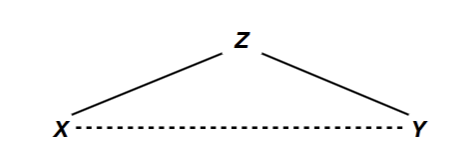
what does a diagram explaining multiple causes X and Z look like?
X and Z are distinct causes
the relationship between X and Y is not explained by Z

what does a diagram with an effect modifier W look like?
dashed line connects W to the arrow between X and Y
the dashed line is an annotation, not a causal arrow
*Explain how scholars evaluate causal relationships by accounting for potential sources of spuriousness
CM?
*Distinguish evidence of a relationship from evidence supporting a particular causal mechanism
What are 2 additional challenges with establishing causation?
causation is often probabilistic
a cause might change the probability of an outcome without invariably producing it
Hdeterministic vs Hprobabilistic
causation may change in different contexts
Ex: X criminal record Y employment Z race — the employment penalty of a criminal record differs by race, Z becomes an effect modifier
what is the trouble with the hypothesis: a criminal record reduces the employment opportunities
the cause is not the same effect in every context
race is an effect modifier, which changes the magnitude or direction of the effect of X on Y
what is an effect modifier
changes the magnitude or direction of the effect of IV on DV
what is a deterministic hypothesis compared to a probabilistic hypothesis no political influence and being selected for a polluting facility
H deterministic: greater political influence prevents a community from being selected for a polluting facility
H probabilistic: greater political influence reduces the probability that a community is selected, all else equal
What is the causal diagram and all the parts of reading Does Oil Hinder Democracy
Oil and democracy is the core relationship
the causal mechanisms are rentierism, repression, and modernization
rival explanations are wealth, islam, location, country history/culture, common temporal shocks

what does Ross 2001 Does Oil Hinder Democracy find
more oil wealth → less democracy (negative relationship)
analyzing the data produces evidence of covariation. by itself, this is not evidence that oil wealth causes less democracy
taking muslim population share into account does not eliminate relationship betwn oil and democracy, rival explanation is less plausible
states that rely more heavily on taxation are more likely to be democratic (taxes are related to regime, not oil)
how do you prove causal direction in oil hindering democracy case study
greater oil wealth should precede lower levels of democracy
ross measures oil five years before the corresponding measure of regime, asks if past oil wealth is associated with subsequent democracy
relationship is still negative — greater past oil wealth is associated with less democracy 5 years later
*wtf is covariation
what is rentierism?
if oil reduces democracy by suppressing demands for democracy, we expect greater oil wealth to reduce taxation and/or increase government spending
While many states export resources or license their development by foreign parties, rentier states are characterized by the relative absence of revenue from domestic taxation, as their naturally occurring wealth precludes the need to extract income from their citizenry and is a challenge to developing civil society and democracy
what is a research design
a strategy or blueprint for answering a research question