Module #2 : The Structure of the cell organelles and energy
 Call Kai
 Learn
Learn Practice Test
 Spaced Repetition
 Match
Match Flashcards
 Knowt Play
1/28

There's no tags or description
Looks like no tags are added yet.
Name | Mastery | Learn | Test | Matching | Spaced | Call with Kai | Chat |
|---|
No analytics yet
Send a link to your students to track their progress
29 Terms
The Precambrian:
This is a point in history and includes the hadean, archaean, and proterozoic eons
this point in history included the origins of life, photosynthesis and the oxygen atmosphere.

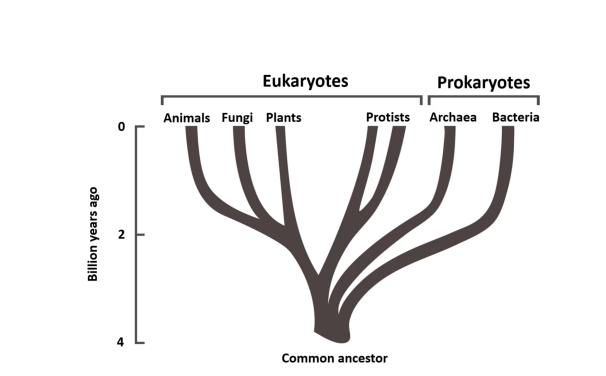
How was life 4 billion year ago?
Life began 4 billion years ago, it was exclusively unicellular for most of Earth’s history because oxygen was absent from the oceans and atmosphere - Harsh in hospital environment

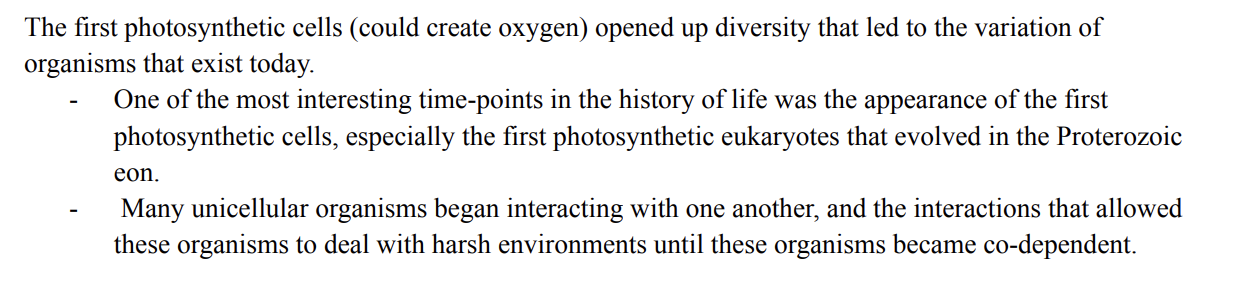
The first photosynthetic cells:
Prokaryotic VS eukaryotic cells:
Both have a: An external membrane that separates the inside of the cell from the outside of the cell.
Eukaryotic cells: an organisms whose cells contain a nucleus and many membrane bound organelles - Internal network of membranes
- Double membrane bound nucleus that serves as an internal compartment to separate the genetic material of the cell (chromosomes) from the rest of the cell interior
- True compartmentalized nucleus
Prokaryotic cells: unicellular organisms that lack a nucleus and have few to no organelles
1) Life on earth was almost exclusively unicellular for most of Earth’s history with oxygen virtually absent until the first photosynthetic cells
2) Prokaryotic cells have been around the longest, eukaryotic cells appeared about 2 billion years ago

Early Eukaryotes:
Single-celled organisms that contained organelles and internal membrane systems with distinct structures and functions.

Organelles
Membrane-bound structures inside the cell

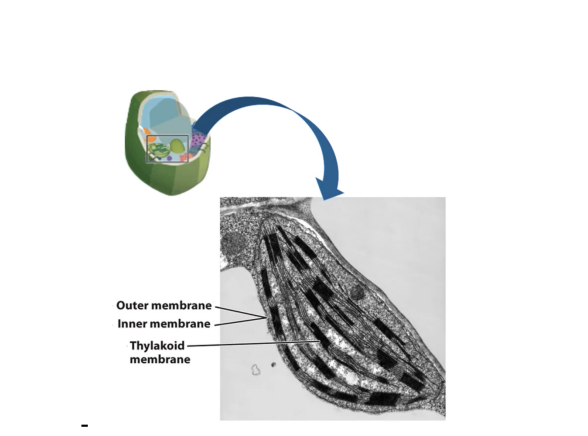
Chloroplasts
In plant cells. Photosynthetic protists and plant cells contain chloroplasts, actively engage in photosynthesis, producing chemical energy from light energy.
- Has a double membrane around its exterior and an interior filled with hundred of flattened and stacked membranes called thylakoids
- Thylakoid stacks are organized into piles called grana
- In these membranes, pigments and enzymes participate in photosynthesis
Mitochondria
In animal and plant cells. Mitochondria generate energy in the form of ATP. Convert energy from the food we eat into energy that powers most cellular functions in our bodies. - Mitochondrial malfunction = exhaustion, a common symptom of mitochondrial diseases
Photosynthesis:
a process in plant cells and other organisms to convert light energy into chemical energy. Chemical energy is stored in the bonds of carbohydrate molecules
- We rely on photosynthesis to produce sugars we consume in our diets
Cellular respiration:
a process used by plant and animal cells to release the chemical energy stored in the bonds of carbohydrate molecules and partially capture it in the form of ATP. - Chemical requirements of our bodies can be obtained from sugars we consume - We have between 50 to over a million mitochondria within one of our cells, depending on which type
- Mitochondria have two membranes
- Outer Membrane: Surrounds the organelle
- Inner membrane: Connected to a series of sac-like structures called cristae.
- It is in these membranes that most of ATP is synthesized in eukaryotic cells.
How did mitochondria end up in our cells?
- Dr. Lynn Margulis proposed that eukaryotic cells originated as communities of interacting entities that joined together
- She thought prokaryotic cells were ingested or entered into a host cell, where over time the prokaryotes and eukaryotes developed a mutually beneficial interaction and became obligatory for host survival.
- Mitochondria and chloroplasts are two distinct membrane bound compartments thought to have entered from external origins.
Mitochondria
- Look like bacterial cells
- About the same size as bacterial cells
- Have their own circular genome
- Produce the enzymes necessary for protein synthesis
Why is it advantageous to develop this type of endosymbiotic relationship?
1) The early atmosphere of the Earth was a hostile environment
2) Anaerobic ancestral eukaryotes had the capability of producing small amounts of ATP from carbon compounds, and the interactions with aerobic bacteria are able to produce high amounts of aTP from the same carbon compounds through a complex membrane system
3) It is likely that a mutually advantageous relationship developed when anaerobic eukaryotes engulfed aerobic bacteria
a) The bacterium could supply lots of energy, while the eukaryote provide a safe environment with a supply of carbon compounds


Endosymbiotic theory of organelle evolution:
1) A timeline that outlines how all cells were derived and modified from an ancestral prokaryote that contains genetic material of inheritance
2) Cell membrane allowed ancestral prokaryotes to compartmentalize the genetic information into a nucleus and obtain greater regulation of games and processing of proteins to become most ancestral eukaryotes
3) These cells containing nuclei and an endomembrane system became hosts to aerobic and photosynthetic prokaryotes (modern-day mitochondria and chloroplasts)
4) All eukaryotic cell types have mitochondria, but not all have chloroplasts

A hypothesis or theory of endosymbiotic relationships
A hypothesis or theory leads to a set of predictions. What predictions can we make if the endosymbiotic theory is an accurate representation of organelles such as the chloroplast and mitochondria?
1) One prediction is that there might be living examples of acquired endosymbiotic relationships which can be seen in eukaryotic organisms
a) There are examples of eukaryotic organisms that acquire the ability to engage in photosynthesis only after they engulf a photosynthetic bacteria that will perform those functions (phagocytosis by an early eukaryote, first step in the origin of plastids)
b) Green Algae cymbomonas is an example where living bacteria is maintained inside the protists and share their photosynthetic products with the protist host, both organisms benefit from this relationship
Temporary endosymbiotic relationships
1) Corals (similar to the human microbiome) live symbiotically with microbes called dinoflagellates. They photosynthesize as long as they have light and nutrients. They don’t keep the products of photosynthesis but release them to coral.
2) Sea slugs take this relationship one step further, the sea slug consumes photosynthetic algae and harvests the chloroplast from the algal cells. These chloroplasts are maintained in the cells of the sea slug.
Endosymbiotic relationships in the context of evolution
1) These temporary relationships must become permanent and heritable
2) When the host cells divides, then the organelles are distributed evenly between two daughter cells
3) Both mitochondria and chloroplasts contain their own circular genomes, such as found in bacteria, and analysis of the genes shows significant similarity to bacteria
Compartmentalization:
Different organelles existing within the cell allow for compartmentalization of different cellular functions. Organelles are a distinct domain within a cell with a specific function
Different compartments contain:
1) A unique set of enzymes
2) Produce and contain different products
Increased membrane surface area can
1) Increase the potential metabolic capacity across the membrane
This is advantageous because:
1) Specific sets of enzymes responsible for specific biochemical functions can be kept in close proximity to each other
2) Chloroplast has all enzymes necessary for photosynthesis, mitochondria for aerobic respiration 3) Efficiency of chemical reactions is increases if enzymes, substrates, and products are concentrated in an organelle
4) Incompatible processes like synthesis and degradation can be kept separate and not interfere with each other
Energy flow in organisms:
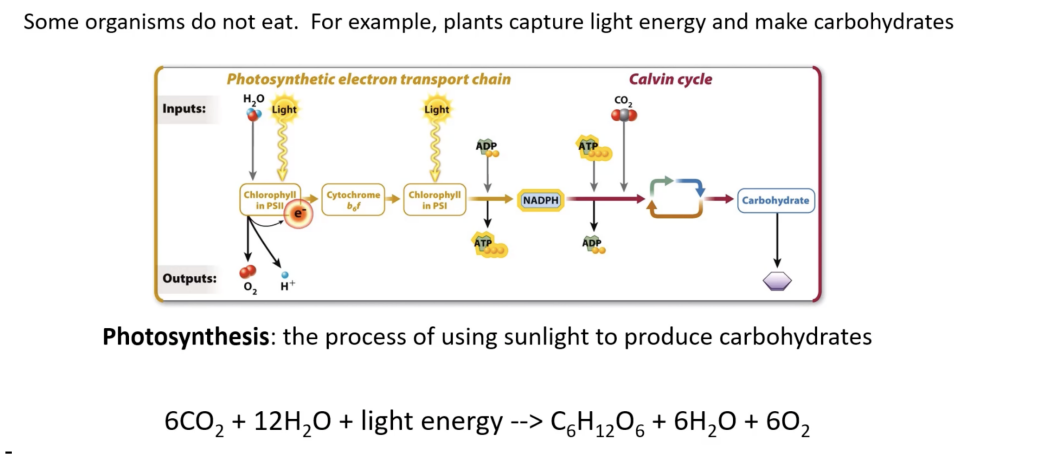
A chloroplast that is actively engaging in photosynthesis, harnesses light energy and together with atmosphere carbon dioxide it makes important organic sugars and gaseous oxygen. The energy present in sugars can then flow into the remaining ecosystem.
1) Living things need energy from outside sources (non-photosynthetic organisms) because they lack chloroplasts and cannot harness light energy to make organic molecules
2) Much energy is provided through metabolism of organic molecules produced by chloroplasts in the plants that we consume directly, or by feeding animals that feed on plants
3) Cyclists intake sugars to synthesize ATP to power their muscle cells


How do chloroplasts make energy?
1) Presence of sunlight, carbon dioxide, water, and the primary energy source being produced as carbohydrates as glucose and oxygen as a byproduct
2) During the photosynthetic cascade of events, light energy is transformed into chemical energy in the form of ATP and NADPH which then enters the Calvin Cycle
3) In the Calvin cycle NADPH and ATP are used to drive the reduction of atmospheric carbon dioxide into carbohydrates
This cascade shows the important of light reactions and the calvin cycle to produce sugar and oxygen
most abundant sources of ATP
Carbohydrates are the most abundant sources of ATP that fuel our bodily processes 1) Formed by the polymerization monosaccharides through glycosidic bonds to form complex sugars
2) Monosaccharides include glucose, fructose, and galactose
3) Special proteins called enzymes can catalyze the condensation reaction between specific hydroxyl groups of certain monosaccharides to produce disaccharides such as lactose, sucrose, maltose and others (metabolism of carbohydrates requires proteins called enzymes)
4) The reaction occurs between the OH group of carbon 1 of one molecule and carbon 4 of another monosaccharide to give either
a) Alpha 1-4 glycosidic linkage
b) Beta 1-4 glycosidic linkage
Polysaccharides
Polysaccharides are the structures that form when many monosaccharides are linked together
1) Simple disaccharides or more, or larger and more common polysaccharides like starch and glycogen
2) Starch is the storage polysaccharide found in all photosynthetic plants made up of a) Alpha 1-4 glycosidic linkages between alpha-glucose monomers


Two types of starch include two types of polysaccharides
Two types of starch include two types of polysaccharides
1) Unbranched amylose
2) Branched amylopectin
3) These differences in structure vary only based on the interactions between neighboring carbon atoms of each glucose monomer
a) In amylopectin the branches formed by glycosidic linkages between the carbon 1 of one glucose molecule and carbon 6 of another
b) It is often these starches that we consume and use as energy in our own bodies
When starches are consumed, we store digested carbohydrates as highly branched glycogen polysaccharide helices. This stored glycogen energy can be broken into glucose through cellular respiration to produce ATP for necessary cellular processes.
Our cells are dynamic
1) We require molecular fuel to support our activities
2) The molecular fuel that gives energy for all our cellular processes is derived from ATP a) Cells can generate ATP from the metabolism of simple sugar molecules (cellular
respiration)
i) 4 steps take place in cellular respiration that result in ATP synthesis
ii) A given cell typically only contains enough ATP to fuel 30 seconds - 1 minute of cellular activity, meaning the evolution of fast glucose processing systems has
occurred (they are constantly active and efficient)

Glycolysis:
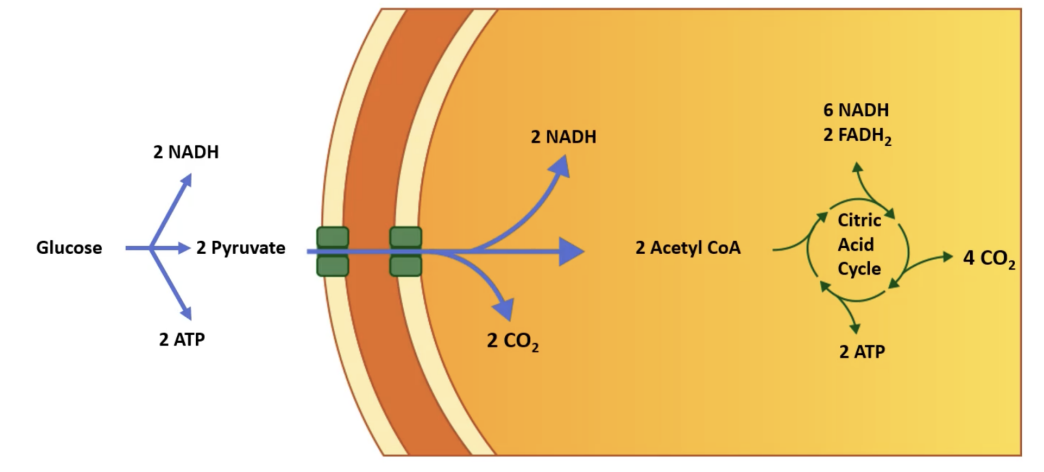
Glycolysis: Occurs in the cytosol of the cell and leads to the production of 2 molecules of ATP and 2 NADH molecules that act as electron donors
Step 1 of Glucose Processing
1) Glycolysis results in the production of 2 molecules of a 3-carbon compounds called pyruvate (NADH) for each molecule of glucose
2) Following glycolysis, pyruvate is processed to form acetyl CoA, which is free to enter the mitochondrial matrix of the mitochondria, while also producing carbon dioxide and NADH 3) Once in the mitochondrial matrix, acetyl CoA is further processed in the Krebs cycle producing ATP, carbon dioxide, and additional electron donors in the form of NADH and FADH2. These electron donors will add up during glucose processing to facilitate production of ATP in the mitochondria
Not much ATP is produced in the first 3 steps of glucose processing, not a whole lot of ATP is synthesized
Electron donors?
The bulk of the electron donors are used in the electron transport chain in the inner mitochondrial membranes or cristae to produce another 32 molecules of ATP
a) As a result for every glucose molecule that we process in our cells, we produce 36 theoretical ATP, with negligible amounts coming from glycolysis and the Krebs cycle and most ATP forming when electron donors NADH and FADH2 move through the protein complexes of the electron transport chain in the extensive inner mitochondrial
membranes
b) The transfer of these electrons allows protons to be pumped into the intermembrane spaces of the mitochondria
i) Creates an electrochemical concentration gradient across the inner mitochondrial membranes that drives protons through the ATP synthase protein channels that are embedded in membranes
ii) This results in the synthesis of 32 additional ATP
Until recently it was thought 36 molecules of ATP were synthesized per molecule of glucose, the theoretical maximum, but recent research using more precise measurements suggests its closer to 30 ATP molecules per molecule of glucose
A proton gradient drives the synthesis of ATP


Sources of energy for ATP
Carbohydrates are not the only source of energy used to make ATP
1) Proteins and lipids can be converted into components that enter into the cellular respiration pathway and lead to the production of ATP
2) All three of these macromolecules contribute to ATP production, carbohydrates are metabolized first, then fats, and then proteins
Why is ATP a source of molecular energy?
1) It fuels cellular processes because it has a very high potential energy. ATP has 3 phosphate groups attached to a ribose sugar and an adenine. The 3 phosphate group shave 4 negative charges in close proximity, so these negatively charged phosphate groups repel each other, giving the electrons of the phosphate groups a very high potential energy
2) The potential energy of ATP can be released and harnessed during hydrolysis, where ATP can react with water and beak the bond between the outermost phosphate group and its neighbor resulting in the formation of ADP and inorganic phosphate
3) The hydrolysis of ATP is highly exergonic (releases energy)
The cell’s interior machinery takes advantage of the energy that is released during atp hydrolysis to perform, mechanical transport, and chemical work
- Cyclist pedaling uses ATP hydrolysis to fuel the contraction of his or her muscles during strenuous exercise
- ATP is also important for the transport of substances across the cell membrane AGAINST a concentration gradient
- Many enzymes within a cell require energy to perform their functions and the cell is then able to use ATP-derived energy to help drive endergonic or energy requiring reactions

Today of eukaryotes:
Today’s eukaryotes were likely derived and modified from an ancestral prokaryote that contained genetic material of inheritance.
1) The endosymbiotic theory states that these early eukaryotes became hosts to aerobic and photosynthetic prokaryotes which are now mitochondria and chloroplasts
Endomembrane system: a group of organelles in eukaryotic cells that performs most lipid and protein synthesis; endoplasmic reticulum, golgi apparatus, and lysosomes
