Biodiversity II Lab: Midterm Review
 Call Kai
 Learn
Learn Practice Test
 Spaced Repetition
 Match
Match Flashcards
 Knowt Play
1/36

There's no tags or description
Looks like no tags are added yet.
Name | Mastery | Learn | Test | Matching | Spaced | Call with Kai | Chat |
|---|
No analytics yet
Send a link to your students to track their progress
37 Terms
Three Different Kinds of Microscopes
Dissecting scope
Compound light scope
Electron scope
Phylogenetic Tree/Cladogram
Diagram that shows hypothesized evolutionary relationship between species.
Endpoints
Specific data on a phylogenetic tree (like a species).
Branch Points/Nodes
Shared/common ancestor on a phylogenetic tree.
Clade/Monophyletic Group
A group of organisms that includes a common ancestor and all of its descendants.

Paraphyletic Group
A group of organisms that includes a common ancestor but not all of its descendants.
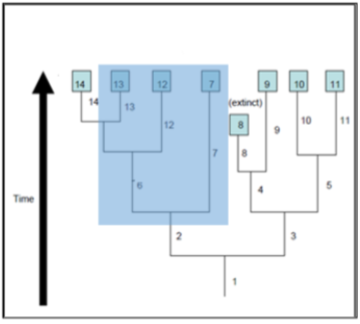
Polyphyletic Group
A group of organisms that includes groups of species with different ancestors.

Divergent Evolution
The process of related species adapting differently to their environment and becoming more dissimilar. Involves species that share a recent common ancestor.
Convergent Evolution
When a similar trait arises between species that do not share a recent common ancestor.
Homology
The morphological and molecular traits that are derived from a common ancestor and are retained.
Homoplasy
Independently evolved but similar traits.
Natural Selection
The process where organisms with traits best suited to their environment survive and reproduce more often than others; this is not survival of the fittest, you just have to not be the worst.
Genetic Drift
Random phenotype/allelic change.
3 Domains of Life
Bacteria
Archaea
Eukarya
Extremophiles
An organism that thrives in physically or geochemically harsh environments that would be deadly to most other life forms.
Pathogenic
Harmful to other organisms.
Cyanobacteria
Bacteria that produce O2 via photosynthesis; ecologically important bc they fix carbon and nitrogen out of the atmosphere.
3 Groups of Cyanobacteria
Anabaena
Oscillatoria
Merismopedia
Anabaena
Cyanobacteria in long chains; has heterocyst and akinete cells. Symbiotic with aquatic ferns and can be found in freshwater, saltwater, hot springs, and top-soil.
Heterocysts
Specialized cells in Anabaena that fix nitrogen; formed during periods of nitrogen limitation.

Akinete Cells
Dormant cells in Anabaena that are resistant to the cold and drying out.

Oscillatoria
Filamentous cyanobacteria found in freshwater, salt water, and hot springs. These colonies slide back and forth against each other to orient to a light source.
Merismopedia
Sheet-like grid cyanobacteria, found in aquatic habitats and freshwater sediments. They can form symbiotic relationships with zooplankton. Held together by a mucilaginous sheath.
Mucilaginous Sheath
A slimy, protective, outer layer made of glycoprotein that surrounds cyanobacteria and certain other algae or plant tissues.
Gram Staining Technique
Staining technique developed by Hans Christian Gram to differentiate gram positive and gram negative bacteria.
Order of Gram Stain Process
Transfer
Fixation
Crystal Violet
Gram’s Iodine
Decolorization (Ethyl alcohol)
Counterstain (Safranin)
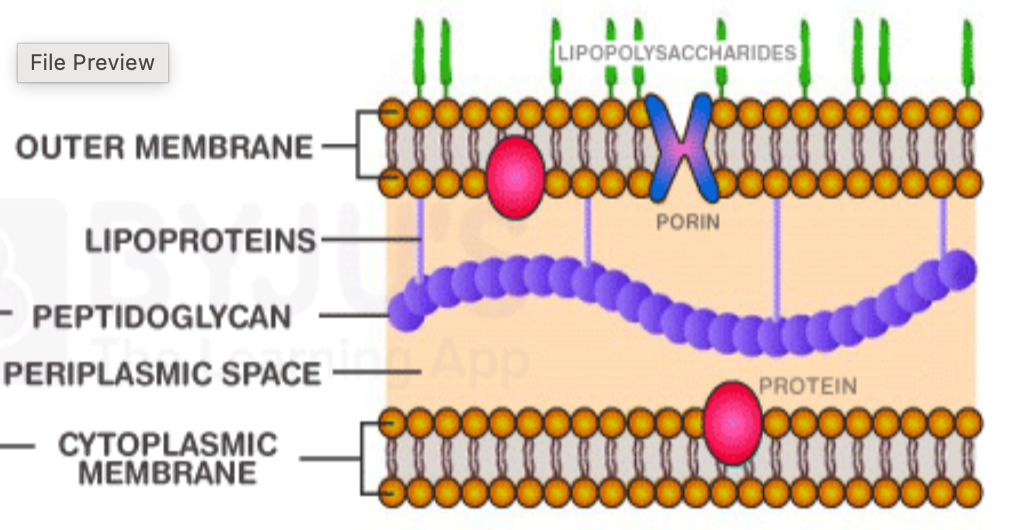
Peptidoglycan
Polymer of sugars and animo acids that compose the cell wall of bacteria.
Gram Positive Bacteria
Bacteria with thick peptidoglycan layer with no outer membrane.

Gram Negative Bacteria
Bacteria with a thin peptidoglycan layer and an outer membrane.
Protobionts
Thought to be first single celled organisms, RNA speculated to be it’s genetic material.
Photoautotrophs
An organism that uses light energy to convert inorganic substances and water into organic compounds for food.
Chemoautotrophs
Organisms that make their own organic food using energy from chemical reactions instead of sunlight.
Chemoheterotrophs
An organism that gets both its energy and its carbon by consuming organic compounds.
Obligate Aerobes
Bacteria that requires oxygen to survive.
Facultative Aerobes
Bacteria that use oxygen to survive, but they can survive and tolerate not having oxygen.
Obligate Anaerobes
Bacteria that requires an area with no oxygen to survive.
Aerotolerant Anaerobes
Bacteria that don’t use oxygen to survive, but they can survive and tolerate its presence in the environment.