Psychology 101: final exam
 Call Kai
 Learn
 Practice Test
 Spaced Repetition
 Match
 Flashcards
 Knowt Play
1/209

There's no tags or description
Looks like no tags are added yet.
210 Terms
active coping
response to a stressor that reduces stress by changing the situation to eliminate or lessen the negative effects of the stressor;
-change in outlook/mindset
-relaxation
-exercise
social loafing
the tendency for people in a group to exert less effort when pooling their efforts toward attaining a common goal than when individually accountable
Solomon Asch
conducted an experiment where participants' estimates of line length were influenced by the presence of others giving incorrect answers
Philip Zimbardo
conducted the famous Stanford Prison Experiment; illustrated the powerful impact of role-playing
Stanley Milgram
conducted experiments where "teachers" were made to shock "learners" under direction from an authority figure
attribution theory
the theory that we explain someone's behavior by crediting either the situation or the person's disposition; studied by Fritz Heider
General adaptation syndrome
Alarm- fight or flight
Resistance- cope/resist
Exhaustion- adrenal and other glands created by fight or flight can no longer secrete hormones
central route to decision-making.
When we are motivated and able to pay attention, we take a logical, conscious thinking; This can lead to permanent change in our attitude as we adopt and elaborate upon the speaker's arguments; occurs when people think carefully about the message and are influenced because they find the arguments compelling.
peripheral route to decision making
Here we do not pay attention to persuasive arguments but are swayed instead by surface characteristics such as whether we like the speaker. In this case although we do change, it is only temporary (although it is to a state where we may be susceptible to further change);
Occurs when people are influenced by incidental cues, such as a speaker's attractiveness, emotional music or images.
Forensic Psychology
The application of the science of psychology to criminal law.
approach-avoidance conflict
a type of conflict involving a single goal that has both positive and negative aspects
approach-approach conflict
a type of conflict involving a choice between two positive but mutually exclusive options
avoidance-avoidance conflict
a type of conflict involving a choice between two negative or undesirable options
Job opportunities
crime prevention and solution, criminal rehabilitation, and issues of the criminal law.
Research opportunities
They examine human behavior in relation to the legal system.
Determine sanity and competence.
Evaluate and examine criminals.
Help lawyers prepare for trial.
Help police catch criminals.
Personality
is the major motivational element within individuals. It is the seat of drives and the source of motives.
Insanity Defense
based on the theory that most people can choose to follow the law
Insanity
Mental illness of such a severe nature that a person...
cannot distinguish fantasy from reality,
is subject to uncontrollable impulsive behavior.
<1% of cases
rarely successful 25%
Competency
The mental state of the defendant at the time of trial.
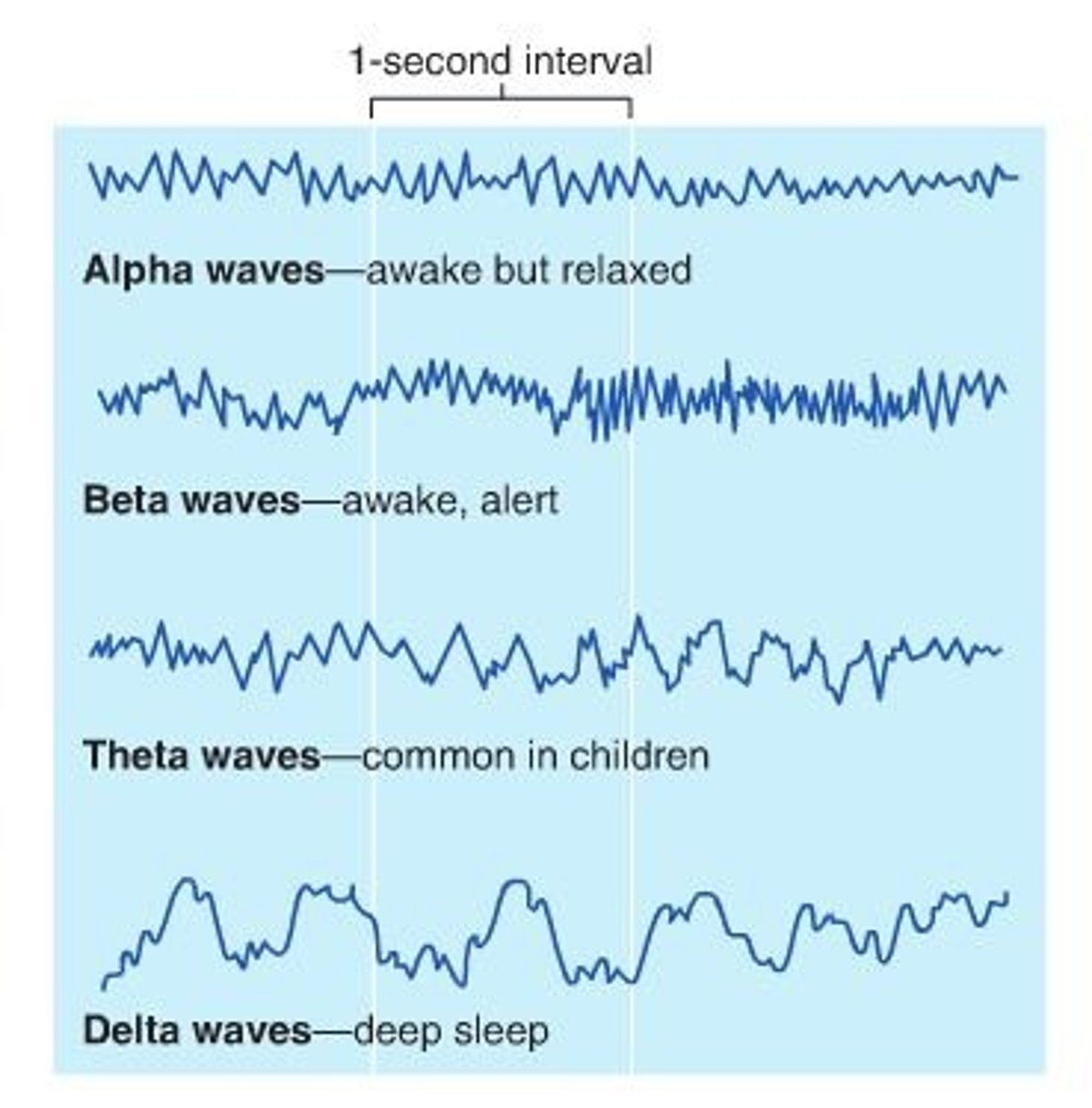
Beta
most engaged level of awareness; also in REM
Alpha
more in automatic consciousness
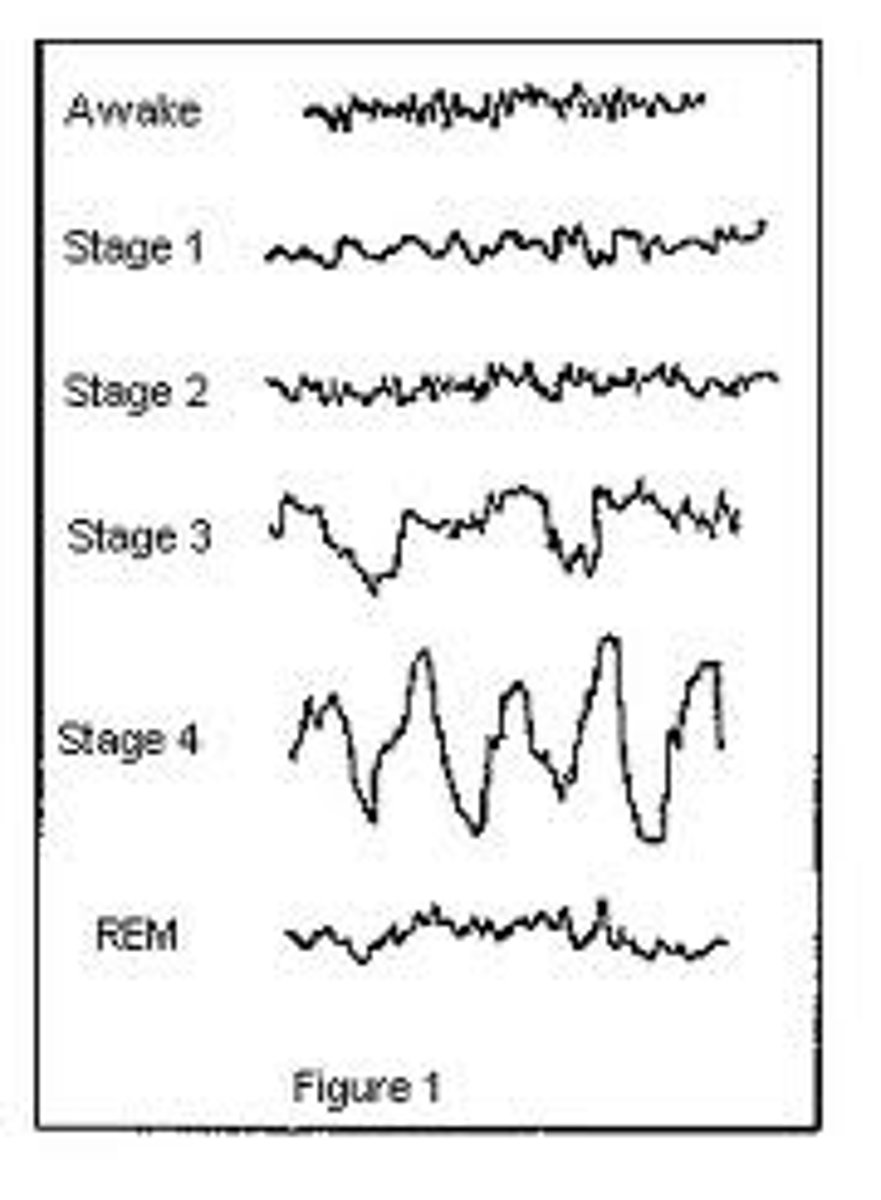
Theta
first stage of sleep
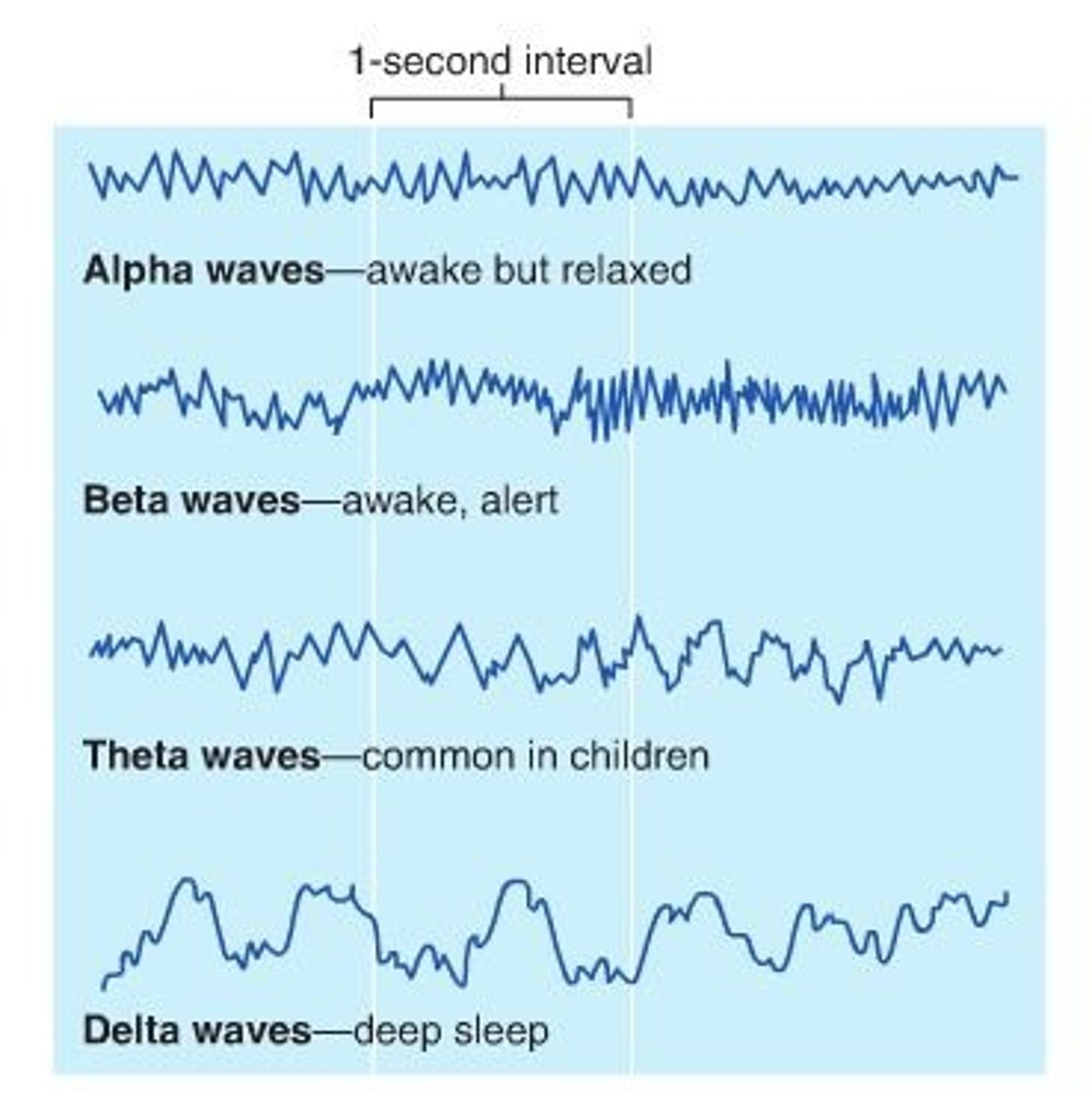
Delta
slowest frequency and largest amplitude; deep sleep
Investigative Psychology
The application of psychology to criminal investigation.
what are the sleep stages
stage 1: transition to light sleep
stage 2: sleep spindles
stage 3: deep sleep
REM sleep
stage 1: transition to sleep
Alpha to theta brainwaves
Light sleep
Hypnotic jerks
Physiological changes
Heart rate slows
Body temp drops
Stage 2: continuation to deep sleep
sleep spindles- mixed eeg
stage 3: deep/ slow wave sleep (SWS)
Delta Waves
Extremely difficult to awaken
Important for consolidating information
REM sleep: Rapid Eye Movement
Rapid eye movement
Limited bodily movement
More rem the more you sleep- later in the evening/towards end of sleep
High brain activity but low awareness
Difficult to awaken (deep sleep)
Beta brain waves
Dreaming
why we need sleep
REM and SWS facilitate learning/ memory consolidation/ neurosis;
Rebound effect
brain will rebound quickly to REM or slow wave sleep
lowered awareness
sleeping; still taking in a perceiving external stimuli but to a much lower degree
Profiling
the process of identifying personality traits, behavioral tendencies, geographical location, and demographic or biographical descriptors of an offender (or offenders) based on crime scene characteristics.
levels of awareness: automatic
perceive environment but not fully aware - day dreaming, highway hypnosis, reading and not grasping
What does psychological skills training (PST) emphasize in relation to working with athletes?
PST emphasizes control of internal states - athletes are taught to control or reduce unwanted thoughts emotions an sensation to increase their potential for achieving an ideal mental state conducive to optimum performance
What is an assumption of PST?
That it decreases in negative internal experiences ( thoughts, emotions) minimize distractions and enhance opportunities for positive experiences and confidence building
What is the current research regarding the effectiveness of PST techniques?
Studies have reported inconsistent findings regarding whether reduction in anxiety improve wellbeing or athletic performance; In fact, efforts to control or entirely suppress negative experiences may be a suboptimal and even counterproductive strategy for improving athlete's performance
What is experiential avoidance?
An unwillingness to maintain contact with unpleasant internal thoughts and demotions
What is psychological inflexibility and how does experiential avoidance lead to psychological inflexibility?
Rigid orientation toward experiences which can hinder the pursuit of valued and meaningful behavior and cause health problems and hinder athletic performance
What is the core message of acceptance and commitment therapy and what component is emphasized?
To observe and accept what is beyond ones control or ability to change and to commit to actions that are aligned with personal values - ACT based approaches emphasizes mindfulness (bringing conscious attention to the present moment in a receptive curios manner)
What are some positive outcomes of self-reported mindfulness?
Adaptive emotion regulation strategies, even after controlling for anxiety, stress, and depression; regular mindfulness practice can help individuals become more adept at guiding attention toward desired stimuli, allocating limited cognitive resources toward valued ends and improving task performance
What is flow (in relation to athletes)?
A state of energized focus and full involvement during athletic performance
9) What are the three components of the MAC program?
Mindfulness, acceptance, and commitment
10) What is the difference between "goals" and "values" in the context of the MAC program?
Whereas goals pertain to specific outcomes, values are continuously constructed dynamic patterns of behaviors.
11) According to the MAC program, why is it important to learn how to use mindfulness skills to increase acceptance of unwanted/negative internal experiences (emotions/thoughts, etc)?
Because emotions—particularly negative ones—often derail goal-related efforts, MAC program teaches athletes how to use mindfulness skills to increase acceptance of unwanted internal experiences. Accordingly, the basketball player can learn how to accept unwanted feelings (e.g., anxiety) and commit to behavior (e.g., practicing free throw shooting) that is in line with his value of being a reliable teammate. Together, awareness and acceptance build commitment toward values-driven behavior.
12) What are some benefits of practicing yoga? How does it promote mindfulness?
The central message of yoga is to learn how to listen and respond to bodily sensations. This awareness helps individuals move to a comfortable "physical and mental space" while challenging their body (Shiffmann, 1996). Various physical poses and movements are used to increase awareness of one's physical and mental states. Yoga practitioners are shown how to mindfully focus their attention on the present moment. Decreased stress, fatigue, cortisol, more positive emotions, increased satisfaction of life; reduction of anxiety and depression
13) What experiential exercise was used to in the current experiment to help athletes move their attention more flexibly between internal and external states?
Two session each week of MAC program and 60 minute yoga class after each session
cognitive defusion
Looking at thoughts rather than from thoughts
Noticing thoughts rather than becoming caught up in thoughts
Letting thoughts come and go rather than holding onto them
What is experiential acceptance?
e willingness to experience (i.e., not try to change) unwanted private events in the pursuit of one's values and goals.
What were some experiential tasks of the MAC program experiment that facilitated enhanced flexibility and increased attention?
Brief centering exercises then task focused exercise in which they learned how to redirect their attention from internal processes (emotions or thoughts) to an external task and body scan; brief centering exercise then task focused attention exercise in pairs
At the end of the experiment, how did the experiential group compare to the control group in terms of self-reported mindfulness, goal-directed energy, perceived stress, and tolerance for negative experiences?
Baseline comparisons revealed that the groups did not differ in levels of anxiety, stress, or depression (from DASS subscales), with the experimental group reporting relatively low levels of anxiety (M 0.79, SD 0.51), stress (M 0.97, SD 0.49), and depression (M 0.69, SD 0.51), comparable to the control group: anxiety (M 0.64, SD 0.36), stress (M 0.83, SD 0.47), and depression (M 0.65, SD 0.59); all ps .30. Consistent
Consistent with expectations for the control group, we found no significant changes from pre- to postassessment for any measure (ps .05). Repeated-measures analyses of variance (ANOVAs) revealed that compared with the control group, participants in the experimental group reported a greater increase in mindfulness, F(1, 19) 4.55, p .05, and goaldirected energy, F(1, 19) 4.94 p .05.
In their written feedback, what did athletes most request (i.e., what did they want more of?)?
Wrote that the mindfulness activities were the most helpful part of the intervention and suggested that incorporating more hand on exercises would improve the intervention
In general, what was Eddie's home life like as a child? military experience? Haiti?
- Strict parents who had rules
- Lenient aunt who did drugs
- Uncle and grandfather died from drugs
- Marines, Iraq as weapons specialist, prisoner guard,
- Haiti for humanitarian ;Severe earthquake where he saw lots of corpses
When Eddie finished serving in the military, he was described as a changed person. What were some changes to his behavior? substance use? odd thoughts?
Drinking more heavy
Suicide threats
Panic attacks while flying
Obsessive odd thoughts - he has worm, he is Dracula
Paranoia thought government was watching him
Agitated hypervigilant behaviors - nail gun, bridge
Suicidal threats and behaviors - grabbed gun
Manic like thoughts/ behaviors
What type of treatment did he receive as a result of these psychological changes?
3 week impatient stay PTSD; cocktail of meds; again committed after threatening to hurt himself and other; psychiatric hospitalization; more anitphyschotic dosage
Top-Down Approach
Bottom-Up Approach
profiler has experience & uses evidence at the crime scene to develop a profile of the likely criminal; profiler uses statistics & research based on similar crimes in order to develop a profile of the criminal based on previous convictions
Prior to the murder, Eddie was hospitalized - when was that (how soon before the murders?) and what type of treatment was it?
Involuntary Psychiatric hospitalization - pacing with knife about gov agents
how did Kyle describe eddie the day of the murders?
straight up nuts
what happened when the police approached Eddie in his car immediately after the murders; what did he tell the police at the station after he was arrested
15 min convo then flee; He knew what he did was wrong but he needed to take his soul before his is taken and doesn't want to play chess with his life.
How did the psychiatric evaluation from the defense expert differ from the prosecution expert?
Defense: schizophrenia - cannibals, mafia, pigs
Prosecution: paranoid personality disorder- faking schizophrenia, mj and alc use
According to the defense psychiatrist, what did Routh think after he shot Chris and Chad?
Routh felt like he was in danger, thought the guys were pig assassins, he felt remorse
What did the prosecution expert (Arambula) say about Routh's sanity at the time of the crime?
Not insane during murder because he was intoxicated, not schizophrenic because turned back on kyle
what is substance use disorder
Recurrent use of a substance in spite of clinically and functionally significant impairment. Examples include:
Health Problems
Disability
Failure to meet major responsibilities at work, school, or home
Diagnosis is also based on evidence of impaired control, social impairment, and risky use.
alcohol use disorders
Alcohol is the most commonly used addictive substance in the U.S.
17.6 million people suffer from alcohol abuse or dependence (as well as several million more who engage in risky binge drinking patterns that often results in alcohol problems)
Most alcohol dependent individuals do not seek treatment
Stigma often plays a role
Cost
Don't see it as a problem
how effective is substance use treatment
The majority of individuals in treatment improve, but relapse is common
Better outcomes are associated with:
Longer retention in treatment
Addressing multiple problems or stressors (psychiatric, family, legal, housing, employment)
Aftercare participation
how to help one control his impusive drinking behavior
Clinicians would work with Joh to
Develop awareness for his triggers and how to avoid them
Not face his triggers alone
Find alternative, immediate action
Which of the following is NOT a unique feature of REM sleep?
A. high-frequency (beta) brain waves
B. dreaming
C. sleep spindles
D. rapid eye movements
C. Sleep spindles
Which of the following is NOT one of the types of insomnia?
A. difficulty falling asleep
B. difficulty taking naps when needed
C. difficulty staying asleep
D. early awakening
B. difficulty taking naps when needed
According to the sleep hygiene articles, which of the following is NOT a way to improve sleep hygiene?
A. have a consistent bedtime
B. clean your sheets once a week
C. do not do activities in your bed (e.g., watching television, using your phone/computer)
D. avoid 1-hr mid-day naps
B. Clean your sheets once a week
What is likely to happen to individuals who are deprived of REM sleep?
A. their dreams will become more "life-like"
B. they will have difficulty dreaming when they are in REM
C. they will spend disproportionately more time in REM compared to other sleep stages when they do sleep
D. they will be more likely to engage in sleep talking and sleep walking
C. they will spend disproportionately more time in REM compared to other sleep stages when they do sleep
Some long-term benefits associated with consistent meditation include all of the following EXCEPT:
A. lower levels of stress hormones
B. blood pressure regulation
C. improved concentration
D. flexibility
D. flexibility
According to role-playing theories of hypnosis, who is most susceptible to being hypnotized?
A. individuals with mental illness
B. highly suggestible individuals
C. trained actors/actresses
D. children
D. children
This type of meditation allows the individual to attend to the present moment and experience it without judgment.
A. focused attention
B. continual meditation
C. open monitoring
D. focused monitoring
C. open monitoring
What theory of dreaming suggests dreams are the byproduct of neural processes that occur during the REM stage?
A. Wish fulfillment
B. Problem-solving
C. Activation-synthesis
D. Lucidity
C. Activation-synthesis
Which of the following was NOT identified as a factor that can less the negative impact of stress on one's physical health
A. openness
B. conscientiousness
C. optimism
D. social support
A. openness
When you must make a choice that has both pros and cons, what type of conflict are you likely to experience?
A. approach-approach
B. avoidance-avoidance
C. approach-avoidance
D. ambivalent-ambivalent
C. approach-avoidance
People with Type A personality are at a greater risk for coronary heart disease. What specific component of this personality trait explains that increased risk?
A. competitive orientation
B. anger/hostility
C. impatience
D. time urgency
B. anger/hostility
The broaden-and-build theory of positive emotions states that positive emotions promote resilience in each of the following ways EXCEPT:
A. positive emotions increase flexibility in problem-solving
B. positive emotions can counteract the physiological damage of negative emotions/stress
C. positive emotions protect people from experiencing stress
D. positive emotions facilitate social support
C. positive emotions protect people from experiencing stress
This type of stress occurs when you are expected to perform a certain way or meet certain demands.
A. conflict
B. frustration
C. implosion
D. pressure
D. pressure
According to the sleep article, how is melatonin released in individuals with inconsistent sleep patterns?
A. the release of melatonin is delayed
B. the release of melatonin is increased
C. the release of melatonin is decreased
D. it is released the same as in individuals with consistent sleep patterns
A. the release of melatonin is delayed
How is mindfulness meditation described in the assigned article?
A. It's a time to focus on oneself and be in the present moment
B. It's a time to study for classes in a quiet place without interruption
C. It's an activity that challenges an individual to think about what is most important to them and how to prioritize one's thoughts
D. It's a class that emphasizes the importance of thinking
A. It's a time to focus on oneself and be in the present moment
According to the Mindfulness Meditation article, the results of the 2016 student indicated what?
A. mindfulness meditation only increased connections in the stress regulatory areas of the brain if it was practiced daily for at least 15 minutes
B. mindfulness meditation can permanently change/stabilize the stress regulatory areas of the brain
C. mindfulness meditation had no impact on stress regulatory areas of the brain
D. mindfulness meditation was linked to increased connections of the stress regulatory areas of the brain
D. mindfulness meditation was linked to increased connections of the stress regulatory areas of the brain
Based on the results of the study presented in the sleep article, what was the advice given by the study authors?
A. wake-up and go to bed at similar times each day
B. get more sleep
C. go to bed and wake-up earlier
D. all of the above
A. wake-up and go to bed at similar times each day
According to the Mindfulness Meditation article, what type of individual was recruited to participate in a 2016 study to examine the effect of mindfulness meditation on the brain?
A. college students
B. unemployed adults
C. stay-at-home parents
D. business executives
B. unemployed adults
According to the sleep article, what variable was specifically found to be linked to a higher GPA?
A. sleep quantity
B. sleep quality
C. sleep regularity
D. all of the above
C. sleep regularity
You earned a 98% on your last PSYC 101 exam. According to the self-serving bias, to what are you most likely to attribute your high score?
A. an easy exam
B. lucky guesses on the multiple choice
C. tutoring from a peer
D. hours of of studying
D. hours of of studying
You are more likely to have negative stereotypes of people in your outgroup - why is that?
A. an evolutionary and automatic tendency to classify people in your outgroup as "the enemy"
B. a tendency to only put people you do not like into your outgroup
C. an evolutionary bias to spread negative stereotypes about your enemy so they are outcast by others
D. all of the above
A. an evolutionary and automatic tendency to classify people in your outgroup as "the enemy"
Jane Elliott conducted a classroom experiment to assess discrimination. Which of the following accurately describes her experiment?
A. She divided her students by race (e.g., Caucasian students, African-American students)
B. She divided her students by academic achievement (e.g., "A" students, "B" students)
C. She divided her students by eye-color (e.g., blue-eyed students, brown-eyed students)
D. She divided her students hair color (e.g., brunette students, blond students)
C. She divided her students by eye-color (e.g., blue-eyed students, brown-eyed students)
The Fundamental Attribution Error states that observers are likely to attribute others behaviors to an ______________ attribution.
A. external
B. internal
C. actor
D. observer
B. internal (she is a bad person)
What is the purpose of stereotyping?
A. Stereotyping enables humans more readily identify individual differences.
B. Stereotyping enables humans to process information more quickly.
C. Stereotyping enables humans to make more accurate decisions about other people.
D. Stereotyping exists to help humans distinguish their "friends" from their "enemies."
B. Stereotyping enables humans to process information more quickly.
Why do we stereo type?
i. Saves on the time and effort required to get a handle of people individually
ii. Save energy by simplifying our social world
What is a defining feature of cognitive dissonance?
A. an idea sounds good but it is not easily implemented
B. an individual has beliefs that are inconsistent with another individual's beliefs
C. an individual has contradicting or inconsistent beliefs within him or herself
D. telling lies
C. an individual has contradicting or inconsistent beliefs within him or herself
According to your text, what type of message is influential to an observer?
A. a two-sided argument
B. a one-sided argument
C. messages that rely on intellect as opposed to fear
D. messages that are shorter than 15 minutes
A. a two-sided argument
According to the Elaboration Likelihood Model, what route of persuasion is more likely to result in durable attitude change?
A. central
B. peripheral
C. cognitive
D. emotional
A. central
According to your textbook, what source factor appears to be the most important for establishing credibility and inducing persuasion?
A. repeated exposure
B. personality
C. fear
D. trustworthiness
D. trustworthiness
Which of the following is NOT a component of one's attitude?
A. cognitive
B. physiological
C. affective
D. behavioral
B. physiological -- remember ABC
The bystander effect is likely to occur in large groups because of why psychological phenomena?
A. social loafing
B. groupthink
C. diffusion of responsibility
D. group polarization
C. diffusion of responsibility
diffusion of responsibility
reduction in sense of responsibility often felt by individuals in a group; may be responsible for the bystander effect, social loafing, and related phenomena
Zimbardo's Stanford Prison experiment discovered that social roles have a significant influence on behavior. What aspect of the experiment demonstrated this?
A. College students recognized their social role as "college students" and did not adopt the roles of "prisoner" and "correctional officer"
B. Prisoners had a hard time overcoming their social role of "prisoner" when given the opportunity to be a correctional officer
C. Correctional officers were unable to control the prisoners because the prisoners knew the correctional officers were truly college students
D. College students quickly adopted the social roles of "prisoner" and "correctional officer"
D. College students quickly adopted the social roles of "prisoner" and "correctional officer"
Which of the following factors contributes to groupthink?
A. social loafing
B. group cohesiveness
C. polarized thinking
D. opposing points of view
B. group cohesiveness
From his study, Milgram concluded that people are more likely to obey those who _______________.
A. are similar to them
B. give clear directions
C. are in a position of authority
D. all of the above
C. are in a position of authority