Unit 2 Cells
 Call Kai
 Learn
Learn Practice Test
 Spaced Repetition
 Match
Match Flashcards
 Knowt Play
1/73

There's no tags or description
Looks like no tags are added yet.
Name | Mastery | Learn | Test | Matching | Spaced | Call with Kai | Chat |
|---|
No analytics yet
Send a link to your students to track their progress
74 Terms
plasma membrane
Phospholipid bilayer, surrounds cell and transports nutrients and provides support

saturated fatty acid membrane
packed tight; rigid membrane

unsaturated fatty acid membrane
not packed tight; flexible membrane

selectively permeable
allows: small, unchanged, polar molecules; hydrophobic molecules
blocks: large polar molecules; ions
integral proteins
imbedded in bilipid layer

peripheral proteins
attached to membrane surface

channel proteins
passage for hydrophillic substances

aquaporins
channel proteins; increase rate of H20 passage

ion channels
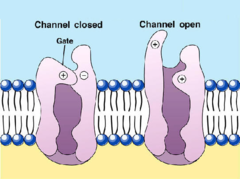
ions; gated channels

gated channels
open and close in response to stimuli
EX: nerve and muscle cells
carrier proteins
specific molecules bind, changing protein shape

transport proteins
use ATP (active transport)
EX: sodium-potassium pump

recognition proteins
unique identification; glycoproteins
EX: blood types

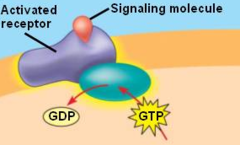
receptor proteins
provide binding sites; activates specific cell response
adhesion proteins
attaches cells to cells; provides anchors for filaments

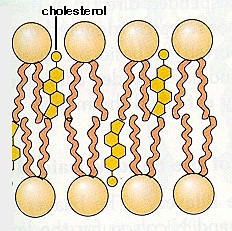
cholesterol
stability to animal cells
organelles
Structures within cell that help it function

nucleus
contains DNA and nucleoli; site of cell division

chromatin
DNA spread through nucleus like web

chromosomes
DNA becomes rod-shaped as cell begins division; includes 2 long DNA molecules

histones
organize long DNA

nucleosomes
coiling of DNA by histones

nucleoli
concentrations of DNA in process of manufacturing ribosomes

nuclear pores
passageway for proteins and RNA

nuclear envelope
2 bilipid layers; bounded to nucleus, continuous with ER

ribosome
Structure made of proteins and RNA, builds proteins for cell

free ribosomes
Build proteins within the cell
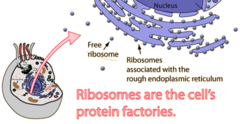
bound ribosomes
attached to ER or nuclear envelope; translates proteins and exports things

smooth ER
Without ribosomes: makes lipids and cleans toxins

rough ER
Covered in ribosomes: makes, folds, and checks proteins

golgi apparatus
Processes, sorts, and packs proteins & lipids

lysosomes
(animal cells only) vesicles from Golgi that break down waste

peroxisomes
animals: breakdown H202, fatty acids, AAs; plants: modify by-products of photosynthesis
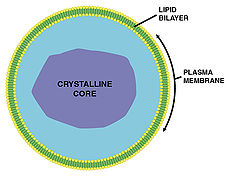
mitochondria
carry out cellular respiration; two membranes allow separation of metabolic processes

chloroplasts
(plant cells only) carry out photosynthesis; two membranes

microtubules
Cytoskeleton, helps cell maintain its structure

intermediate filaments
support for cell shape
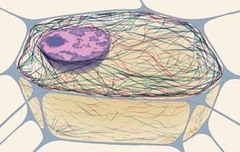
microfilaments
made of protein actin; found in cells that move by shape change, e.g. muscle cells; cell motility

flagella
long, few, snake-like mvmnt; 9+2 microtubule
EX: sperm

cilia
short, many, back-and-forth mvmnt; 9+2 microtubule
EX: line respiratory tract

centrioles
(animal cells only) organizes cell and guides cell division

transport vesicles
move materials between organelles

food vacuoles
receive nutrients; usually merge with lysosomes

contractile vacuoles
collect and pump water in cell

central vacuoles
(plant cells only) contain most of plant cell interior; exert tugor when full for cell rigidity; functions specialized:
1) store starch, nutrients, waste, etc.
2) lysosome function
3) cell growth by absorbing H20
4) renders large SA-to-V ratio

cell walls
(plant cells only) support

extracellular matrix
(animal cells only) mechanical support, helps bind adjacent cells

cell junctions
anchor cells together for cellular exchange

anchoring junctions
(animals) protein attachments between cells
EX: desmosome

tight junctions
(animals) seal that prevents cellular exchange

communication junctions
allow chemical and electrical signal passage

gap junctions
narrow tunnels; basically channel protein allowing 2 animal cells to communicate

plasmodesmata
(plants) (communication) narrow tunnels; like gap junctions

prokaryotes
plasma membrane, DNA, ribosomes, cytoplasm, cell wall

hypertonic
solute hypertonic to solution=higher [solutes]
![<p>solute hypertonic to solution=higher [solutes]</p>](https://assets.knowt.com/user-attachments/fe026c9b-9b54-4eef-ba31-e1bfc2fe07de.jpg)
hypotonic
Lower concentration of solutes, water flowing into cell causing it to swell

isotonic
Letting in and out equal amount of solute and water

bulk flow
collective movement in response to pressure

passive transport
[higher] to [lower]; increases w/ increase in [x], temp., smaller particle size
![<p>[higher] to [lower]; increases w/ increase in [x], temp., smaller particle size</p>](https://assets.knowt.com/user-attachments/948864d0-2577-4ef7-9a75-6a7510efbb13.jpg)
diffusion
random mvmnt leads to net mvmnt from [high] to [low]
![<p>random mvmnt leads to net mvmnt from [high] to [low]</p>](https://assets.knowt.com/user-attachments/98dda741-1a6f-4dd6-8fd1-50aa84be598b.png)
osmosis
diffusion of water across selectively permeable mmbrn

turgor pressure
osmosis into cell

plasmolysis
osmosis out of cell

cell lysis
swelling of cell b/c excess turgor pressure

facilitated diffusion
diffusion through channel or carrier proteins

active transport
[lower] to [higher]; requires use of E (usually ATP)
![<p>[lower] to [higher]; requires use of E (usually ATP)</p>](https://assets.knowt.com/user-attachments/056ce9e2-c3d0-46dc-b9ae-f93bc9b1ea33.jpg)
electrochemical gradient
combo. of concentration and electrical voltage gradients of ions

cotransport
active transport, move 2 diff substaces across cell membrane at same time

vesicular transport
uses vesicles to move substances across plasma mmbrn

exocytosis
fuse w/ membrane, release contents outside cell

endocytosis
capture substance outside cell, fuse w/ membrane, release contents into cell; 3 types: phagocytosis, pinocytosis, receptor-mediated

phagocytosis
cellular eating; undissolved material enters cell; forms phagocytic vesicle

pinocytosis
cellular drinking; dissolved material enters cell; forms liquid vesicle

receptor-mediated endocytosis
specific molec. (ligands) binds to site, resulting in pinocytosis
