Unit 4: Persia and Greece Review Guide
 Call Kai
 Learn
 Practice Test
 Spaced Repetition
 Match
 Flashcards
1/63

Earn XP
Description and Tags
Vocabulary practice flashcards covering Persian governance and culture, early Greek civilizations, Athenian democracy and Spartan militarism, the Persian Wars, the Athenian Golden Age, and Greek contributions to science, philosophy, and art.
64 Terms
Avesta
The holy book of Zoroastrianism.
Cyrus the Great
Persian ruler known as a tolerant ruler and military genius.
Darius I
Persian leader who created the imperial bureaucracy, the Royal Road, and the capital of Persepolis.
Imperial Bureaucracy
A government structure that is organized and divided into local provinces.
Royal Road
An extensive Persian road network used for trade, communication, and military defense.
Satrap
A royal governor of a province in the Persian Empire.
Tolerance
The acceptance of other religions, languages, and customs; the core policy used by the Persians in their political and social governance.
Xerxes
Persian leader who launched an invasion of Greece and lost against the Greeks.
Zoroastrianism
Persian monotheistic religion founded by the prophet Zoroaster.
Dorians
A less advanced group that took over the Mycenaeans in ancient Greece.
Greek Gods
Polytheistic deities rooted in myths that explained natural phenomena and represented shared Greek religious culture.
Homer
The blind Greek poet credited with composing the epic poems the Iliad and the Odyssey.
Iliad
An epic story composed by Homer recounting the events of the Trojan War.
Minoans
Early civilization regarded as the first Greeks, known for artistic themes of bull leaping, myths, and water-based activities.
Mycenaeans
Civilization that replaced the Minoans, settled mainland Greece, and fought in the Trojan War.
Myths
Traditional stories handed down through generations that explain natural phenomena and describe the actions of gods and heroes.
Odyssey
An epic adventure story composed by the poet Homer.
Trojan War
The legendary conflict fought between the Mycenaeans and the city of Troy.
Citizen
Individuals with recognized legal and political rights within a society.
Cleisthenes
Athenian reformer who expanded political participation by granting citizenship to all free Athenian men.
Direct Democracy
A system of government characterized as rule by the people, in which citizens vote directly on laws and policies.
Draco
Athenian tyrant who codified harsh laws featuring severe punishments for offenses.
Monarchy
A form of government featuring a single ruler holding all governing power.
Oligarchy / Aristocracy
A system of government characterized by the rule of a small, wealthy group of elite men.
Polis
The Greek term for an independent city or city-state.
Solon
Athenian leader who outlawed and abolished debt slavery.
Tyrant
A leader who seizes political power illegally.
Helots
State-owned slaves in Spartan society.
Militarism
The glorification and prioritized development of military power.
Olympic Games
Athletic competitions held periodically between rival Greek city-states.
Peloponnese
The large peninsula located on mainland Greece that was home to city-states like Sparta.
Athens
Greek city-state characterized by direct democracy, an economy based on trade, formal school for boys, and domestic education for girls.
Sparta
Militaristic Greek city-state governed by an oligarchy, with an economy based on farming and conquest, schooling for girls, and boys beginning military training at age 7.
Delian League
An alliance formed during the Persian War era between Athens and its allied city-states.
Herodotus
Greek historian who wrote the detailed historical accounts of the Persian Wars.
Peloponnesian League
A mutual defense alliance formed by Sparta and its allied Greek city-states.

Phalanx
A tight Greek battle formation of soldiers lined up closely side-by-side with overlapping shields and forward-pointing spears.
Battle of Marathon
An early Persian War engagement in which Greece defeated the Persian invading force.
Battle of Thermopylae
Persian War conflict at a narrow mountain pass where Persia defeated the defending Greek forces.
Battle of Salamis
A decisive naval battle during the Persian Wars in which the Greek fleet defeated Persia.
Battle of Plataea
A major land battle of the Persian Wars in which Greek forces secured victory over Persia.
Acropolis
A fortified hilltop located at the top of a Greek city that housed temples and government buildings.
Alexander the Great
Macedonian military commander and ruler who established the largest empire for Macedonia.

Corinthian Column
A classical architectural column style characterized by elaborate, highly decorated with intricate designs.
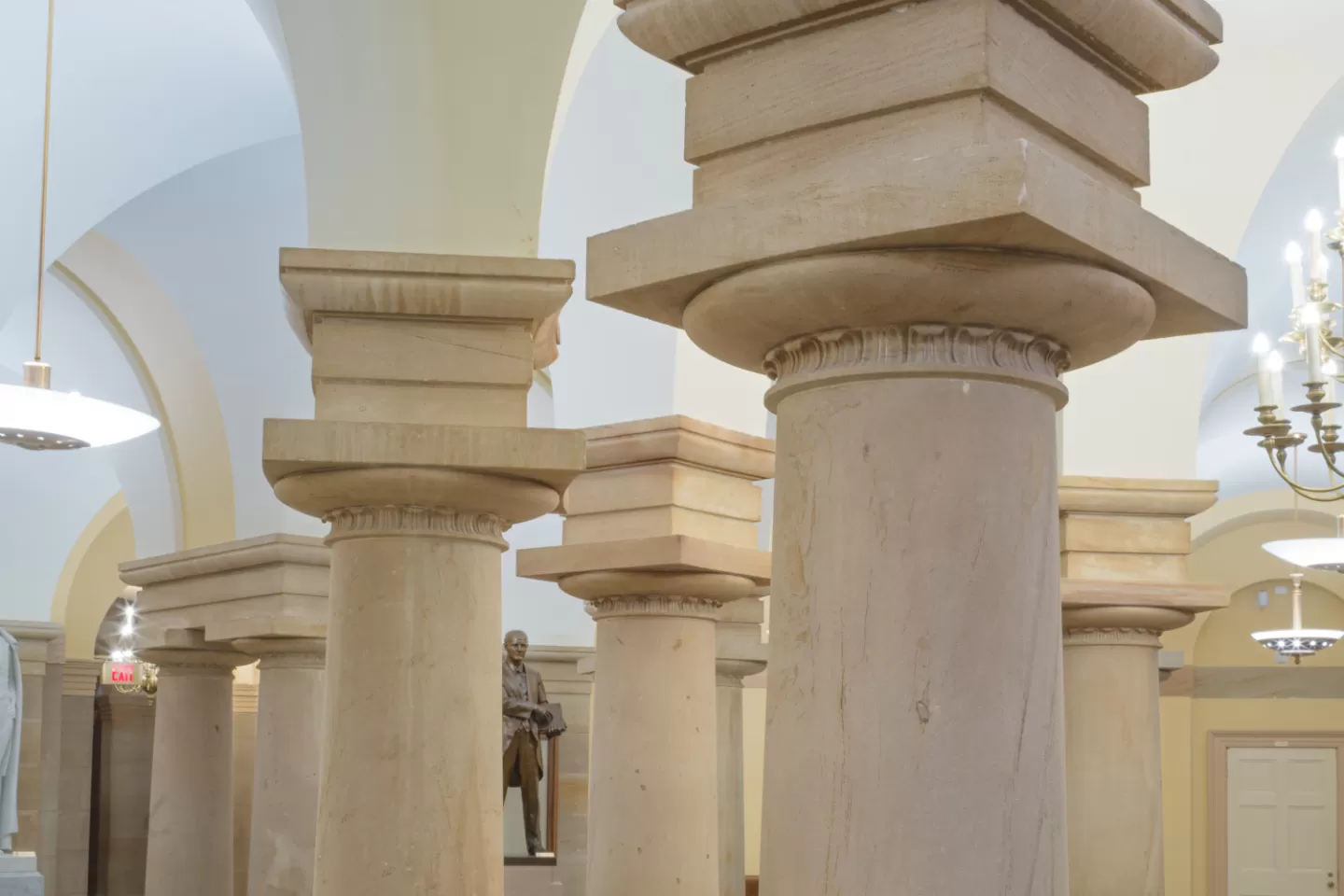
Doric Column
The simplest and plainest of the classical Greek architectural column styles.

Ionic Column
A classical architectural column style featuring distinctive spiral scroll motifs at the top.
Golden Age
A historical time period characterized by exceptional cultural, political, and artistic success and achievement.

Parthenon
The premier temple dedicated to the goddess Athena, located on the Athenian Acropolis.
Pericles
Prominent Athenian statesman and general who led Athens during its Golden Age.
Phillip II
King of Macedonia who led the invasion and conquest of Greece.

Archimedes
Greek scientist and mathematician recognized as the father of simple machines, such as the lever and pulley.

Aristarchus
Greek astronomer who developed the heliocentric model of the universe, arguing that the Earth revolves around the Sun.

Aristophanes
Ancient Greek playwright celebrated for writing comedic theatrical plays.
Aristotle
Greek philosopher who studied under Plato and served as the personal tutor to Alexander the Great.

Euclid
Greek mathematician renowned for writing foundational works on geometry.
Hellenistic Culture
The cosmopolitan blend of Greek, Persian, Indian, and Egyptian cultural traditions, knowledge, and ideals.

Hippocrates
Greek medical pioneer widely revered as the father of modern medicine.
Phidias
Famous Greek artist who sculpted the renowned statue of Athena.
Plato
Greek philosopher, student of Socrates, and author of The Republic, in which he described an ideal society.

Ptolemy
Ancient astronomer who formulated the geocentric model of the universe, proposing that the Sun moves around the Earth.

Pythagoras
Greek mathematician credited with developing the Pythagorean theorem: a2+b2=c2.
Socrates
Greek philosopher who challenged people to question their assumptions by asking "why"; he was subsequently condemned and sentenced to death.

Sophocles
Athenian playwright known for composing renowned dramatic works and tragedies.

Thucydides
Greek historian who documented the events of the Peloponnesian War.