Principles of Ecology (chpt 38)
 Call Kai
 Learn
 Practice Test
 Spaced Repetition
 Match
 Flashcards
 Knowt Play
1/38

There's no tags or description
Looks like no tags are added yet.
39 Terms
Ecology
Study of interrelationships of plants and animals w each other and w their environment
Ecosystem
Organisms and their interactions with their environment
Biosphere
All parts of earth where life exists
Regions: lithosphere (land), hydrosphere (water), atmosphere (air), cryosphere (ice)
Habitat
Place where a species lives
Aboitic factors
Non-living features of the environment: climate factors (macro and micro), edaphic (soil)
Climatic Factors
Influence of prevailing weather conditions. Macroclimate; global or regional, microclimate; small habitat eg. log or cave
Macroclimate
Light intensity: eg. daisies only grown in strong light exposure, like lawn, but bluebells can photosynthesise w little light, like woodland
Temperature: Important in controlling rate of chemical reactions. Temperatures in air fluctuate more than in water as able to retain heat, therefore organisms in water less tolerant to heat changes. Effects solubility of gases in water also, increase in water temp, decrease in solubility of gases
Exposure
Day length
Rainfall
Wind speed
Salinity
Wave action
Humidity
Edaphic factors
Abiotic factors relating to soil
pH: acidity/alkalinity of soil affects availability of nutrients to plants
Mineral content: determined by underlying bedrock
Water content
Humus
Porosity
Air content
Soil type
Biotic factors
Influences of living organisms on each other
Feeding
Disease
Pollination
Nitrogen-fixing bacteria
Decomposers
Energy flow
Law of conservation of energy states energy cannot be created or destroyed but only changed from one form to another
Main source of energy is the sun (1% trapped in plants)
As energy passes from one organism to the next, about 90% is used/lost as heat, excretion, and egestion or used in growth and respiration. Only 10% assimilated
Producers (Autotrophs)
Chemosynthetic: make own food using chemical energy, eg. nitrifying bacteria in soil and bacteria in deep-sea volcanic vents
Photosynthetic: make food from light
Consumers (Heterotrophs)
Herbivores: Eat producers, mainly plants (Primary consumers). Ridged teeth to crush grass, long intestines to digest it, with aid of bacteria to break down cellulose. Produce methane
Carnivores: Eat herbivores and other carnivores (ie mainly meat)
Omnivores: Eat both plants and animals and have adaptations intermediate of the two
Detritus feeders: Eat remains of dead plants and animals, eg. dugesia in ponds, woodlice/worms in forest
Decomposers: Break down dead plants and animals into basic components by extracellular digestion, eg. fungi and bacteria
Food Chain
Feeding relationship between plants and animals (and microorganisms)
Trophic levels
Position of an organism in a food chain
Trophic Levels:
Primary producers (usually green plants)
Herbivores (primary consumers) eat first trophic level species
Carnivores (secondary consumers eat herbivores in second trophic level
Carnivores (tertiary consumers) eat carnivores in third trophic level
Food web
Two or more interconnected food chains
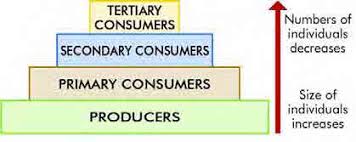
Pyramid of numbers
Chart showing number of organisms at each trophic level
Limitations:
If organism is very large, eg. oak tree, one tree may house thousands of greenfly → inverted pyramid
Parasites create parasitic pyramid
Niche
Functional role of an organism in its habitat
Nutrient recycling
Movement of essential elements from abiotic environment into living organisms and then returning to the abiotic environment to be used again
Carbon cycle
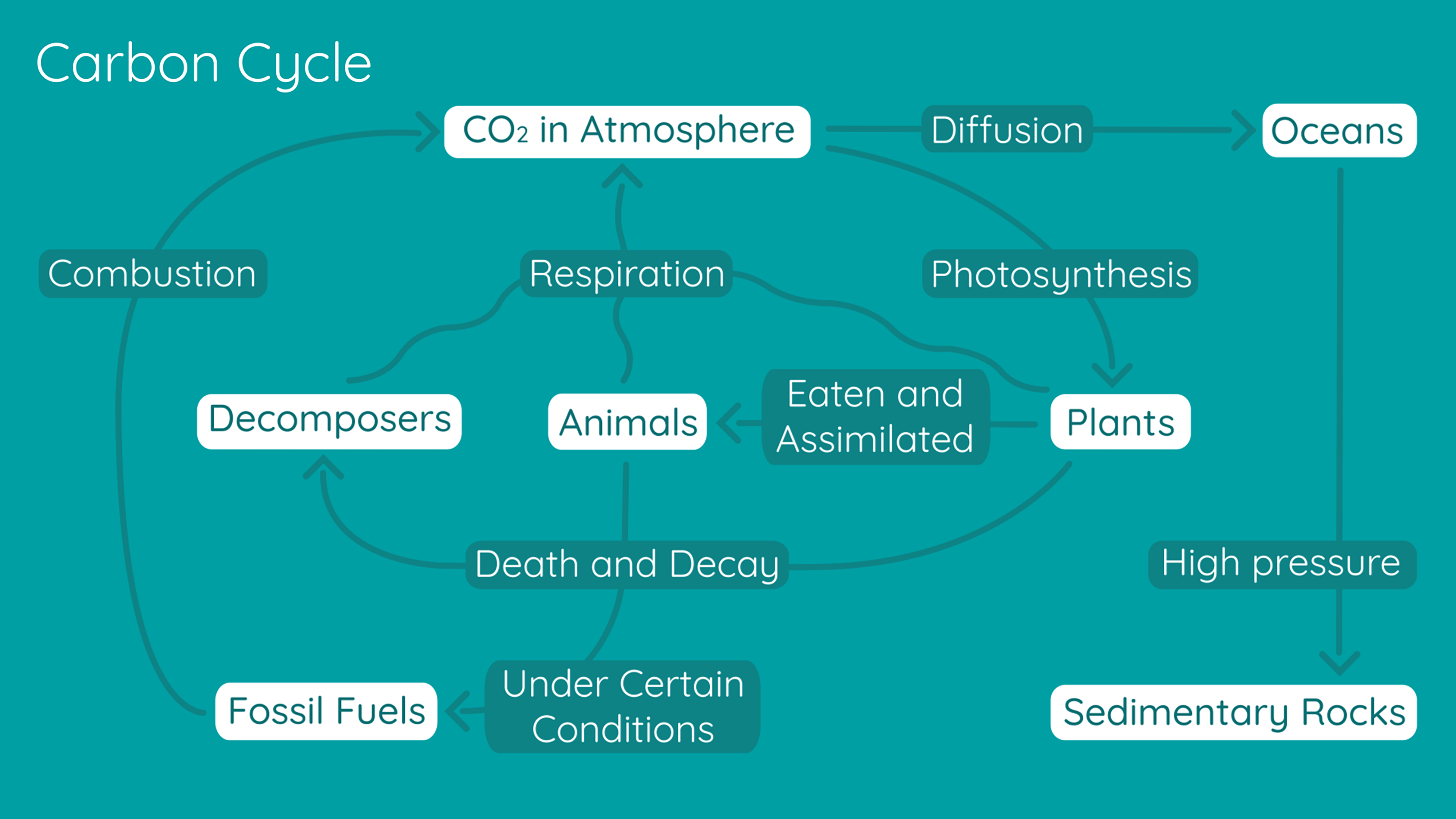
Concentration of CO₂ is 0.03%. Sea acts as buffer for CO₂ concentration by dissolving it at night when concentration rises and releasing it during day when it drops
Plants → (animals) → dead matter → respiration in microorganisms/carbon in fossil fuels → CO₂ in atmosphere
Nitrogen cycle
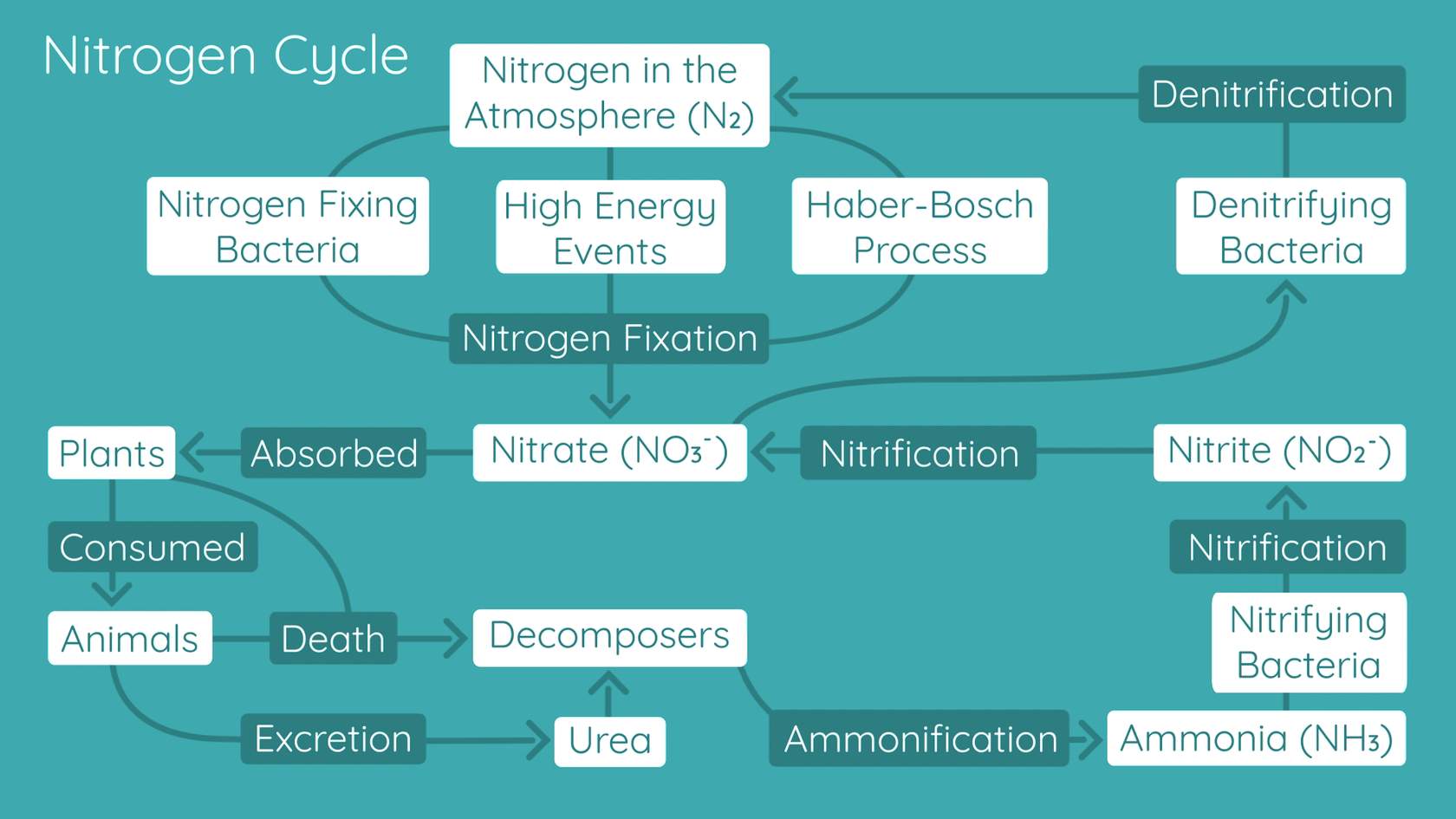
Atmosphere: 80% nitrogen in form of N₂ gas
To be available to plants and animals needs to be converted into nitrates NO₃⁻ which can be absorbed. Occurs by action of nitrogen-fixing bacteria and lightning. Also artificially by humans by Haber process
Nitrates enter soil in rain, absorbed through roots. Used to produce proteins → assimilated into animals when plants are eaten
some nitrogen lost in excretion mainly in form of urea. When plants and animals die, decomposed by bacteria and fungi, nitrogen-containing compounds found in bodies converted to ammonia
Ammonia converted to nitrites NO₂⁻ by bacterial action → nitrification. Nitrites are toxic to plants so not absorbed. Nitrites converted to nitrates by other bacteria (also nitrification)
In soil, chemosynthetic bacteria break down nitrates releasing nitrogen gas back into atmosphere and completing cycle → denitrifying bacteria (most live in stagnant waterlogged soil
Biodiversity
Large variety of organisms in an ecosystem
Pollution
Any harmful addition to the environment
Conservation
Wise management of existing resources to maintain existing populations
Conservation Practises:
Agriculture: Slurry is very rich in nutrients and used as fertiliser, should only spread in dry weather and no closer than 10m from watercourse → prevents run-off into water courses, preventing eutrophication
Fisheries: Setting minimum mesh size allows young immature fish to escape netting and reach breeding age. Prevents depletion of fish stocks. Can also be augmented by applying quotas of endangered commercial species
Forestry: Removal of biological material from woodland on a regular bases can result in ground becoming depleted in nutrients. To prevent this, fallen or cut leaves and branches should be left to rot naturally on forest floor. Maintains constant supply of nutrients for trees
Eutrophication
Excess plant growth caused by excess nutrients. When nutrients run out, algae that has grown dies and rots due to bacterial action. These bacteria use up all the oxygen in water, killing most of animal life it contains. Slurry also contain pathogens, eg. cyrptosporidium, which can infect people and animals
Waste management
Main ways to dispose of waste: landfill and incineration
Problems w waste disposal:
Vermin: Waste attracts vermin, eg. rats and gulls. Rats carry disease (eg. Weil’s disease) and destroy food and property. Gull’s droppings also carry disease and are problem near airports, where bird strikes can cause damage to planes
Odours; rubbish dumps have pervasive odours which are unpleasant for those that live nearby
Contamination: Waste can contaminate groundwater when unsuitable items are left at dumps. Batteries contain heavy metals, eg. lead and cadmium, can leach into groundwater
Toxic products: Burning rubbish reduces bulk in landfill sites, heat produced through burning can be used to heat local houseing, or treat other waste to make it biologically safe, however some products of incineration, eg. dioxins, can be toxic or carcinogenic
Importance of waste minimisation
Reduce: Amount of waste, especially packaging. Can be reduced by choosing to buy items w less packaging
Reuse: Packaging, eg. plastic bags, or by bringing reusable shopping bags to supermarket. Results in saving financially and helps conserve valuable resources
Recycling: Collecting materials and using them again for same purpose or modifying them for different purpose, eg. recycled plastics are washed, shredded and reused to make other products
Role of Microorganisms in Waste Management and Pollution Control
Sewage treatment: Sewage made safe by biological oxidation using microorganisms to break down organic waste and destroy pathogens. Remnants are then composted or heat-treated before spread on land as fertiliser or disposed of in watercourses/sea (tightly controlled by legislation)
Bioremediation: Uses microorganisms to remove pollution and allow area to revert to its unpolluted state. eg. oil spills, deactivating pesticides, converting mercury or arsenic to non-toxic forms
Competition
Struggle between organisms for resources that are in short supply
Intraspecific competition: competition between members of same species
Interspecific competition: competition between different species (harder to demonstrate as each species has own particular niche and only partially overlap → tends to be short-lived
2 types of intraspecific competition
Contest competition: winner takes all and as a result has excellent chance of survival and producing offspring. Loser is marginalised to poorer areas of habitat. As a result, loser may not survive or will have difficult time rearing offspring successfully. Usually for the right mate, or for territory
Scramble competition: each individual gets some of the resource without direct physical confrontation w other members of species. Works as long as resources are not very scarce. If resources become scarce, can result in population crash as no individual will get enough to support reproduction and survival. eg. Lackey moth caterpillar. Concregate in what look like spiderwebs on blackthorn/hawthorn bushes.
Role of competition
Controls population size by ensuring least members get enough resources
Only fittest and best adapted to environment will survive
Results in natural selection, and therefore evolution
Adaptation
Any change in the behaviour or structure of an organism that makes it better suited to its environment
Types of Adaptation
Behavioural
Plants: grow towards light, fast growing, deep roots to find water and minerals, etc. eg. bindweed twines around plants to grow upwards quickly without need for supportive tissue
Animals: Birds singing to deter other birds, rooks fly in flocks to make it more difficult for predators to catch them, frogs bury in mud in bottom of ponds in harsh weather
Structural
Plants: Hawthorn and gorse bushes have thorns to deter browsers, nettles have stings to achieve same, pea pods burst open to scatter seeds
Animals: Snails grow shells to protect against predators and adverse weather, peacock butterfly has eyes on wings to startle predators
Colouration
Plants: Bright colours attract pollinators, grow leaves that look like they have been damaged by insects/disease
Animals: Wasps have yellow and black stripes to warn they are dangerous (aposematic colouration), other animals blend into surroundings, eg. woodcock (cryptic colouration)
Prey
Animal that is caught and killed for food
Predator
Organism that catches and kills animal for food
Predation
Act of catching and killing animal for food
Symbiosis
Close relationship between two species, where at least one of the species benefits
Types of Symbiosis
Parasitism: One species benefits, other is harmed. Species that benefits is the parasite, species that suffers is the host
Mutualism: Both species benefit, eg. bacteria that produce vitamins B and K
Commensalism: One species benefits while other is neither harmed nor benefits, eg. bird in tree, barnacles
Population Dynamics
Study of changes in populations and factors that cause these changes
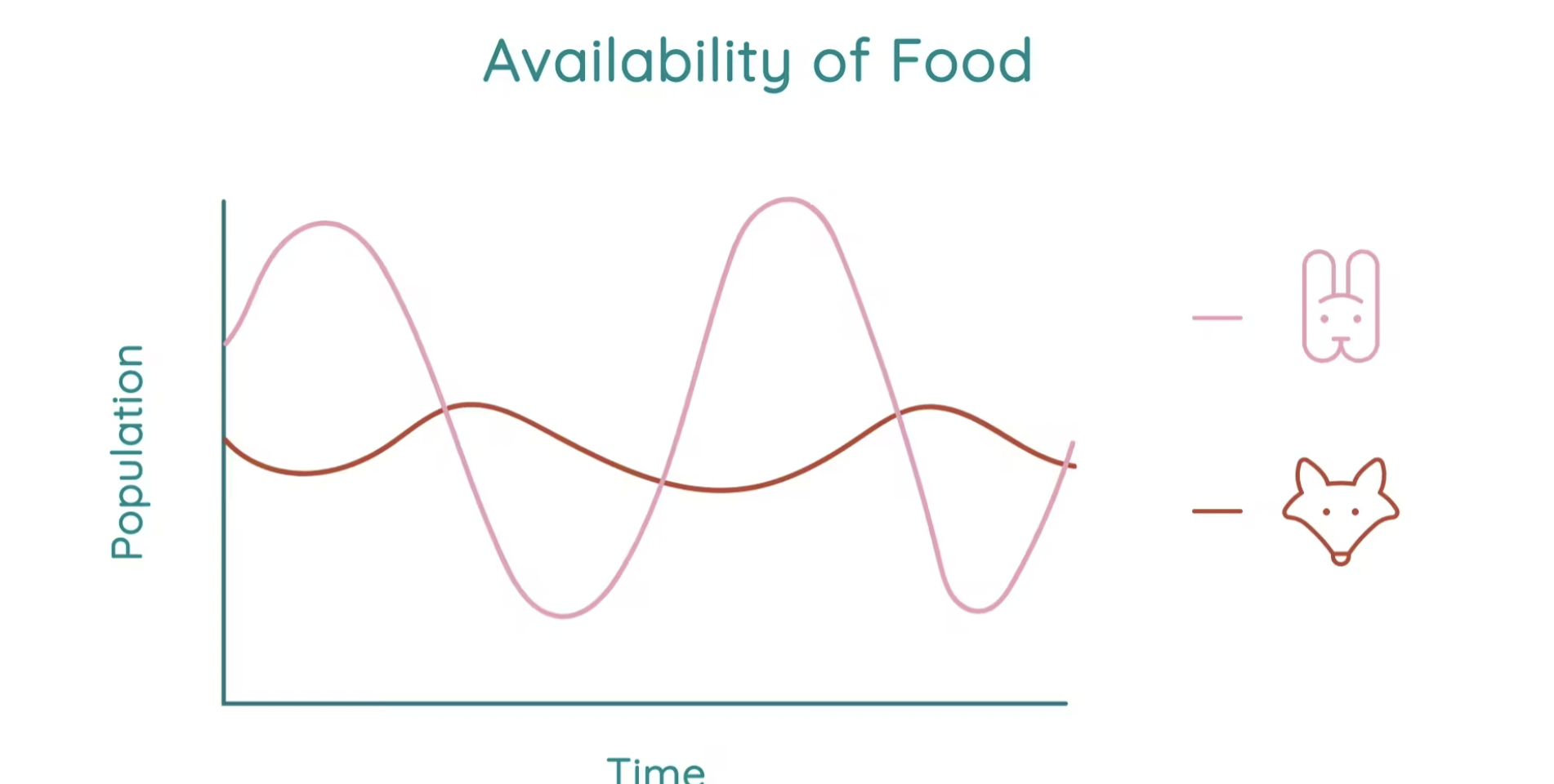
Predator-Prey Relationship
Plenty of food, herbivores thrive and rapidly multiply. Predators are less abundant, however w plenty of available food, predator population grows rapidly also. Will eat all prey except a few, both populations crash. Cycle repeats
Factors Affecting Human Population
War: In particular regions have marked impact, but globally, effects are less
Diseases: both infectious (no physical contact) and contagious (physical contact required) play significant roles. Epidemic is large number of people in given population in short period of time. Pandemic is a disease outbreak across a continent or world. Study of spread of diseases is epidemiology
Famine: Sever and prolonged lack of food in widespread area, often followed by regional malnutrition, starvation and epidemics, resulting in increased mortality
Contraception and Improved Education: Helps to control population growth, particularly in developed nations