Ch. 04 Immunology
 Call Kai
 Learn
 Practice Test
 Spaced Repetition
 Match
 Flashcards
 Knowt Play
1/93

There's no tags or description
Looks like no tags are added yet.
94 Terms
Antibody
Secreted form of B cell antigen receptor
recognizes protein/carb antigens by disabling or rendering it susceptible to destruction
where are antibodies located
blood, lymph, on mucosal surfaces
Antibody specificity
each antibody binds to one antigen or a few structurally related antigens
Antibody diversity
recognition of enormous range of antigens
Immunoglobulin
general name for antibodies and B-cell antigen receptors
Naive mature B cells
resting B cells that express membrane-bound immunoglobulin before encountering antigens
Plasma cells
effector B-lympocytes that produce/secrete antibodies during an immune response
Clonal selection
Antigen stimulates B cells to proliferate/differentiate into plasma cells
Agammaglobulinemia
Unable to make antibodies
renders high susceptibility to certain types of infection
How is Agammaglobulinemia caused?
a critical kinase, BTK, on the X chromosome is defective
B-cell to plasma cell pathway
Mature naive resting B cell encounters an antigen → stimulates it → gives rise to antibody-secreting plasma cells
Antibody composition
Polypeptides with variable and constant regions
Carbs attached to heavy chain portion
Heavy chains
2 identical 50 kDa polypepyides forming stem and parts of the Y arms
Light chains
two identical 25 kDa polypeptides paired with heavy chains in each arm
Variable regions
domains with sequence diversity that determine antigen specificity
VH
Variable region of the heavy chain
VL
Variable region of the light chain
Constant regions
Domains with limited variation providing structural stability and effector function
CH
Constant region of the heavy chain
CL
Light chain constant region
Antigen-binding site
Region in variable area that binds to antigen and determines specificity
Isotypes of immunoglobulins
differences in heavy-chain constant regions, each with distinct functions
List of isotypes in heavy chain
IgG (γ)
IgM (μ)
IgD (δ)
IgA (α)
IgE (ε)
Light-chain isotypes list
Kappa and lambda

What are the differences in heavy chain isotypes?
length of heavy chains, locations of disulfide bonds, hinge regions in IgG, IgA, and IgD (not IgM and IgE)
carbohydrate group distribution

Differences in light-chain isotypes?
No functional differences
Every antibody has either kappa or gamma light chains, never both
varies with animal species
Membrane bound immunoglobulins occur as what -mers?
all isotypes occur as monomers
Soluble immunoglobulin monomers
IgD, IgE, IgA, and IgG
Soluble immunoglobulin dimers
IgA
Soluble immunoglobulin pentamers
IgM
IgG molecule can be dissected into
2 Fab fragments and 1 Fc fragment
How is a IgG molecule dissected
protease cleaves hinge of each heavy chain
reducing agent breaks disulfide bonds connecting the hinges
Fab fragment
Fragment antigen binding
Arm portion of antibody containing antigen-binding site
Fc fragment
fragment crystallizable
stem portion mediating effector functions through receptor and protein binding
Flexible hinge region
bendable part of antibody that connects two antigen-binding arms to stem
What does flexible hinge region allow
allows antibody to bind with both arms to many different antigen arrangements
Immunoglobulin-like domains
Structural motifs found in many immune proteins beyond antibodies
Immunoglobulin superfamily
group of cell-surface and secreted proteins sharing immunoglobulin-like domain structures
Each Fab and Fc fragment is made up of
4 immunoglobulin domains
Each Fab/Fc fragment makes
similarly shaped globular structure
Light chain C domain structure

Light chain V domain structure

Hypervariable regions
short segments in VH and VL domains where amino acid sequence diversity is greatest
Framework regions
conserved sequences that flank hypervariable regions and maintain variable domain structure
Complementarity-determining regions
Hypervariable loops that form surfaces complementary to antigen structure
Three hypervariable regions
HV1, HV2, HV3 aka CDR1-3
different amino acid sequences
surrounded by four framework regions on both sides (FR1-4)
Antigen
triggers an immune response
Antigenic determinant (epitope)
part of antigen where an antibody binds
can be linear or discontinuous
Multivalent antigen
antigen with multiple epitopes
can have either different or repeated epitopes
Affinity
Binding strength of an antibody determined by shape and chemical complementarity of the antigen-binding site to the epitope
Antiserum
Contains antibodies against immunizing antigen and any contaminating macromolecules
Polyclonal antiserum
blood serum containing differently specified antibodies
Immunizing antigen/Immunogen
Antigen used to induce an immune response and antibody production during immunization
hybridoma
Hybrid cell formed by fusion of an antibody-producing B cell from an immunized mouse with an immortal myeloma cell
Monoclonal antibodies
Identical antibodies from single hybridoma clone, specific to one epitope
Made in 1980
Eliminate many diseases
Flow cytometry
analytical technique that detects and classifies cells based on labeled antibody binding to their surface molecules
How is a mouse monoclonal antibody made
Myeloma cells fuse with antigen-immunized mouse B cells
Fused cells are grown in drug-infused medium which kill myeloma and unfused lymphocytes
Hybridoma which makes the right antibody is selected for and cloned to make a large culture

Immunoglobulin is first made in
membrane-bound form on B-cell surface
Secreted antibodies are made by
alternative pattern of heavy-chain RNA processing
Antibodies with different constant regions
have different effector functions
Naive B cells express
IgM and IgD on surfaces
Naive B cells have
the same light chains and same heavy chain V region
1 Antigen specificity
Ig-alpha and Ig-beta
Transmembrane proteins that pair with immunoglobulin to form a complete B-cell receptor complex
disulfide-linked complex
What do the cytoplasmic tails of the Ig-alpha and Ig-beta proteins do
Interact with intracellular signaling proteins that signal B cells to divide/differentiate
How does the disulfide-linked complex interact with the immunoglobulin
Can help it transport it to the B cell surface from the Endoplasmic reticulum lumen
Functional B cell receptor composition
Immunoglobulin
Hydrophobic transmembrane sequence
Ig-alpha and Ig-beta disulfide complex next to the receptor outside the cell
Cytoplasmic portion (short for the actual receptor, long tails for Ig-alpha and Ig-beta proteins)
After antigen encounter, what do B cells do
Antibodies are produced by an alternative pattern of heavy-chain RNA processing
Heavy chain IgM
μ
IgD heavy chain
ẟ
IgM
Most common class of antibody made as a response to an antigen
neutralizes and agglutinates antigen, activates complement

IgD
Important as an antigen receptor on B cells
neutralizes and agglutinates antigen

IgG
Most common class of antibody in the blood
major class produced in secondary responses
crosses the placenta for fetal/newborn immunity
neutralizes/agglutinates/opsonizes antigen
activates complement
enhance NK cell activity

IgE
Involved in allergies such as hay fever
neutralizes/agglutinates antigen
binds to mast cells and basophils, which causes histamine release

IgA
Crosses epithelial cells
present on mucosal surfaces and breast milk
imprtant for newborn immunity
neutralizes/agglutinates antigen
Neutralization
antibodies block pathogen activtity
Agglutination
Multiple pathogens are aggregated by antibody molecules
Opsonization
Pathogens bound by antibodies to be more efficiently phagocytized
Complement activation
Antibodies bound to pathogens activate complement cascade to lyse the cell
Enhanced NK cell activity
Abnormal body cells are bound to be recognized by NK cells and lysed.
Pentameric IgM
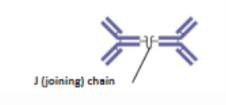
5 IgM monomers are cross-linked to each other and a J chain polypeptide via disulfide bonds
allows for strong binding to repetitive epitopes
Monomeric IgA
made by plasma cells in lymph nodes, spleen, and bone marrow
secreted into blood
Dimeric IgA
Two monomers joined by a J chain
made in lymphoid tissues under mucosa
secreted into gut lumen
Also in milk, saliva, sweat, tears
FcεR receptor
high-affinity that binds IgE in the absence of antigen, present on mast cells in epithelium, eosinophils at mucosal surfaces, and basophils in blood
What happens when antigen binds to cell-surface IgE on Mast cells, eosinophils, and basophils
strong physical and inflammatory reactions that expel and kill infecting parasites
What are IgE major effects in its response in countries with a low amount of parasite infections
allergies and asthma
IgG flexibility
small size and flexibility allow it to access antigens in extracellular spaces of damaged and infected tissues
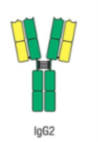
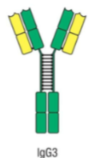
How do the subclasses of IgG differ?
Relative length of hinge and number of disulfide bonds in that hinge
IgG1

IgG2
IgG3
IgG4

In circulation IgG4 molecules can
exchange one heavy chain + light chain combination, allowing it to have two different antigen binding sites, and interact with a pathogen/antigen through one binding site