4.1 - Evolution
 Call Kai
 Learn
 Practice Test
 Spaced Repetition
 Match
 Flashcards
 Knowt Play
1/32

There's no tags or description
Looks like no tags are added yet.
33 Terms
Purpose of classification
Species
Group of organisms that are able to breed to produce fertile living offspring
Allows scientists to
Identify new species
Study evolutionary relationships
Understand shared traits and adaptations
Share research globally to identify links with organisms
Hierarchical taxonomic system
Order (King Philip came over for grape soda)
Domain
Kingdom
Phylum
Class
Order
Family
Genus
Species
Domains
Bacteria, archaea, Eukarya
Eukarya includes all eukaryotes
Plantae, animalia, Protoctista, fungi
Nomenclature
Consists of the genus (uppercase first letter) and species (all lowercase)
Underlined when written down
Five kingdom system: plantae
Eukaryotic
Multicellular
Contain nucleus and other membrane bound organelles
Cell walls made of cellulose
Autotrophic
Store sugar as starch
Spores or seeds as reproduction
Five kingdom system: Animalia
Eukaryotic
Multicellular
Nucleus and other membrane bound organelles
No cell walls
Store sugar as glycogen
Variable reproduction
Five kingdom system: Prokaryote
Unicellular
No nucleus or membrane bound organelles
Cell walls of peptidoglycan
Autotrophic, heterotrophic or parasitic
Store sugar as glycogen
Binary fission
Five kingdom system: Protoctista
Eukaryote
Unicellular or simple multicellular
Nucleus and other membrane bound organelles (like chloroplasts sometimes)
Variable cell walls
Autotrophic, heterotrophic or parasitic
Variable storing of sugar
Variable reproduction
Five kingdom system: Fungi
Eukaryotic
Unicellular or multicellular with a body made of hyphae
Present but with no chloroplast
Cell wall of chitin
Saprophytic - absorb organic nutrients from dead matter
Glycogen
Spores
Three domain system
Older systems became outdated when new molecular and genetic data arose
Proposed 6 kingdoms instead of five
Split prokaryote into two kingdoms
Eubacteria and archaebacteria
Domain bacteria
Contains eubacteria only
Prokaryotic unicellular organisms
Distinct cell membrane lipids
Have peptidoglycan/murein in their cell walls
Unique RNA polymerase enzymes
Domain archaea
Contains the kingdom archaebacteria only
Prokaryotic unicellular
Have histones so gene and protein synthesis is more similar to Eukarya
No peptidoglycan in cell walls
Different cell membranes that contain fatty acids bound to glycerol by ether linkages
Have a more complex from of RNA polymerase than bacteria
Domain Eukarya
Contains four kingdoms from the five kingdom system
All nuclei and membrane bound organelles
Phylogeny
Classification based on evolutionary relationships between organisms and ancestors
Advantages
Produces a continuous tree that doesn’t force organisms into specific taxonomic groups
No overlap between the groups produced
Map evolutionary relationships between organisms and histories
Relative positions of branching points show distance of shared common ancestors
Relative distances between vertical lines shows closeness of species' evolution from common ancestral branches
Proximity of species shows closeness of evolutionary relationships
Improved approaches to classification
Artificial classification groups organisms based on differences that are physical
These features can misrepresent true evolutionary relationships
Sharks are fish while dolphins are mammals
Modern taxonomy
Uses more
Molecular comparisons
DNA and amino acids
Development studies
Comparisons of embryonic similarities
Anatomical examinations
Species' physical features
Behavioural analyses
Fossils for evidence of evolution
Fossil records
Palaeontology involves examining organisms preserved in rock layers
Key evidence
Simple bacteria and algae fossils are found in the oldest rocks
More complex vertebrates in newer rocks
Plant fossils appear before those of animals that feed on these plants
Natural order of evolution
Why is it incomplete
Many fossils decompose before fossilisation
Often uncommon and require specific conditions
Many fossils lost due to erosion
Many organisms have not yet been discovered
Certain organisms are less likely to fossilise (softer bodies)
Comparative anatomy for evidence of evolution
Examines anatomical structure of different living species
Evidence
Homologous structures are physical features in different species
May have similar structure but different functions
Organisms who share homologous structures likely evolved from a common ancestor
Adapted for different functions
Homologous structures are evidence for divergent evolutions
Organisms evolve different traits as they occupy new niches
Comparative biochemistry for evidence of evolution
Useful molecules
Cytochrome C
Conserved protein used in cellular respiration
Ribosomal RNA
Integral in protein synthesis
Changes slowly so can find species that diverged long ago
Nuclear, mitochondrial and chloroplast DNA
Species more closely related will have more similar DNA sequences
Messenger RNA
Bases of mRNA are complementary to DNA
Can assess DNA diversity
Amino acids
Hypothesis of neutral evolution
Most variability in a molecules structure does not affect its function
Useful
Neutral changes don’t affect function so accumulate as not impacted by NS
Comparing the rates of neutral substitutions
Greater number of differences mean more ancient divergence
What is correlation
Positive
Both variables increase or decrease together
Negative
When one variable increases as the other decreases
Non-existent
No clear relationship
Coefficient of 1 indicates perfect positive linear correlation
Spearman’s rank correlation
Is used to measure the strength and direction of association between two continuous variables
Process for calculating
Convert the raw data of each variable into ranks
From smallest value to largest
If two values are the same for one variable give them an average rank (e.g. 1st rank, 1.5 rank, 1.5 rank, 3 rank)
Determine the difference in ranks (d) for each pair of values
Square these rank differences
Sum them

Results
P value near +1 is a strong positive correlation
Near -1 is strong negative correlation
Around 0 implies no correlation
Causes of variation (3)
Genetic factors
Mutations
Meiosis
Random fertilisation
Random mating
Environmental factors
Light
Nutrient and food availability
Temperature
Rainfall
Soil conditions
Combined effect
Polygenes
Different genes at different loci that all contribute to a particular aspect of phenotype
Individual effects on phenotype are too small to observe
Combined effect is common in continuous variation
Continuous vs discontinuous variation
Continuous
Range of values between two extremes (spectrum of phenotypes)
Typically affected by both genes and environment
Discontinuous
Clear distinct categories
Typically caused by genes
Intra vs inter specific variation
Intraspecific
Occurs within a species
Interspecific
Occurs between different species
Quantifying variation using means
Mean provides an average value
Normal distribution curve is bell-shaped and symmetrical around mean

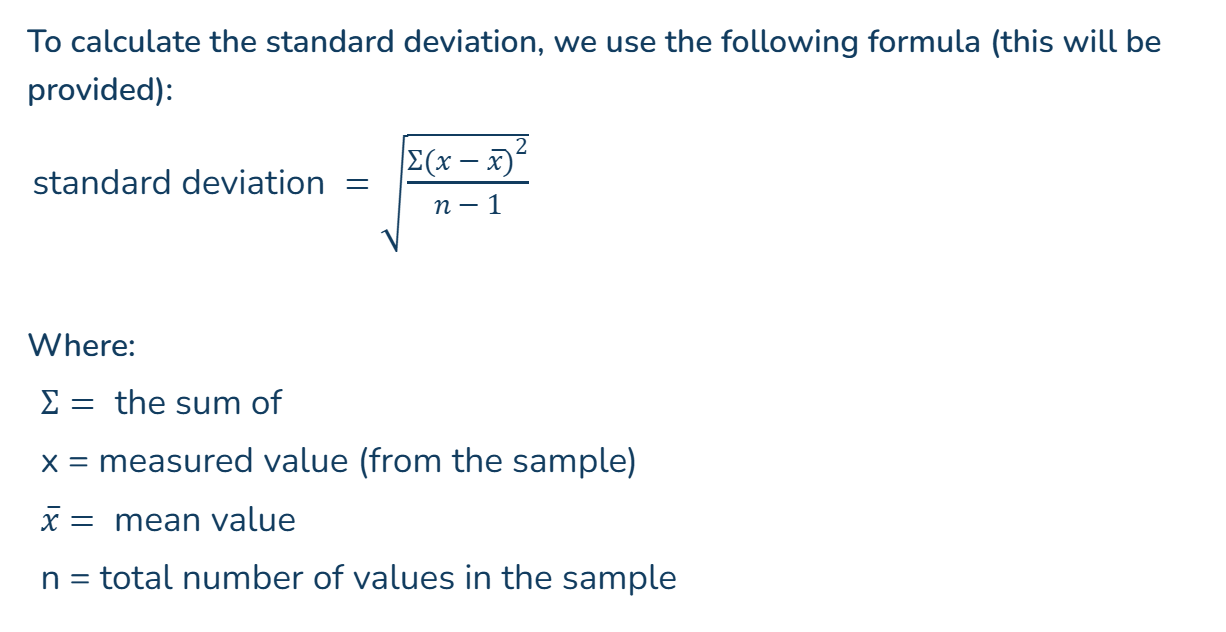
Standard deviation
Smaller value
Fairly consistent values around the mean
Larger value
Fairly inconsistent values spread around the mean
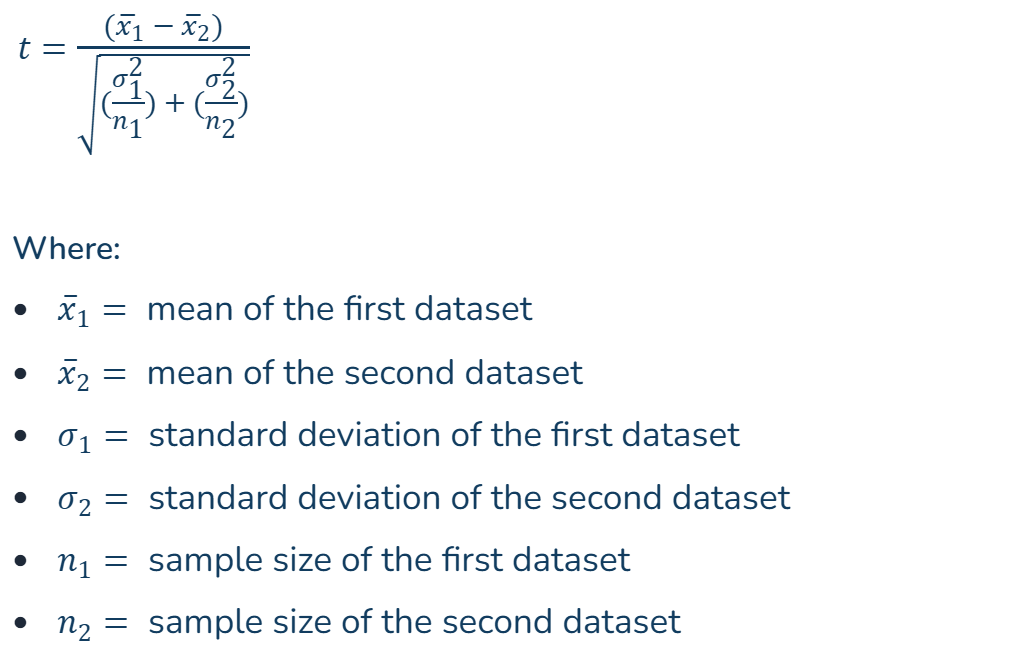
Student’s T-tests comparing
Statistical test used to determine if there is a significant difference between the mean values of particular variable in two populations
Conditions
Data must be continuous and normally distributed
Variance of the populations should be equal
Samples must be independent of each other
Variance = standard deviation squared
Conducting T-test
Conducting a t-test
State the null hypothesis
Assumes there is no significant difference between the means
Calculate the t statistic
Calculate the degrees of freedom
n1 + n2 - 2
Compare the t-statistic against critical value
Critical value is determined by the degrees of freedom and the chosen significance level (usually 0.06)
CV is provided in exam
If t is greater than critical value
Reject null hypothesis
Means are significantly different
If t is less
Accept null hypothesis
No significant difference between the means
Adaptions
Inherited characteristics that enhance an organisms' ability of sruvival
Anatomical - physical structures
Behavioural - activities and responses
Physiological - internal biological functions
Anatomical, behavioural, physiological
Anatomical
Body coverings
Camouflage
Mimicry
Teeth
Behavioural
Innate and instinctive
Defensive responses (freeze to avoid predators)
Courtship displays
Seasonal actions
Learned
Tool use
Physiological
Venom
Antibiotics
Water storage
Evolution of analogous adaptations
Serve similar functions but originate from different evolutionary paths
Dolphins (mammals) and sharks (fish) have adapted to develop dorsal fins
Example of convergent evolution
Natural selection: selection pressures
Environmental factors that affect survival and reproduction
Includes
Predation
Competition for resources
Climate change
Disease
How natural selection works
Process
Variation in characteristics within a species
More genetic variation emerges within a population due to random mutations
Individuals with alleles that code for traits that are advantageous are more likely to survive to reproduce
Beneficial alleles become more common in the population
Modern examples of evolution
Anti-biotic resistance
Some bacteria develop random mutations that provide resistance to antibiotics
When antibiotics are used, only the resistant bacteria survive
Resistance bacteria reproduce
Proportion of resistant alleles increases
Pesticide-resistant insects
Some insects randomly develop a mutation providing resistance to a pesticide
Resistant individuals survive to reproduce
Frequency of resistance alleles increases over generations