Flashcards genomics vs genetics + variants
 Call Kai
 Learn
Learn Practice Test
 Spaced Repetition
 Match
Match Flashcards
 Knowt Play
1/85

There's no tags or description
Looks like no tags are added yet.
Name | Mastery | Learn | Test | Matching | Spaced | Call with Kai | Chat |
|---|
No analytics yet
Send a link to your students to track their progress
86 Terms
impact of genomics on genetic change
1. increase productivity
2. longer lasting animals
3. lower cost (higher feed : gain)
Genomic breeding values
can give info on hard-to-measure traits (carcass weight)
applications of genomics
1. detect genetic disorder conditions
2. improve accuracy of selection
3. percentage testing (breed or ethnic %)
4. genomic selection
5. bio
6. custom marker panel
7. traceability + parentage verify
8. heterosis/hybrid vigor
9. QTP mapping, GWAS, candidate gene
10. biomarker development
11. ID haplotype
12. genetic diversity
genomics
study all genes in org. structure, function, compare. genotype (DNA) + phenotype = GBV
goal of genomics
use genome to predict performance
genetics
pedigree + phenotype = EBV (estimated breeding value)
Omics
study all bio molecules in org.
metabolome
list of all metabolites in organism
transcriptome
all RNA transcripts in 1 cell/tissue.
proteone
list of all proteins expressed
metagenome
all genetic material
phenome
get high-dimentional phenotypic data, different levels of activity (behavior
monogenetic trait
trait is decided by one gene (coat color)
polygenetic trait
trait is decided by multiple genes (milk production)
qualitative trait
categorical, able to be divided into categories (calving ease)
quantitative trait
bell curve, not in categories (height)
William Thomson
to measure is to know, cannot improve if cannot measure
Robert Bakewell
Old father of animal breeding. intro systemic recording performance
multidisciplinary genomics
bio, genetics, comp sci
genomics long term benefit
enhance breeding
genetic variants (markers)
1. SNPs : (short) single nucleotide variant (SNV)
2. Indels : (short) insertion or deletion
3. copy number variants : (structure) and short tandem repeats
genomics short term benefit
find haplotypes (lethal) + genetic disorders, parentage testing, sire assignment, genetic diversity- genomic relationship/inbreeding and hybrid vigor
1. structural genomics
physical nature of genomes- based on DNA (not tissue specific) gen seq and QTL mapping, GWAS, detect SNP, Indels, CNV
inbreeding
the probability that two alleles at any locus in an individual are identical by decent from a common ancestor
hybrid vigor
the offspring two genetically diverse parents has enhanced traits compared to its parents
QTL
genomic regions that hold genes or genetic variants. look for location + which genes or variants
QTL mapping
Genome wide association analysis. use full sequence to detect genes that control variation between traits. Look for causative genes.
GWAS
genome wide association study- genetic diff linked to diseases or traits (X-linked)
copy number variants
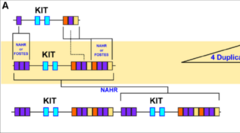
segment of DNA where copy number differences are- too many copies of one gene. happens during meiosis, mechanisms: Non Allelic homologous recombination (NAHR) + Fork stalling and Template Switching(FoSTeS)

NAHR
Nonallelic homologous recombination - mech for CNV. DNA strands switch places bc they look similar but are not matching pairs *during meiosis*
FoSTes
Fork Stalling and Template Switching. mech for CNV
DNA replication on strand 1, stops, puts new DNA from strand 1 onto strand 2. continues replicating on strand 1 *during meiosis*

KIT
ex. CNV, coat color in pigs controlled by stem cell. CNV duplications of regulatory elements up+downstream of KIT gene locus
genotype
combination of alleles at a locus
Indels
insertion or deletion
Most common genetic Variant
SNPs
Linkage disequilibrium (LD)
2 alleles are inherited more or less than expected by random chance. There IS a NON-random association between alleles at different genomic locations. alleles distanced but inherited together
2. Functional Genomics
study expression and function of whole genome. Transcriptome, meta-transcriptome, epigenomics, eQTL + gene enrichment, CHIP-seq
Meta-transcriptome
study mRNA expressed by microbes
epigenomics
study tags on DNA that control gene expression
eQTL + gene enrichment
are eQTLs clustered by chance or linkage. effects how much RNA a gene makes- expression.
ChIP-seq
ID where proteins bind to DNA - Chromatin Immunoprecipitation seq
comparative genomics
comparing genomes of diff org. detect evol changes
knowledge of gene structure + function in one species can be applicable in another (myostatin)

3 reasons for DNA testing
1. health benefit
2. traits
3. ancestry
DNA testing health benefit
1. ID haplotypes
2. recessive traits
3. GBV- select higher disease resistance
haplotype
alleles of different genes inherited together (albino + deaf)
DNA testing for traits
GBV for traits of offspring
DNA testing for ancestry
see genetic diversity of individual
genetic eval database
needs reference pop with data form all breeds being tested to be accurate- if no angus in reference pop, angus genetics will not be flagged
what is genetic eval
genetic relationship between candidate and the animals in reference pop
larger reference pop
more accurate prediction of GBV
larger # of breeds in reference
increase # SNPs identified in panel
SNP
substitution 1 nucleotide at specific position. minor allele freq less than 1%
Indel
insertion (dna gained) or deletion (dna lost). shift codon reading frame- changes amino acids connected. change peptide protein seq + gene function
frameshift mutation
insertion 1 nucleotide pushes all other nucleotides down line + incorrect amino acid sequence after insertion or deletion

indel deletion ex. MSTN
deletion of 11 base pair nucleotides in the third exon -> frame shift -> lose 102 amino acids
no Myostatin, muscles grow 40%, incomplete autosomal dominance
incomplete autosomal dominance
one allele on non-sexed chromosome does not fully mask effects of another- both phenotypes of alleles are seen
DGAT1
Diacylglycerol O-Acyltransferase. enzyme catalyzes final step of mammary triglyceride synthesis (milk fat)
SNP in DGAT1
in cattle, A (Alanine) instead of K (lysine) so lower milk fat. K (lysine) version -- more milk + higher fat
SNP version is w A (Alanine)
factors that shaped genomics
1. Seq tech + reduce cost of seq
2. HPC (high performing Computing facilities)
3. ML (machine learning) data analysis approach

ML data anal
find pattern, predict without coding
sequencing tech
high-res image of all nucleic acids

illumina seq
seq by synthesis, short read. 2nd gen seq. - copy DNA strands
Sanger DNA seq
capillary electrophoresis, shorter strand dna travels farther in gel
nanopore
long read seq- attach to cell membrane + process dna strands. real time seq
PacBio
HiFi: high fidelity
SMRT: small mol. real time seq
99% accurate long read, complete genomes, detect base mods. isolate DNA + use adapters to make circular
most challenging part of genomics
getting big data computation + analyses. HPC and cloud computing providers
Cloud computing
use when no HPC
1. AWS- amazon wed service
2. google cloud
3. digital ocean
4. microsoft azure
why cost of genome seq decrease?
because of next generation sequencing (NGS)
process of genotyping my sequencing
1. a FASTQ: store nucleotide seq + their quality scores
2. 2 reading filtering: remove low quality data, unneeded DNA
3. c alignment: compare individuals dna to other org, finds similarities
4. 4 BAM file (Binary alignment map): store genetic data aligned to a reference genome
5. e variant calling: find difference of individual + reference pop
6. 6 VCF, variant call format: stores genetic seq variations + differences
GBS
genotyping by sequencing. analyze genetic variations (SNP, indel, CNV). testing fixed set of markers on genome- not analyzing whole raw genome
FASTQ
raw data file

breadth of coverage
% of bases from reference pop that are captured at a specific depth. How much of the genome was mapped
deep sequencing
genome scanned + analyzed 15-30x , fewer errors
low pass sequencing
genome scanned + analyzed 0.5-1 x, lots of errors
results from sequencing
1. Data analysis for genomic + transcriptomic seq files
2. detect genetic variants (SNP, Indel, CNV)
3. Genotypes
COSMIC database
Catalog of somatic mutations in cancer. info abt genetic variants in caner, does SNP cause cancer or not
High quality assembled genome (HQ MAG)
precise, continuous (DNA sequence connected instead of fragments), contains whole genome. reconstruction of DNA sequence

Low density SNP panel
3-30K snps
medium density SNP panel
50-150K snps
HD - high density panel
700,000 snps. based on full/deep sequencing
most common genetic variance
SNP
1990s genotyping
use 1 marker on genome to look for QTL
2001 genotyping
add more markers onto genome, genome wide selection. easier to find QTL bc more markers
4 ways to see genetic + genomic evaluation
1. SNP
2. QTL mapping
3. genome prediction (GBV)
4. sequence genome
Dairy industry genome prediction
uses to get genomic predicted transmitting ability (GPTA = 1/2 GBV)
Beef industry genome prediction
uses to get genomic expected progeny difference (GEPD = 1/2 GBV)