B3 L2 - The structure and function of the hippocampus
 Call Kai
 Learn
 Practice Test
 Spaced Repetition
 Match
 Flashcards
 Knowt Play
1/43

There's no tags or description
Looks like no tags are added yet.
44 Terms
the structure of the hippocampus
along its length the hippocampus shows distinct cell fields that are tightly folded (like an onion)

within the hippocampus
inputs from cerebral cortex via dentate gyrus → dentate gyrus projects to associations between CA1 and CA3 fields (also direct projections to this field) → output via subiculum (also direct projections to this field)
structures connected to the hippocampus
entorhinal cortex, perirhinal cortex, parahippocampal cortex
entorhinal cortex
gateway between hippocampus and cortex
perirhinal cortex
densely connected to hippocampus, important for object recognition (extracts semantic info about objects)
parahippocampal cortex
densely connected to hippocampus, spatial layout coding
theory of hippocampal function
perirhinal cortex/parahippocampal cortex learn about familiar objects/locations→ entorhinal cortex → hippocampus
relational theory
hippocampus forms asssociations between places and objects so you can reconstruct the connections later on
posterior hippocampus
greater input from parahippocampal cortex (spatial memory)
anterior hippocampus
greater input from amydala and perirhinal cortex (emotional memories, item familiarity/salience)
Moser et al, spatial learning in rats
impaired by posterior not anterior lesions
Strange et al, double dissociation in humans
could see difference in different regions of hippocampal damage
feature of the hippocampus that link to memory
receives connections from all modalities (vision, sound, smell - memories are multi-sensory), contains multiple nested feedback loops (ideal for associative learning, can strengthen synapses by repeating info), neurons have special properties that support memory
What is long-term memory?
reflects structural changes at the synapse
Donald Hebb; memories are stored in connections between neurons (cell assemblies)
LTM through Hebbian learning; happens because of long-term potentiation (LTP)
LTP
strengthening a connection between two neurons
pre-synaptic cell during LTP
glutamate is released (excitatory neurotransmitter), diffuses across synapse and causes sodium channels to open briefly at dendrites of post-synaptic cell and create action potential
synapse need to be
strengthened via LTP, post-synaptic cell responds more strongly when the pre-synaptic cell fires
Bliss & Lomo, studied the post-synaptci cells and two diff pathways that connect to these post-synaptic structures
pre-experiment: electrical stimulus releases glutamate and causes some depolarization, weak response because no learning has occured yet
conditioning: give pre-synaptic cell much larger stimulus to cause action potential in postsynaptic cell → trigger memory formation
post-experiment: individual pulse into two neurons, conditioned pathway causes more glutamate release and an action potential
mechanism of LTP before conditioning
only a little glutamate is released by CA3 (pre-synaptic cell) and only a little sodium is let in by CA1 (post-synaptic cell)
AMPA receptor allows some sodium in
NMDA receptor stays closed and no ions can get in because Magnesium blocks
mechanism of LTP after conditioning
more glutamate is sent into synapse, sodium pushes the magnesium out of the way
AMPA receptor lets in more sodium, causing large depolarization and repels magnesium blockade around NMDA receptor
NMDA receptor is permeable to calcium ion, which cause LTP changes at the synapse
early phase of LTP
creation of new AMPA receptors temporarily, inserted when influx of calcium
late phase of LTP
prolonged influx of calcium causes gene expression (new proteins), new AMPA receptors inserted at synapse and new synapses formed
changes in synaptic function and morphology assoc with LTP maintenance
bigger response happens each time; more glutamate released, more responders, more likely to get action potential
structural change =
synaptic consolidation; synapse will start to enlarge and create new dendritic spines to recieve more glutamate in the synapses that matter, allows memory to last for a long time
LTP summary
Glutamate released from neuron 1 → sodium ions enter neuron 2 → reach threshold for action potential in neuron 2 → NMDA channels open → calcium ions enter neuron 2 → calcium ions cause structural change to strengthen synapse
Features of LTP
LTP can be induced by a single high frequency train (memory for single event possible e.g. episodic memory); LTP elicits change that lasts for weeks; only synapses active during the stimulation are increased, inactive pathways to the same neurons aren’t
Morris water maze
Trial 1: rat searches for way out and disc hidden platform
Trial 2: rat remembers location of platform, swims there much faster using landmarks to navigate
hippocampal lesions in rats
shows role of hippocampus in memory tasks; post hippocampus is more important for spatial memory; these studies don’t sho the contribution of specific processes like LTP
pharmacological studies
Morris bathed hippocampus of rats in NMDA receptor antagonist which blocks glutamate binding site
Tonegawa and transgenic mice
gene-splicing used to create strain of knock-out mice that lack NMDA receptor in CA1, impaired in spatial learning but other forms of learning such as classical conditioning preserved → LTP in CA1 field is critical for spatial memory
How could the researcher prove this is spatial not procedural learning?
release the rat in a diff position on each trial; can guarantee that rat has to navigate the platform using sptial landmarks which don’t change but can’t rely on muscle memory
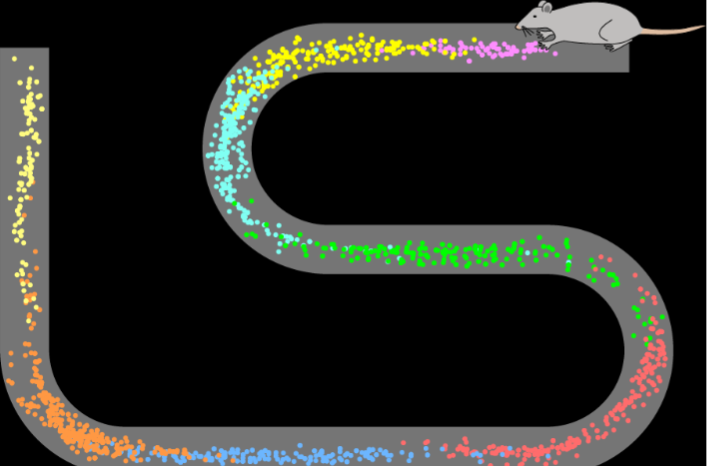
John O’Keefe, place cells
cells in CA1 that become active when the rat is in a particular place; recording from single neurons in awake behaving animals, each color is action potential from a diff neuron, each neuron has a ‘place field’ that it responds to
Theory 1: cognitive map, John O’Keefe and Lynn Nadel
hippocampus provides an internal map that codes for spatial relations between objects in the environment
Eleanor Maguire: hippocampus and spatial memory in humans
voxel-based morphology measures size of brain structures, experienced taxi drives have slightly more voxels in post hippocampus
Ekstrom et al: place cells in epileptic patients
navigation through VR environment - proportion of neurons that fire in response to a specific location in hippocampus, parahippocampal cortex, amydgala and frontal cortex
place cells in amnesia
selective and severe deficit of episodic memory in amnesia
spatial deficits in amnesia
amnesic patients show deficits in tasks that don’t appear to have spatial dimensions, yet all episodic memories are encoded and recalled in a spatial location (mental time-travel involves reconstructing environment, spatial location is profound cue to recall) → both episodic and spatial memory req a relational code
theory 2: relational memory, Eichenbaum & Cohen
rats with hippocampal lesions can remember individual associations but cannot infer relations → need relational framework, can’t just use conditioning
theory 3: recollection vs familiarity
unique role of hippocampus in time-travel, recollection involves relations between items and contexts; familiarity is a form of declarative memory (feeling of familiarity is conscious), related to priming in perirhinal cortex (which shows strong response to novelty)