Chapter 7 - Quantum Theory & Atomic Structure
 Call Kai
 Learn
 Practice Test
 Spaced Repetition
 Match
 Flashcards
 Knowt Play
1/34

There's no tags or description
Looks like no tags are added yet.
35 Terms
What is electromagnetic radiation/energy?
This is energy that travels through space in the form of waves, characterized by oscillating electric and magnetic fields. It includes a range of wavelengths, from radio waves to gamma rays.
EX: visible light, x-rays, gamma rays, radio waves, microwaves
Electromagnetic radiaton’s wave properties can be chacterized by three variables and one constant:
Wavelength (lambda), frequency (nu, v), amplitude, and speed of light. ← this is the constant
What does wavelength represent?
This represents the distance between iddentical points on adjacent waves, such as from the crest of one wave to the crest of another wave.
look at image
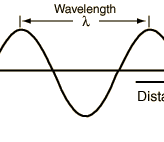

Which one has the highest frequency? What about wavelength?
Letter A has the highest wavelength (look at that big gap). Letter C has the highest frequency (it passes A LOT OF CYCLES per 1 second)
What is frequency? What is its equation?
This is the number of complete waves, or cycles, that pass a given point per second.
nu = 1/second OR nu = 1 hz
nu is frequency
What is speed in terms of electromagnetic radiation?
This is the distance a wave moves per unit of times (m/s). Typically, we’ll use speed of light (C = 3.00 × 10⁸ m/s)
If wavelength is high, then frequency is (high/low). If frequency is low, then wavelength is (high/low).
Connecting these, what’s a good equation to use and why?
low; high
Since we know that all waves are moving at the same speed (just a known fact), and that frequency and wavelength are indirectly proportional, then it means that:
C = wavelength * frequency
What is amplitude?
This is the height of one peak to the midline. It indicates the intensity of radiation, or the brightness of visible light.
Thinking about it further: light of a particular color has a specific frequency (and therefore wavelength), but its amplitude can vary; the light can be dimmer (lower amplitude, less intense) or brighter (higher amplitude, higher intensity).
In the electromagnetic spectrum, how is it arranged?
It is arranged in order of increasing wavelength or DECREASING frequency.
Look at image

A dental hygienist uses x-rays (lambda = 5.0 × 10⁻¹¹ m) to take radiographs while patients listen to a radio station (lambda = 3.25 m) and looks out the window at a blue sky (lambda = 473 nm).
What is the frequency in Hz of the electromagnetic radiation from each source?
Remember that C = wavelength * frequency
C is in m/s! frequency is Hz or 1/seconds
x-rays
3.00 × 10⁸ m/s / (5.0 × 10⁻¹¹ m) = frequency. frequency = 6.00 × 10¹⁸ Hz
radio station
3.00 × 10⁸ m/s / (3.25 m) = frequency. frequency = 9.23 × 10⁷ Hz
blue sky
3.00 × 10⁸ m/s / (473 nm * 1 m / 109 nm ) = 6.34 × 10¹⁴ Hz
What happens if a wave strikes the edge of an object (like a gap). What about a particle?
A wave will end up diffracting, and will bend AROUND both the edges of a small opening to form a semicircular wave.
A particle will simply enter the small opening. Think of a line going right through it.
Look at image

What is constructive and destructive interference?
Constructive interference is when two separate waves coincide with each other. The amplitudes add together to form a brighter region.
Destructive interference is when two separate waves’ amplitudes (peaks) coincide with each other. This causes the amplitudes to cancel to form a darker region.
Look at image

What is the blackbody radiation model telling us?
It tells us that when an object is heated, it emits radiatoin of various wavelengths including visible light. However, the maximum intensity that is emitted shifts to shorter and shorter wavelenghts as the temperature increases.
For example, smoldering coals are black, but as they’re heated they glow orange. Look at image

The blackbody model actually tells us an equation. Give me it and the constant :)
It tells us that these hot objects could only emit (or absorb) CERTAIN quantities of energy:
E = n*h*v
n = any positive integer
h = Planck’s constant (6.626 × 10⁻³⁴ J*s)
v = frequency
E = energy in J
Since energy can only be changed in certain QUANTUMS (certain energies), and we know the equation to be E = nhv, then how do we calculate quantums?
We can calculate quantums by just doing:
quantum = hv
Remember, n is a positive interger, so if it’s two then we have two quantums.
How would you find the amount of energy change of an atom?
It’s simply finding the amount of energy that was emitted or absorbed in radtion.
delta Eatom = delta Eemitted
REMEMBER, delta Eemitted = delta*(nhv)
And REMEMBER you can substitute variables here since we know: c = wavelength (lambda) * frequency (v)
What is the photoelectric effect? Any equations with it?
This effect is where electrons are emitted from a material when it absorbs an amount of light/electromagnetic radiation AFTER reaching a certain threshold.
Ephoton = hv = delta*Eatom
A student uses a microwave to heat a meal. The wavelength of the radiation is 1.20 cm. Wha tis the energy of one photon of this radiation?
We are given wavelength, so we can find the frequency!
0.0120 m is wavelength * X frequency = 3.00 × 10⁸ m/s
then plug into the E = hv
E = 1.66 × 10⁻²³ J
What does the Schrodinger equation tell us?
It tells us that there is a mathematical way to express an electron’s matter in a three dimension region of the nucleus and allows us to determine the probability of finding an electron in a given space.
Essentially, this is where we get electron configuration from—orbitals!
What is the principal quantum number? What happens as this number increases? In the end, what are we left with?
This is measured in n, where n is a positive integer.
This indicates the relative SIZE of the orbital and therefore the relative distance from the nucleus of the peak electron density. As n increases, the orbital becomes larger and the electron spends more time farther from the nucleus.
In the end, we are left with the atom’s energy level or shell. The higher then n-value, the higher the energy level.
What is the angular momentum quantum number? What does this ultimately give us?
This is l and it’s an integer between 0 to n-1. Therefore, its value depends on the principal quantum number. If n = 2, then l is 0, 1 (2 values)
If n = 3: l = 0, 1, 2.
This ultimately gives us the sublevels or subshells, into which each energy level is divided. Think of s, p, d, f levels and them having 0, 1, 2, 3, respectively in sublevels.
Tell me the sublevel if n = 3 and l = 1.
You woul be at the 3p level.
since when I = 0, 1, 2, 3
You have s, p, d, f, respectively.
What does the spin quantum number tell us?
It tells us the the “spin” of an electron, which can be +0.5 or -0.5.

De broglie told us that because there is a fixed radii on certain elements, then electrons will have wavelike motions CONFINED by that radii. What is the equation this allows us to use?
lambda = h / m*u
h = Planck’s Constant
lambda = wavelength
m = mass
u = speed
Look at image (higher wavelengths = lower mass)

Find the de Broglie wavelength of an electron with a speed of 1.00 × 10⁶ m/s (electron mass = 9.11 × 10⁻³¹ kg; h = 6.626 × 10⁻³⁴ kg * m2/s)
The only thing you NEED to pay attention to is used. If electron mass is in Kg, then h needs to be in Kg.
Plug into de Broglie equation: lambda = h / mu
Look at image

What is the uncertainty principle and why is it a thing (start w/ this first)?
The reason why this principle is a thing is because an electron can display properties of both a particle and a wave. It has a definit location at any instant.
The uncertainty principle tells us that we can never know the position and momentum of a particle at the same time:
deltaX (m times deltaU) >= h/4pi
X = uncertainty of the position
U = uncertainty of the speed
h = Planck’s constant
Look at image for better equation

What happens if DeltaX is low in the uncertainty principle? What about speed?
If the change in position is really small (which means we accurately know the position), then we are more inaccurate about the speed (deltaU), and vice versa.
Essentially, as we get more dead set on the position, we become more dispared from the speed.
Why doesn’t a macroscopic item have an uncertainty principle?
it’s because of the incredibly large mass compared with h/4pi. This way, we can just use the laws of position and speed of a baseball. We only use the uncertainty principle for electron trajectory.
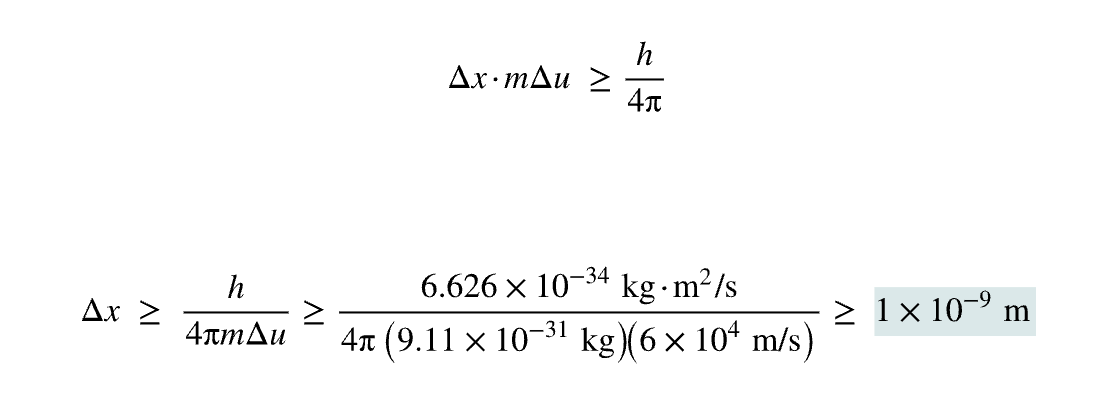
An electron moving near an atomic nucleus has a speed of 6 × 10⁶ m/s +- 1%. What is the unceratinty of its position (deltaX)?
Start by calculating deltaU, which you can do by multiplying the speed by 1%; 1% represents the uncertainty in that speed.
6 × 106 × 0.01 = 6 × 10⁴ m/s
We now have deltaU, so sub it into our equation: deltaX * (m x deltaU) > h/4pi
An we get 1 × 10⁻⁹ m.
Look at image for plugging in of the equation
What is a line spectrum?
This is a series of fine lines at specific wavelengths (and therefore frequencies) separated by black spaces.
Look at image

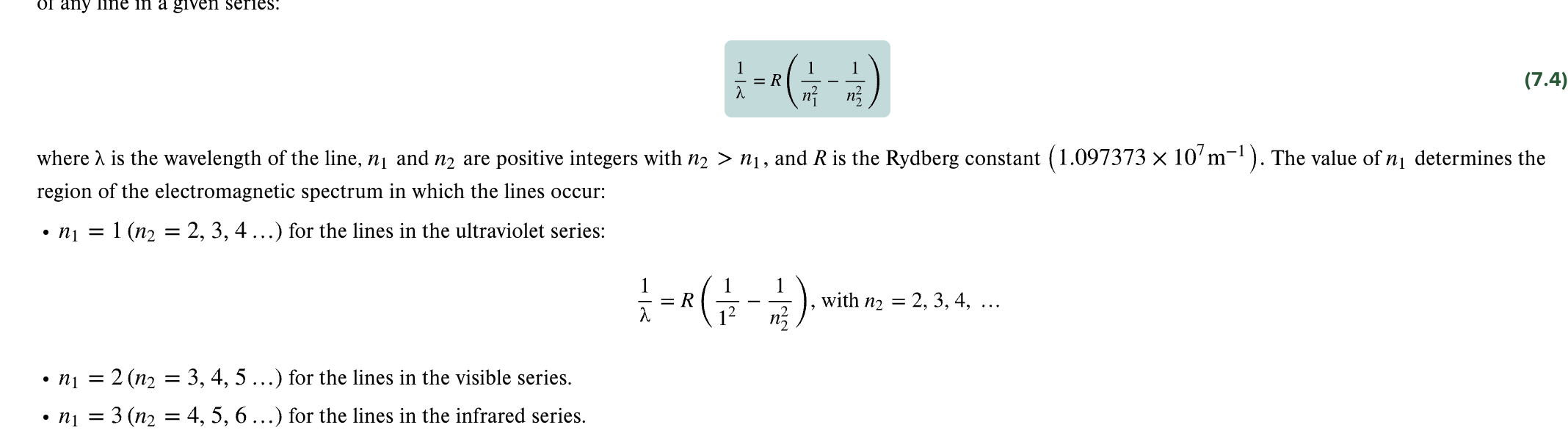
What does the Rydberg equation state? Also give the equation!
This equation states the position and wavelength of any line in a given series
1/lambda = R(1/n12 - 1/n22)
R = Rydberg constant = 1.097373 × 10⁷ m-1.
Look at image
The Rydberg equation could not explain why line spectra occur in line spectrums. The Bohr model did. Describe the Bohr model to me using the three states…
The Bohr model states that the H-atom has certain energy levels called stationary states. Each state has a fixed, circular orbit of the electron around the nucleus. It also says that the lowest energy state is the ground state. For hydrogen, that’s n = 1. Finally, if the electron is in any orbit farther from the nucleus (n > 1), the atom is in an excited state.
Note: the atom CANNOT be between states.
How does Bohr’s model explain the creation of a line vs. continuous spectrum?
This model says that when electrons move closer to the nucleus, the atom’s ENERGY changes from a higher to lower state and loses a SPECIFIC amount of energy that’s EMITTED as a photon of a specific wavelength. Delta Ephoton = hc / lamda
A hydrogen atom absorbs a photon of UV light, and its electron eneters the n = 4 energy level. Calculate the change in energy of the atom and the wavelength (in nm) of the absorbed photon.
know this number R (for energy) = -2.178 × 10⁻¹⁸ J
We know ground state of hydrogen atom is n = 1. We go to n = 4. Therefore, our final energy is BIGGER than the initial energy.
We always use this equation to calculate energy:
Delta E = -RZ2(1/nf2 - 1/ni2)
R = Rydberg equation
Z = atomic number
Plug in
Delta E = -(2.178 × 10⁻¹⁸ J) (1)2 (1/(4)2 - 1/(1)2)
Delta E = 2.04 × 10⁻¹⁸ J’
To find wavelength:
Delta E = hc / lambda
2.04 × 10⁻¹⁸ J = 3.00 × 108 × 6.626 × 10-34 / lambda
lambda = 9.74 × 10⁻⁸ METERS * (1 nm / 10-9 m) = 97.4 nm
Look at the image for an alternative way to find wavelength WWITHOUT using energy.

When shown a graph of energy states and asked for the lines of an absorption spectrum, do you count the ground state as something you’d see on an absorption spectrum?
Absolutely not! For an absorption specturm, just count the excited energy levels—not the ground state!