Anatomy Practice Questions Exam 4
 Call Kai
 Learn
 Practice Test
 Spaced Repetition
 Match
 Flashcards
 Knowt Play
1/352

There's no tags or description
Looks like no tags are added yet.
353 Terms

Identify the structure(s) indicated by Label B.
Rouleaux formation

Identify the structure(s) indicated by Label F.
Platelets
A person who is Rh-positive has the Rh antigen on the plasma membrane of his or her ________.
erythrocytes
Blood assists in defending the body against toxins and pathogens by ________.
transporting white blood cells to injury or infection sites
About 60 percent of plasma proteins are composed of ________.
albumins
Plasma proteins that attack foreign proteins and pathogens are ________.
immunoglobulins
________ clump together to form a temporary patch in the walls of damaged blood vessels.
Platelets
Rh antigen is also called ________.
the D antigen
What prevents an erythrocyte from using the oxygen it carries?
lack of mitochondria
The process of moving toward an area due to chemical signals is called ________.
chemotaxis
Platelets clump together to assist with hemostasis.
True
The matrix of the blood, which has a density only slightly greater than water is called plasma.
True
A round leukocyte whose nucleus resembles a string of beads, and whose cytoplasm contains large, pale inclusions, is a(n) ________.
neutrophil
What is the normal pH range of human blood?
7.35-7.45
A leukocyte can migrate across a capillary wall by squeezing between adjacent endothelial cells, in a process known as ________.
diapedesis
As a megakaryocyte develops and grows, what happens to its nucleus?
it grows larger and undergoes endomitosis
The concentration of ________ in interstitial fluid is much higher than that of plasma.
CO2
The hormone erythropoietin is produced and secreted by the ________ during hypoxic conditions.
kidneys and liver
Fibrinogens are the smallest of the plasma proteins.
False

What is B?
nutrient artery

What is C?
Nucleus of endothelial cell
Basophils are granulocytes formed from myeloid stem cells.
True
Membrane-enclosed enzyme packets are called platelets.
True
Hemoglobin molecules consist of ________ globular protein subunits.
4
In the adult, red blood cells are produced in the areas of the ________.
red bone marrow
Heme molecules are important for holding which of the following in such a way that it can interact with an oxygen molecule?
an iron ion
________ are phagocytic cells that contain a nucleus with many lobes.
Neutrophils
What plasma proteins is an essential component of the clotting system?
Fibrogens
Megakaryocytes produce ________.
platelets

What is D?
Adipocyte
The blood type of an individual is determined at the cellular level by which factor?
the presence or absence of specific surface antigens in the plasma membrane of the erythrocyte
Plasma contributes approximately ________ of whole blood volume.
55%
The white blood cells that contain granules with histamine are called ________.
basophils
Which leukocyte is the least abundant in normal human blood?
basophil
Which component is the primary determinant of blood viscosity?
red blood cells
Blood cells and cell fragments suspended in the liquid matrix are collectively called the formed elements.
True
Individuals with type B blood have plasma that contains anti-B antibodies.
False

What is D?
blood vessel

What is E?
Developing erythrocytes and granulocytes
The ________ synthesize(s) and release(s) more than 90% of the plasma proteins.
liver
Blood is classified as which type of tissue?
connective tissue
The composition of the plasma of blood and the interstitial fluid differs chiefly in the concentration of ________.
dissolved gases and proteins
Which hormone stimulates red blood cell production in the bone marrow?
erythropoietin (EPO)
Formed elements produced by megakaryocytes in bone marrow are ________.
platelets
Basophils assist mast cells of tissues in producing inflammation.
True
For erythropoiesis to proceed normally, the progenitor cells must receive adequate supplies of which of the following?
calcium
iron
B12
Vit. A
amino acids
Vit. K
Iron, B12, amino acids
In terms of organelles, an obvious difference between a mature erythrocyte and a leukocyte, viewed through a light microscope, is that the erythrocyte lacks ________.
a nucleus

What is G?
RBC
Circulating platelets last about 10 to 12 days before they are broken down and their contents recycled.
True
All lymphocytes are leukocytes.
True
Erythrocytes are the most abundant formed elements in the blood.
True
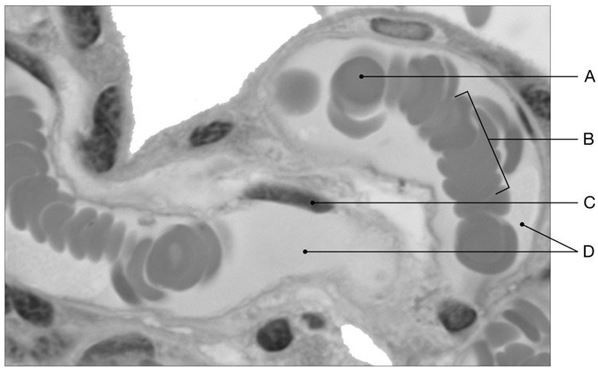
What is A?
RBC
Myeloid stem cells produce all of the following formed elements EXCEPT ________.
lymphocytes
________, also known as B cells, differentiate into plasma cells, which secrete antibodies that attack foreign cells or proteins in distant portions of the body.
Lymphocytes
In a type O individual….
The erythrocytes lack surface antigens A and B.
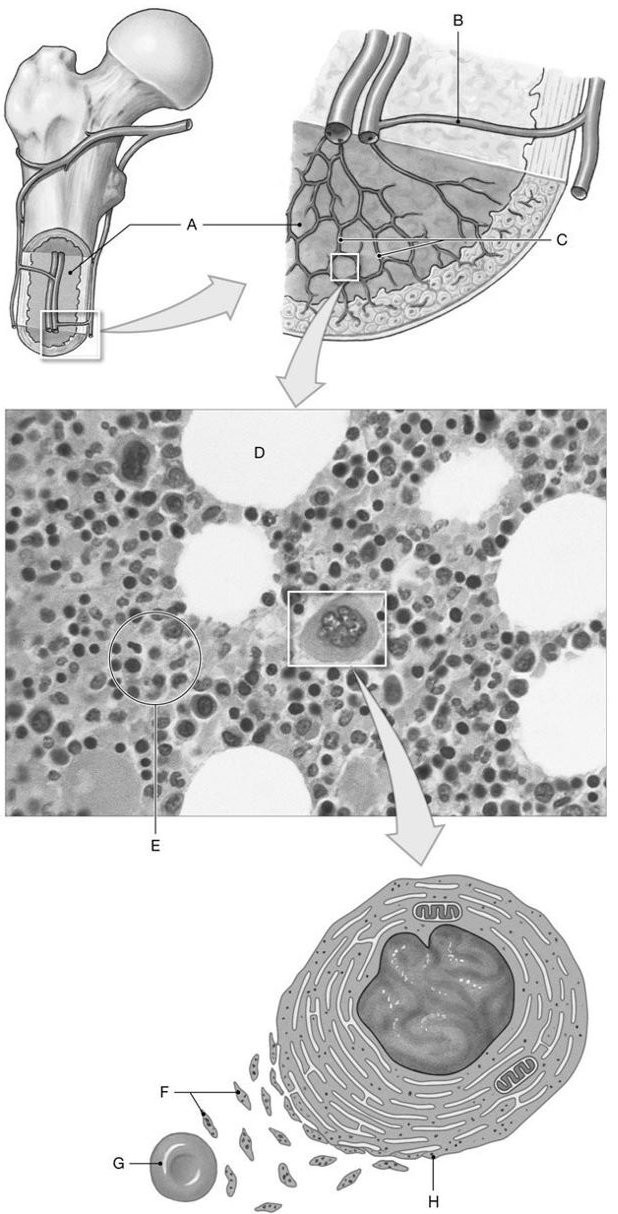
What is C?
Venous sinus
Arteries transport blood away from the heart.
True
Blood leaves the right ventricle through the ________ valve to reach the capillaries supplying the lungs.
pulmonary
The intercalated discs of cardiac muscle cells contain specialized junctions that allow ions to pass between cells, enabling synchronized contraction. These are called ________.
Gap junction
Because cardiac muscles are mechanically, chemically, and electrically connected to one another, cardiac muscle tissue functions like a single enormous muscle cell. For this reason, it is called a functional ________.
syncytium
The coronary arteries…
originate at the base of the ascending aorta and are the first branches off this vessel
Contractions of the heart…
are coordinated by specialized conducting cells that distribute the stimulus to cardiac muscle cells.
The pericardial cavity is actually ________.
a potential space
Which of the following conditions would cause an increase in the heart rate?
activation of the sympathetic nervous system
Which branch(es) of the right coronary artery extends toward the apex along the anterior surface of the right ventricle of the heart?
right marginal branch
The diaphragm is attached to the inferior, pointed tip of the heart, called the ________, which points laterally.
apex
Which of the following is a feature that is unique to the left atrium?
left atrioventricular (mitral) valve

What is A?
Esophagus
The primary function of the pericardial fluid is to provide ________ between the pericardial membranes.
lubrication
Which of these statements characterize blood flow in the human body?
a. There is a unidirectional blood flow.
b. Arteries always carry oxygenated blood.
c. Veins always carry deoxygenated blood.
d. Arteries always carry blood away from the heart.
e. Veins always carry blood toward the heart.
a, d, e
Which surface feature marks the border between the atria and the ventricles?
coronary sulcus
Which statements describe the endocardium?
a. Has single layer of epithelium
b. Has layer of areolar connective tissue
c. Epithelial cells are squamous
d. Epithelial cells are cuboidal
e. Has layer of smooth muscle tissue
a, b, c
Valves of the heart open and close due to ________.
pressure changes
Which of the following structures is a large, thin-walled vein that lies in the posterior portion of the coronary sulcus?
coronary sinus
What is a unique feature of the right ventricle?
pulmonary valve
Which structure makes up a large percentage of the anterior (sternocostal) surface of the heart?
right ventricle
The right ventricle ________.
has thinner muscular walls than does the left ventricle
The epicardium is another name for the visceral pericardium.
True
What is J?
Conus arteriosus

What is B?
Pulmonary veins
The cardiac skeleton reinforces the valves and helps prevent overexpansion of the heart.
True
The sinoatrial node, or cardiac pacemaker, is ________.
embedded in the posterior wall of the right atrium, near the entrance of the superior vena cava
Which of the following is a function of the cardiac skeleton of the heart?
isolates atrial and ventricular muscle cells
There are many interconnections between the arterial branches of the coronary circulation, which function to maintain a constant blood supply to the muscle of the heart. These connections are called ________.
anastomoses
The fibrous pericardium primarily serves to protect the heart by limiting its movement and preventing excessive dilation. Which tissue forms its outer layer?
dense irregular CT
Which structures conduct the electrical impulse from the SA node to the AV node, forming part of the cardiac conduction pathway?
internodal pathways
The right border of the heart is supplied by the ________.
right marginal artery
The left atrium receives oxygen-rich blood from the ________.
pulmonary veins
If the cusps of an atrioventricular valve are damaged or functionally impaired so that they do not close completely during the normal point in the cardiac cycle, blood may flow backwards. This is called ________.
regurgitation
________ release produces a decrease in both the heart rate and force of contraction through the stimulation of muscarinic receptors on nodal cells and contractile cells.
Acetylcholine (ACh)

What is G?
coronary sinus
The conducting system structure that directly delays the impulse to allow atrial contraction before ventricular systole is the ________.
AV node
Which of the following is a major component of the cardiac conduction system located in the interventricular septum, and extends toward the apex of the heart?
bundle branches
Blood exiting the left ventricle must pass through the ________ valve.
aortic valve
The inherent ability of cardiac muscle tissue to contract in the absence of neural or hormonal stimulation is called ________.
autorhythmicity
Externally, the posterior and inferior portions of the left and right ventricles form the ________.
diaphragmatic surface
The superior end of the right ventricle, which tapers to a smooth-walled pouch and ends at the pulmonary valve is called (the) ________.
conus arteriosus
Which element of the fibrous pericardium stabilizes the position of the heart and associated vessels within the mediastinum?
collagen fibers
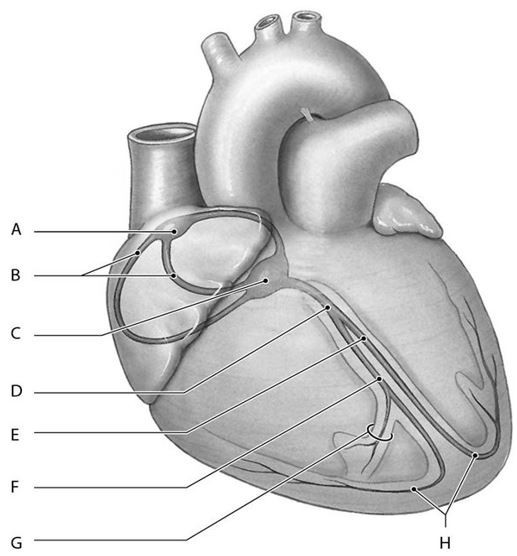
What is A?
SA node
Which chamber of the heart can generate the greatest pressure?
left ventricle