L8-electrolytes and bufffers
 Call Kai
 Learn
 Practice Test
 Spaced Repetition
 Match
 Flashcards
 Knowt Play
1/10

There's no tags or description
Looks like no tags are added yet.
11 Terms
how to know if a drug is non-ionisable or not
for non ionisable drugs their pka’s are typically very low or very high i.e far outside the physiological range
what is a buffer
a solution that can resist PH change upon the addition of an acidic or basic component
its able to neutralise small amounts of added base or acid
they have a working ph range and capacity which dictates how much base/acid can be neutralised before the ph begin to change
in order to do its role what must a buffer contain
it must contain a weak conjugate acid-base pair
so a a weak acid and its conjugate base ( strong base ) or a weak base and its conjugate acid ( a strong acid )
the conjugate base and acid are supplied by a salt
what is an electrolyte
an electrolyte is a substance that is ionised in a solution
electrolytes yield ions when dissolved in water and therefore can conduct an electric current through the solution
differentiate between a strong electrolyte and a weak electrolyte
a strong electrolyte is a substance that is completely ionised in solution i.e. strong acid/bases and their salts
a weak electrolyte is a substance that is partially ionised in a solution i.e. weak acids/bases and their salts.
what is a nonelectrolyte
a substance that is not ionised in a solution and doesn’t conduct electricity
explain how -OH is removed when added
the -OH reacts/ is removed by the weak acid in the buffer and it forms undissociated water
explain how the +H3O/acid is removed by a buffer system when its added
the +H3O/acid reacts with the ions from the negative ions/ strong base contained in the salt.
explain the common ion effect
when a buffer contains a weak acid and a salt containing its conjugate base and they both dissociate to give the same conjugate/strong base
this means that in the system containing the weak acid the equilibrium will shit to the reactants/away from the conjugate base and towards the reactants
so the ionisation of the weak acid is repressed
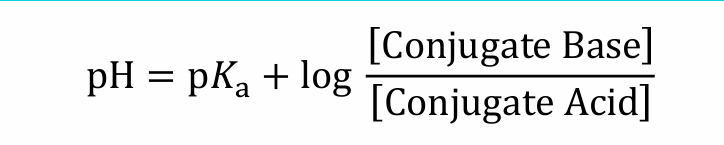
what is the Henderson-Hasselbalch equation for buffers
the only difference is to remember that depending on if its a weak base or acid the conjugate base or acid will be represented by a salt
what is buffer capacity
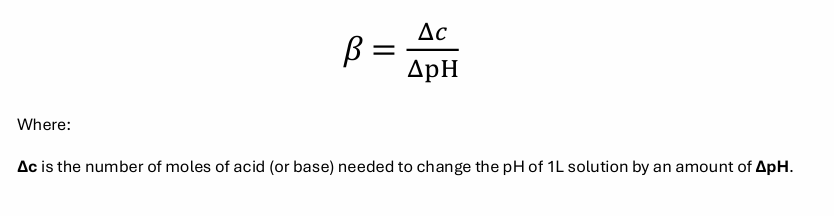
the effectiveness of a buffer in reducing changes in PH