Block 1 Clin Med Cardio 10/31
 Call Kai
 Learn
 Practice Test
 Spaced Repetition
 Match
 Flashcards
 Knowt Play
1/284

There's no tags or description
Looks like no tags are added yet.
285 Terms
A 28-year-old man presents to the ED with sharp chest pain for 2 days after a recent viral illness. The pain worsens with inspiration and lying flat but improves when he leans forward. BP is 118/74 mmHg, and a pericardial friction rub is audible. ECG shows diffuse ST elevation and PR depression. Echocardiography shows no effusion.
What is the most likely diagnosis, and does the absence of an effusion exclude it?
What is the Tx?
Acute pericarditis. An effusion is not required. He meets three of four criteria: characteristic chest pain, friction rub, and typical ECG changes. Only two are needed.
ibuprofen + colchicine + a PPI, with activity restriction
A 35-year-old woman has her first episode of acute pericarditis. She is hemodynamically stable, with normal renal function and no history of myocardial infarction. Ibuprofen 600 mg every 8 hours is prescribed.
Which medication should be added to reduce recurrence, for how long, and what gastric protection should accompany treatment?
A 62-year-old man develops pleuritic chest pain and a low-grade fever 5 weeks after a myocardial infarction. A friction rub is present, and ECG shows diffuse ST elevation with PR depression. Echocardiography reveals a small effusion without chamber collapse.
What is the specific diagnosis, and which anti-inflammatory medication should be selected instead?
Dressler syndrome (post-MI pericarditis). Treat with high-dose aspirin plus colchicine. Avoid ibuprofen and other non-aspirin NSAIDs because they can impair myocardial healing after MI.
A 40-year-old woman previously completed treatment for acute pericarditis. After 7 weeks without symptoms, she develops similar positional chest pain, a friction rub, and new diffuse ST elevation. She is hemodynamically stable.
Is this incessant, recurrent, or chronic pericarditis? How long should colchicine generally be continued?
Recurrent pericarditis. The 7-week symptom-free interval exceeds the required 4–6 weeks. Continue colchicine for at least 6 months.
How do you distinguish acute, incessant, recurrent, and chronic pericarditis?
Acute: Symptoms <4–6 weeks + ≥2 of 4 diagnostic criteria.
Incessant: Continuous symptoms >4–6 weeks but <3 months.
Recurrent: Symptoms return after ≥4–6 symptom-free weeks.
Chronic: Continuous symptoms >3 months.
Memory: Acute = starts; incessant = persists; recurrent = returns; chronic = continues beyond 3 months.
How many of the five criteria are required to diagnose metabolic syndrome?
at least 3
What male waist circumference meets the metabolic syndrome criterion?
What female waist circumference meets the metabolic syndrome criterion?
more than 40 inches for male
more than 35 for female
What BP threshold meets the metabolic syndrome criterion?
or what type of medication
≥ 130/85 mm Hg OR on an anti-
hypertensive medication
What triglyceride meets the metabolic syndrome criterion?
≥ 150 mg/dL OR on meds for
high triglycerides
what blood sugar level meets the metabolic syndrome criterion?
more than 100 or on meds for high blood sugar
HDL level for men that meets the metabolic syndrome criterion?
HDL level for women that meets the metabolic syndrome criterion?
low hdl:
men: less than 40
women: women less than 50
Women have a higher HDL threshold (less than 50 mg/dL is considered low) compared to men (less than 40 mg/dL) primarily due to hormonal differences, specifically the effects of estrogen
Because women naturally run higher HDL levels during their reproductive years, a drop below 50 mg/dL signals a loss of that protective buffer and an increased risk of heart disease, whereas men typically average lower levels and have a clinical low threshold set at 40 mg/dL.
A hypotensive patient has cardiac tamponade confirmed on bedside echo. What would echo show, what chamber be speccific what does this effect preload or afterload?
Immediate definitive treatment?
(effusion, RA/RV diastolic collapse, efftecs preload).
tx: Urgent pericardiocentesis or surgical drainage
A patient with tamponade and hypotension is prescribed a medication. what is the med that should it be avoided?
- Strict Contraindications: Avoid vasodilators and diuretics. for ex ) furosemide
Decreases preload, worsening ventricular filling and cardiac output
A patient with a large pericardial effusion has low QRS voltage and alternating QRS amplitudes. Name the alternating ECG finding.
what would a CXR show?
Electrical alternans on ECG : a beat-to-beat variation in the amplitude, axis, or morphology of the QRS complexes
on CXR: water bottle heart

A patient with systemic venous congestion has an early diastolic sound associated with ?. Name the sound.
which dz is this most assocaited with
Pericardial knock
Constrictive Pericarditis
A patient with suspected constrictive pericarditis undergoes cardiac catheterization. What characteristic pressure tracing is expected?
Dip-and-plateau or square-root sign
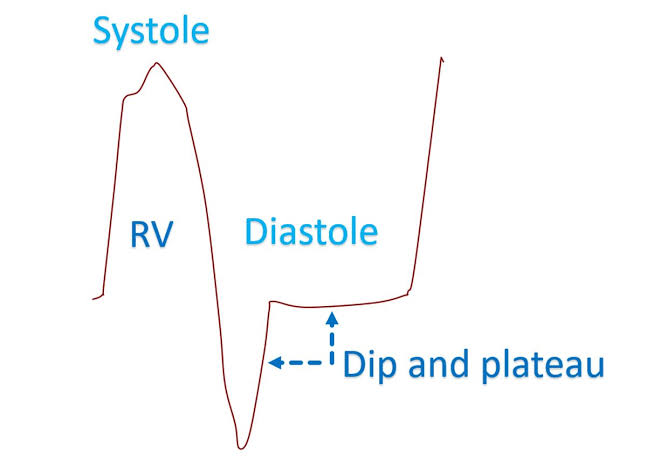
A patient with constrictive pericarditis remains symptomatic despite diuretics. Definitive treatment?
Pericardiectomy

A patient with constrictive pericarditis has evidence of active inflammation. What medication category may be added?
Anti-inflammatory therapy
NSAIDs (such as ibuprofen or aspirin)
Colchicine
Corticosteroids (such as prednisone), particularly if there is an underlying systemic inflammatory or autoimmune condition
Interleukin-1 (IL-1) inhibitors
A patient needs relief of fluid compressing the heart. Which procedure directly treats the problem?
Pericardiocentesis

A 38-year-old man is asymptomatic with an average BP of 148/94 mmHg from at least two readings on each of two visits. He has obesity, a high-sodium diet, and a family history of hypertension, with no identified secondary cause; what is the most likely hypertension diagnosis?
Is his hypertension most likely primary or secondary, Stage 1 or 2?
Stage: Stage 2, based on his BP.
Cause: Primary (essential) hypertension. Typical onset at age 25–50 with genetic and environmental risk factors supports essential hypertension.
A 32-year-old woman with Raynaud phenomenon has a persistent average BP of 138/88 mmHg despite three months of lifestyle changes. She is otherwise healthy and is not pregnant or planning pregnancy; what is the initial medication of choice?
Stage 1 hypertension: nifedipine, a dihydropyridine calcium channel blocker. Persistent hypertension despite lifestyle changes plus Raynaud phenomenon favors a dihydropyridine CCB.
Raynaud phenomenon involves spasms of the small arteries in the fingers and toes, which reduce blood flow and cause color changes, coldness, or pain.
Nifedipine, a dihydropyridine calcium channel blocker, reduces calcium entry into vascular smooth muscle:
↓ Calcium entry → less contraction → arteries relax → improved blood flow to the fingers and toes.
That same vasodilation reduces vascular resistance and lowers BP, so it addresses both her hypertension and Raynaud symptoms.
A 58-year-old man has confirmed BP of 154/96 mmHg without acute symptoms, relevant comorbidities, or medication contraindications. He is not underweight or frail and has no history of multiple medication intolerances; what is the preferred initial medication regimen?
Stage 2 hypertension: COMBO therapy bc he can tolerate it:
an ACE inhibitor OR ARB plus a dihydropyridine CCB, preferably as a single pill.
ex)
Amlodipine / Benazepril (Lotrel)
Amlodipine / Perindopril (Prestalia)
or
Amlodipine / Olmesartan (Azor)
Amlodipine / Valsartan (Exforge)
Stage 2 hypertension without a listed monotherapy exception favors initial combination therapy.
A 55-year-old man presents with BP of 208/112 mmHg and a mild headache but no confusion, chest pain, dyspnea, neurologic deficits, or papilledema. Creatinine and troponin are normal; what is the initial treatment approach?
give the timeline? (hours, days, minutes)
when to follow up?
medication?
Hypertensive urgency: oral combination antihypertensive therapy with gradual BP reduction over 48–72 hours and follow-up within 72 hours.
Severe BP elevation without acute target-organ damage supports oral treatment and gradual reduction.
A 60-year-old man presents with BP of 216/128 mmHg, confusion, and papilledema. He has no asthma, heart block, or acute decompensated HF; what is the diagnosis and the IV antihypertensive of choice from the lecture?
what is the goal to reduce MAP? give the timeline?
Hypertensive emergency with encephalopathy:
IV labetalol with hospital admission, reducing MAP approximately 10–20% in the first hour and another approximately 15% over the next 23 hours.
Confusion and papilledema indicate acute target-organ damage.
A 62-year-old woman with a known intracranial aneurysm has BP of 190/124 mmHg but no symptoms or evidence of acute organ damage. After resting quietly for 30 minutes, her BP remains severely elevated; what is the initial BP-lowering strategy?
give the sys/dias
Hypertensive urgency: lower BP over hours toward ≤160/≤100 mmHg, avoiding a MAP reduction greater than 25–30% over the first several hours. A known intracranial aneurysm places her in the lecture’s higher-risk urgency group.
A 74-year-old woman with diabetes presents with sudden dyspnea, nausea, and diaphoresis without chest pain; BP is 138/84 mm Hg and HR is 96/min. ECG and troponin have not yet been obtained; which diagnosis should prompt immediate cardiac evaluation?
think ab how this dz may present asymptomatic
Suspect ACS; older adults, women, and patients with diabetes may present without chest pain.
A 61-year-old woman presents 1 hour after chest-pressure onset; BP is 132/78 mm Hg and HR is 88/min. Her initial ECG is nondiagnostic and her initial high-sensitivity troponin is negative; what diagnostic step comes next?
Continue serial troponins and ECGs; an early negative troponin does not exclude MI.
The key is that she arrived very early—only 1 hour after her pain started. A heart attack may not show up on the first tests yet.
Two things can happen:
Troponin is still negative: Injured heart muscle releases troponin into the bloodstream, but it takes time to reach a detectable level. An early negative result can mean “too early to detect,” rather than “no heart attack.”
The ECG is nondiagnostic: This means it does not establish the diagnosis. Ischemic changes can evolve or appear during recurrent pain, and NSTEMI can occur without ST elevation.
So “serial” means repeat the tests over time while monitoring her:
Repeat troponins to look for a rise or fall indicating acute myocardial injury.
Repeat ECGs to look for new or changing ischemic findings.
Her normal BP and heart rate show that she is currently stable, but they do not rule out MI.
A 59-year-old woman reports increasingly frequent, prolonged chest-pressure episodes with minimal exertion; BP is 134/80 mm Hg and HR is 82/min. Serial troponins are negative and ECG is normal between episodes; which diagnosis best fits?
Unstable angina; a crescendo symptom pattern can indicate temporary myocardial ischemia without necrosis.
A 60-year-old woman has suspected NSTE-ACS with BP of 136/80 mm Hg and HR of 84/min. Her initial ECG lacks ST elevation and serial troponins are underway; what major management decision should be made first?
what is the main diff btw these 2 tx?
Determine whether an early invasive strategy is appropriate; this is the lecture’s first major treatment decision after initial evaluation.
The core difference is whether you plan cardiac catheterization upfront or use the patient’s response to medical treatment to decide.
Ischemia-guided strategy | Early invasive strategy | |
|---|---|---|
Who? | Generally patients without high-risk features | High-risk NSTE-ACS patients |
Start treatment | DAPT + anticoagulation | DAPT + anticoagulation |
Next step | Monitor response and use noninvasive stress testing | Plan cardiac catheterization within 24 hours |
When PCI/CABG? | If medical treatment fails or evaluation indicates a need | If catheterization shows disease requiring revascularization |
Ischemia-guided: “Start medications and let ongoing ischemia guide whether we need cath.”
Early invasive: “Start medications and plan cath early to identify the blockage and decide whether PCI, CABG, or medications are best.”
Very-high-risk patients—such as those with shock or refractory angina—need immediate invasive evaluation within 2 hours in your lecture.
Remember: Both get medications. Invasive means planned cath; it does not automatically mean a stent.
A 56-year-old man has resolved chest discomfort, BP of 128/76 mm Hg, and HR of 74/min. Serial troponins remain below the 99th percentile, ECG shows no dynamic ST changes, GRACE is 100, and TIMI is 1; what risk category best fits?
what is the tx plan list all meds, what if symtoms get worse?
He fits lower-risk NSTE-ACS, so your lecture allows an ischemia-guided strategy. Lower risk does not mean no treatment.
His plan would be:
Hospital observation and monitoring, with repeat ECGs/troponins as indicated.
DAPT + anticoagulation during acute treatment.
High-intensity statin, plus a beta-blocker if appropriate.
Nitroglycerin if pain returns.
Noninvasive stress testing to guide whether catheterization is needed.
If treatment remains effective, your lecture says aspirin indefinitely and a P2Y12 inhibitor for up to 12 months. A routine or selective invasive approach is also an option for lower-risk patients.
A 67-year-old woman with NSTE-ACS is pain-free with BP of 132/78 mm Hg and HR of 80/min. ECG has no ongoing dynamic changes, troponin is downtrending, and GRACE is 125; what risk category best fits?
tx plan?
Intermediate-risk NSTE-ACS; GRACE 109–140 with absent ongoing ischemic symptoms and stable or downtrending troponin
tx: plan for a cath before they get discarged or 72 hours
A 70-year-old man with NSTE-ACS is stable with BP of 138/82 mm Hg and HR of 86/min. ECG shows no persistent ST elevation, troponin is elevated, and GRACE is 145; what risk category does his GRACE score establish?
tx routine?
High risk; the lecture defines a GRACE score of 141 or higher as high risk.
tx: plan for pt to get a cath in 24 hrs
A 59-year-old woman has chest pressure that resolves, BP of 130/78 mm Hg, and HR of 82/min. ECG during pain showed transient ST elevation that has resolved and troponin is elevated; what invasive timing is indicated without very-high-risk features?
Use an early invasive strategy within 24 hours; transient ST elevation is a high-risk criterion.
Her ST elevation resolved, making it transient, and her elevated troponin supports myocardial injury. She has high-risk NSTE-ACS features, but the vignette excludes very-high-risk features.
A 64-year-old man continues to have severe chest pain despite treatment; BP is 142/86 mm Hg and HR is 104/min. ECG shows persistent ischemic ST depression and troponin is elevated; when should invasive evaluation occur?
Use an immediate invasive strategy within 2 hours; refractory angina despite treatment is a very-high-risk feature.
The deciding clue is “severe chest pain despite treatment”—that means refractory angina. In your lecture, refractory angina is a very-high-risk feature → immediate invasive evaluation within 2 hours.
The pain suggests ongoing ischemia that medications are not controlling, so waiting could allow more myocardial damage.
Findings | Timing in your lecture |
|---|---|
ST depression/elevated troponin without very-high-risk features | Within 24 hours |
Refractory pain despite treatment | Within 2 hours |
His normal BP does not make it safe to wait: refractory ischemia alone qualifies, even without shock.
Exam rule: use the most urgent feature present. Here, refractory pain overrides the 24-hour pathway.
A 71-year-old man with NSTE-ACS develops acute pulmonary edema; BP is 102/66 mm Hg and HR is 116/min. ECG shows ST depression and troponin is elevated; what invasive timing is indicated?
Use an immediate invasive strategy within 2 hours; acute heart failure is a very-high-risk feature.
In this patient, the mechanism is:
ACS → reduced blood flow injures the LV muscle → impaired pumping → pressure backs up into the left atrium and pulmonary veins → fluid enters the lungs.
That is acute left-sided heart failure. You would expect findings such as sudden dyspnea, crackles, and low oxygen saturation.
A 54-year-old woman with suspected unstable angina is pain-free with BP of 124/74 mm Hg and HR of 72/min. Serial troponins are negative, ECG shows no dynamic changes, and GRACE is 95; what noninvasive management strategy is reasonable?
Use an ischemia-guided approach with noninvasive stress testing; patients without high-risk or very-high-risk features may undergo conservative evaluation.
An ischemia-guided strategy is reasonable for this patient, because she is pain-free and has lower-risk findings: GRACE 95, negative serial troponins, and no dynamic ECG changes.
It means medical treatment and monitoring first, with noninvasive stress testing to decide whether she needs catheterization.
For likely unstable angina, your lecture includes:
DAPT + anticoagulation during acute treatment, unless contraindicated.
High-intensity statin and a beta-blocker if appropriate.
Nitroglycerin if pain returns, provided it is safe.
“Ischemia-guided” names the strategy, not a particular medication. If treatment fails or testing suggests significant ischemia, evaluate for cath and possible PCI/CABG. If she develops refractory pain, shock, acute HF, or dangerous arrhythmias, escalate to immediate invasive evaluation within 2 hours in your lecture.
A 58-year-old man is observed after chest discomfort that has resolved. BP is 128/78 mm Hg, serial troponins are negative, and ECG shows no dynamic ischemic changes. His GRACE score is 100. What is the most appropriate management strategy?
can you rule out an invasive therapy?
An ischemia-guided strategy with medical therapy and noninvasive stress testing is reasonable.
No, routine invasive or selective invasive management remains an option; the lecture’s lower-risk algorithm permits either approach.
A 63-year-old woman with NSTE-ACS has BP of 138/84 mm Hg and HR of 88/min. ECG shows ST depression and troponin is elevated; what two antithrombotic treatment categories should be initiated on presentation?
Initiate DAPT and parenteral anticoagulation; the lecture calls for both antiplatelet and anticoagulant therapy at presentation.
(DAPT) combines aspirin and a P2Y12 receptor inhibitor (such as clopidogrel, ticagrelor, or prasugrel)
A 57-year-old man with unstable angina receives DAPT and anticoagulation through an ischemia-guided strategy; BP is 126/76 mm Hg and HR is 74/min. Symptoms resolve, serial troponins remain negative, and ECG shows no dynamic changes; how long should aspirin continue?
Continue aspirin indefinitely; this is the lecture’s recommendation when ischemia-guided therapy is effective.
Aspirin reduces platelet aggregation → lowers the chance of another coronary clot and future MI. This is called secondary prevention because he has already had an ACS event—even though unstable angina did not cause myocardial necrosis.
For your lecture’s ischemia-guided strategy:
Aspirin: indefinitely.
P2Y12 inhibitor: up to 12 months.
A 63-year-old man undergoes catheterization for NSTEMI and remains stable with BP of 128/76 mm Hg and HR of 76/min. His ECG showed ST depression and troponin was elevated, but catheterization finds no indication for intervention; what treatment follows?
give me a breakdown of the medical tx he would be reciveing
Continue medical therapy; the early invasive strategy does not require revascularization when catheterization findings do not support it.
Treatment | Purpose |
|---|---|
DAPT: aspirin + a P2Y12 inhibitor | Reduce platelet aggregation and recurrent coronary thrombosis |
Anticoagulation during acute care | Limit clot formation during the acute episode |
High-intensity statin | Reduce future cardiovascular events |
Beta-blocker, unless contraindicated | Reduce cardiac workload and oxygen demand |
Nitroglycerin if chest pain continues or returns | Relieve ischemic pain |
ACE inhibitor or ARB when appropriate | Especially beneficial with reduced EF, hypertension, or diabetes |
A 69-year-old man with NSTEMI has BP of 132/78 mm Hg and HR of 82/min. ECG shows ST depression, troponin is elevated, and he has severe thrombocytopenia with high bleeding risk on DAPT; how does this affect invasive-strategy selection?
does this present as an absoluet contraindication?
Treat these findings as relative contraindications to an invasive strategy; the lecture specifically lists severe thrombocytopenia and high DAPT bleeding risk.
A 62-year-old man presents 8 hours after the onset of persistent chest pressure; BP is 140/84 mm Hg and ECG shows STEMI. Is reperfusion therapy indicated within the lecture’s symptom-onset window?
Yes, initiate reperfusion therapy; the lecture recommends reperfusion for STEMI presenting within 12 hours of symptom onset.
Reperfusion therapy means restoring blood flow to ischemic heart muscle by reopening the blocked coronary artery.
Your lecture describes two methods:
Primary PCI: a catheter procedure using a balloon and usually a stent to open the artery.
Fibrinolysis: medication that dissolves the clot when timely PCI is unavailable and there are no contraindications.
For STEMI, initiate the reperfusion pathway immediately—do not wait for troponin to become positive.
Timing question | Your lecture’s target |
|---|---|
Symptom-onset window for reperfusion | Within 12 hours of symptom onset |
Primary PCI at a PCI-capable hospital | Door-to-balloon ≤90 minutes |
PCI requiring transfer | Within 120 minutes |
Fibrinolysis when timely PCI is unavailable | Door-to-needle ≤30 minutes |
Fibrinolysis fails | Immediate rescue PCI |
These are maximum targets, not reasons to wait.
For NSTEMI or unstable angina, use medications and risk-guided catheterization, with PCI/CABG if indicated. Do not give fibrinolytics for NSTE-ACS.
Memory anchor: STEMI → restore flow immediately; NSTE-ACS → medications plus cath timing based on risk.