5.2 Stimulus response model
 Call Kai
 Learn
Learn Practice Test
 Spaced Repetition
 Match
Match Flashcards
 Knowt Play
1/8

There's no tags or description
Looks like no tags are added yet.
Name | Mastery | Learn | Test | Matching | Spaced | Call with Kai | Chat |
|---|
No analytics yet
Send a link to your students to track their progress
9 Terms
What is the definition of homeostasis?
The maintenance of a stable internal environment within narrow limits depsite changes to the external environment
Why is it important that homeostasis is maintained? How is it regulated and what is regulated?
Homeostasis: The maintenance of a stable internal environment within narrow limits despite changes to the external environment
It maintains optimal conditions for enzyme and cell function throughout the body
Includes regulation of: Water balance, core body temperature and blood glucose regulation
Homeostasis is regulated by the endocrine system and nervous system
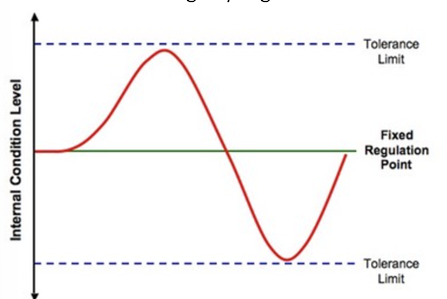
What is the tolerance limit? What happens if an organism exceeds it?
The upper and lower values of an abiotic factor beyond which an organism cannot survive
EG Temperature, pH, salinity
What are the defintions for each component of the stimulus response model?
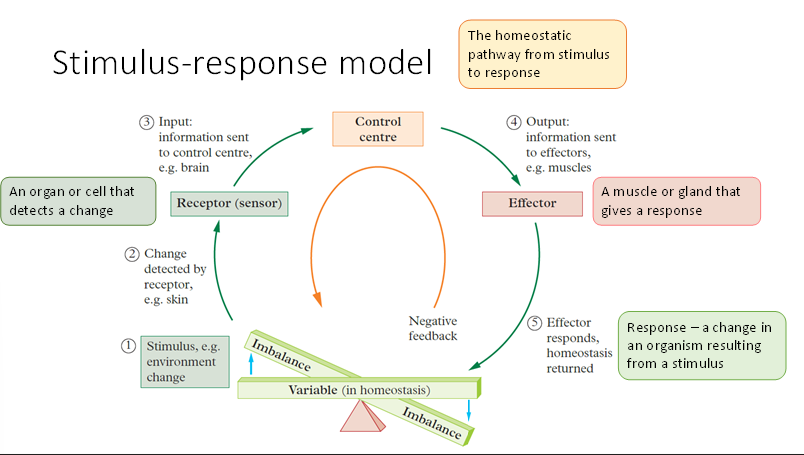
Stimulus: A change in the internal or external environment
Receptor: An organ or cell that detects the stimulus
Control centre: An organ that determines the appropriate response
Effector: A muscle or gland that produces a response
Response: A change that occurs in the organism resulting from the stimulus

What is the pathway of the stimulus responses mode?
A change in the internal or external environment occurs
The receptor detects the stimulus
The information is sent to the control centre where it decides the appropriate response
The information is sent to the effectors which carry out the response
A change occurs in the organism to either reinforce or reverse the stimulus
How can the stimulus response model (the homeostatic pathway) occur?
The homeostatic pathway can occur through nerves (NS) or hormones (ES)
Nerves provide immediate, temporary effects
Hormones take longer as they travel via the bloodstream but have longer lasting effects
What is the role of positive and negative feedback loops and how do they differ?
The two feedback loops that maintain homeostasis and homeostatic mechanisms (EG Thermoregulation, BG regulation)
Negative feedback loops: When the response reverses the stimulus
Positive feedback loops: When the responses reinforces the stimulus
Majority of homeostatic mechanisms in animals involve negative feedback to bring the body back to the tolerance limit
What are examples of negative feedback loops?
Negative feedback example | Stimulus | Response |
Thermoregulation | Increased body temperature | Sweating and vasodilation to decrease body temp |
Blood glucose regulation | Decreased blood glucose | Glycogen released as glucose to increase BG |
Osmoregulation | Increased blood osmolarity | Water reabsorption from filtrate in the nephrons into the bloodstream to increase blood osmolarity |
What are the few examples of positive feedback loops?
Positive feedback example | Stimulus | Response |
Uterine contractions during childbirth | Baby pushing head on cervix | Releases oxytocin which strengthens contractions producing more oxytocin |
Breast milk production | Baby sucking | More breast milk is produced |
Platelets | Vessel damage | Platelets clot blot at the injury site causing more to travel to the site and clot blood to fully cover the injury |
