work and energy flashcards
 Call Kai
 Learn
Learn Practice Test
 Spaced Repetition
 Match
Match Flashcards
 Knowt Play
1/16

There's no tags or description
Looks like no tags are added yet.
Name | Mastery | Learn | Test | Matching | Spaced | Call with Kai | Chat |
|---|
No analytics yet
Send a link to your students to track their progress
17 Terms
what is work? what is the formula? and what do the variables stand for?
applying a force over a distance
U = F x D
F - weight lifted
D - distance lifted
work is U = F x D, what is the relationship between force and distance?
force and distance/displacement are inversely related
if force inc, then distance dec
if force dec, then distance inc
what units is work measured in?
JOULES (even though it looks like it should be Nm)
what is the definition of energy?
the capacity to do work
what are the 5 types of energy?
potential energy
kinetic energy
strain energy
thermal energy
mechanical energy
what is potential energy? formula? units?
the capacity to do work due to an object’s position
PE = m x g x h
remember weight is m x g so PE can also be PE = W x h
measured in Nm or Joules

what is kinetic energy? formula? units?
the capacity to do work due to an object’s motion
KE = ½ x m x v²
measured in Joules or Nm

what is the relationship between mass and velocity in kinetic energy? which one has larger effect and why?
mass and velocity are inversely proportional
mass inc, velocity dec
mass dec, velocity inc
velocity has a larger effect bc it is squared

what is strain energy? formula? units?
the capacity to do work due to the deformation of an object (a type of potential energy)
SE = ½ x k x x²
k is the stiffness of the material
x is the deformation of the material
measured in Nm or J

what is the relationship between k and x in strain energy? which has a larger effect?
k and x are inversely proportional
k inc, x dec
k dec, x inc
deformation (x) because it is squared
what is thermal energy and what causes it?
heat production through the loss of kinetic energy from the system into surrounding molecules
caused by friction

what is the work - energy relationship?
work = energy is transferred from one object to another
basically just passing energy around not creating new energy

how do you do work to increase energy?
apply work (a force over a distance) to increase energy in an object
impulse - momentum - impulse
impulse to start motion
momentum to continue it
impulse to stop motion
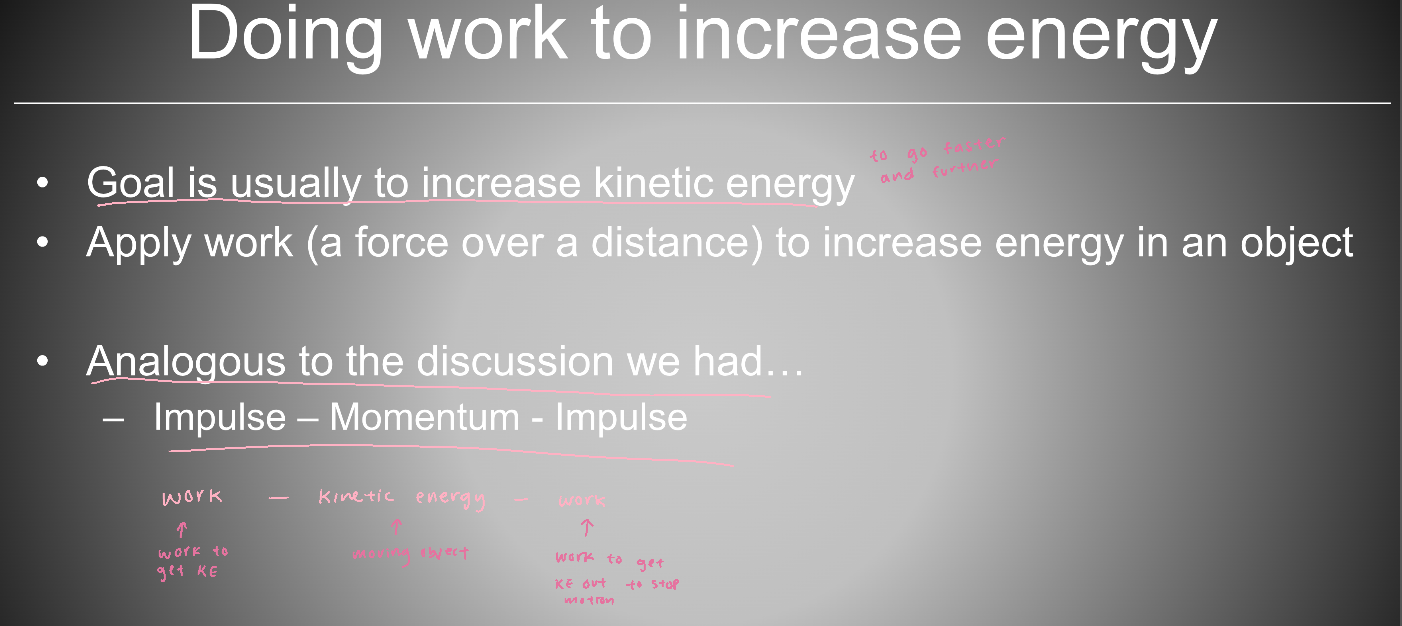

understand the impulse - momentum - impulse in these pictures
impulse starts the motion, momentum continues it in the trajectory, impulse (the target in the second pic) stops the motion
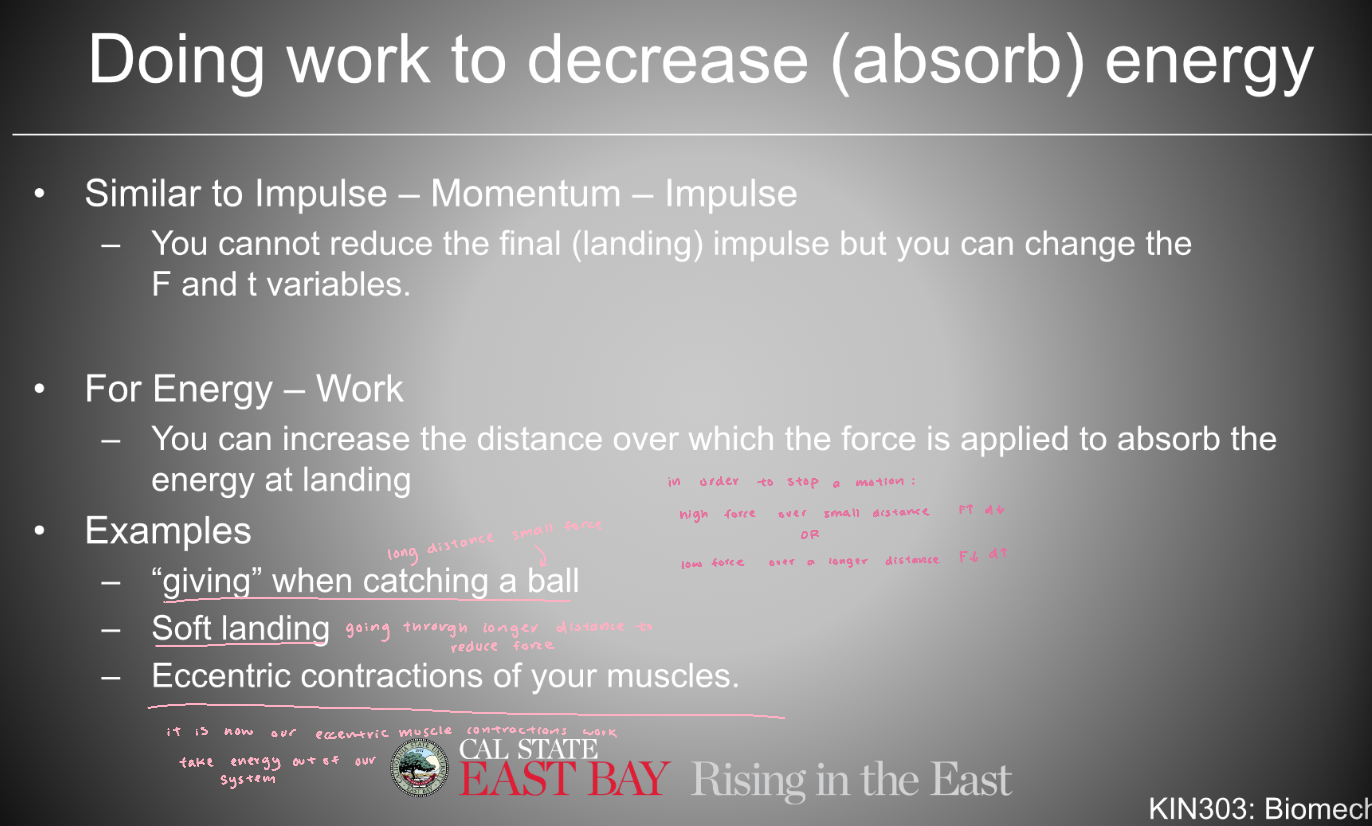
how do you do work to decrease (absorb) energy?
you can manipulate the F and t variables to change how you absorb energy
LOOK AT PIC
what is the main principle of conservation of mechanical energy?
potential energy <-> kinetic energy
energy is never created or destroyed, only transferred
the amount of energy is the same (mechanical energy)
ME = PE + KE


another example of the conservation of mechanical energy
