Genetics and molecular biology semester 1
 Call Kai
 Learn
 Practice Test
 Spaced Repetition
 Match
 Flashcards
 Knowt Play
1/316

There's no tags or description
Looks like no tags are added yet.
317 Terms
Charles Darwin
HMS beagle voyage, diffrences in finches beaks’
Gregor Mendel
Interbred pea plants displaying different traits. Postulated that there are hereditary factors (genes)
Friedrich Miescher
Examined chemical composition of leukocytes. Leading to the discovery of nuclein (DNA)
Friedrich Miescher
Bandages collection and isolated phosphorous-rich ‘nueclein’ using pepsin
Walther Flemming
Stained cells of salamander embryos, enabling the visitation of threadlike material which we know know was chromosomes.
Walther Flemming
Observed the process of cell divison- mitosis
Whilehem Ldvig Johannsesn
Phenotypes and genotypes
Thomas Hunt Morgan
Drosophila fruit flies. Genes are linked on a series of chromosomes
Hermannn Muller
Exposure to x-rays cause mutations- mutations can be caused by environmental factors including radiation
Erwin Chargaff
Complementary base pairings.
Rosalind Franklin
Photo 51 revealed the helical structure of DNA
Marshall Nirenberg
Mapped out 64 RNA triplet codons and the 20 major amino acids
Kary Mulis
PCR
Doudna and Charpentier
CRISPER-Cas9 can be used as an in-vitro genome editing tool.
Gene
Sequence of DNA capable of producing a product (Protein, trait, characteristics etc.)
Allele
alternative form of a gene/DNA sequence (outcome of mutations)
Locus
Site/position of a gene/DNA sequence on a chromosome.
Homozygote:
Trait with similar (like/identical/same) types of alleles
Heterozygote
Trait with unlike (different) types of alleles
Dominant Allele
Allele which are phenotypically expressed in both homozygotes and heterozygotes
Recessive allele
Not expressed when paired with a dominant allele
Co-dominant Allele:
Both alleles can express. (Most common classification of genes)
Each parent has two copies of the genetic information
homozygous
Heterozgous
the F1 progeny contains two different variants (alleles) of the gene
F2 generation

Law of segregation
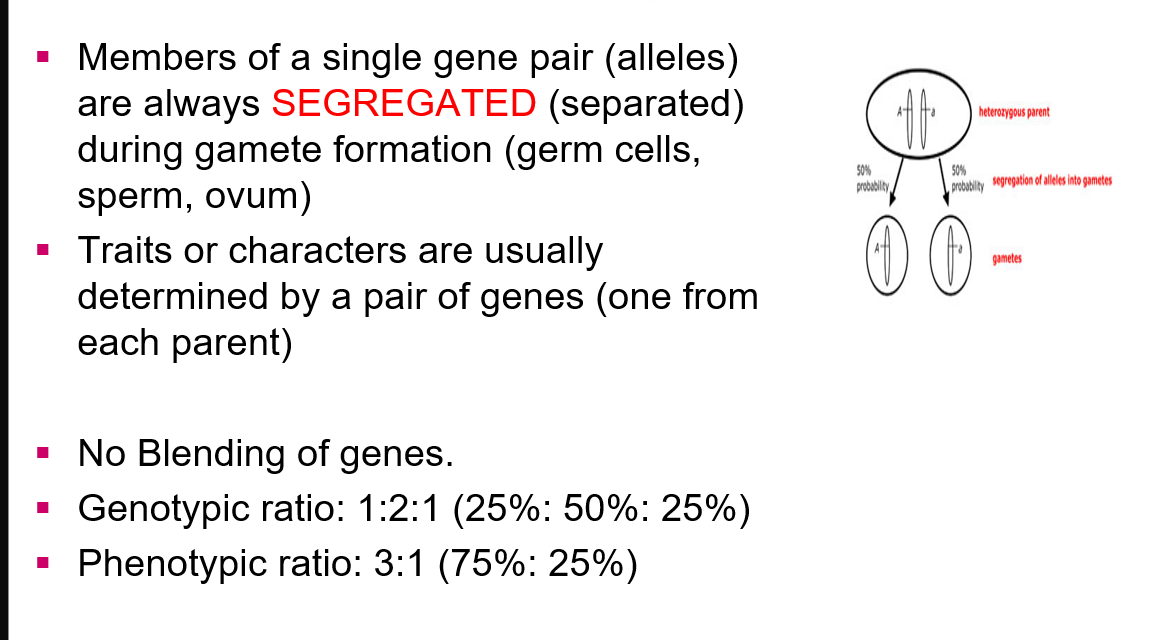
When gametes form, alleles are separated so that each gamete carries only one allele for each gene
Law of independent assortment
The segregation of alleles for one gene occurs independently to that of any other gene
Law of dominance
Recessive alleles will be masked by dominant alleles
Mendel pea experiment

F1 reappearance
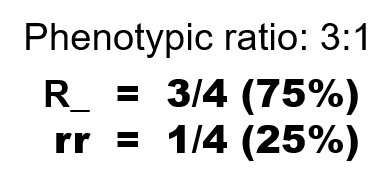
Mendel noted that traits that disappear in the F1 reappear in the F2. The F2 has a ratio of about three individuals with the phenotype of the F1 to one individual with the “reappearing” phenotype – 3:1 ratio
Monohybrid cross

Monohybrid cross genotypic ratio

Monohybrid cross phenotypic ratio
Mendel's First Law is the Law of Segregation.
It states that each organism carries two alleles for a gene, and these alleles separate (segregate) during gamete formation (meiosis), so each gamete receives only one allele.
Segregation principle
Round peas (W)
contain amylopectin and shrink uniformly as they dry
Wrinkled (w)
seeds have a mutation in the starch-branching enzyme I (SBEI) and cannot make amylopectin and shrink irregularly
Gene
A physical and functional unit of hereditry
Testcross analysis
We cross this organism with one we know is homozygous recessive. Then, the phenotypes can be attributed solely to the gene they inherited from the Unknown parent.
if unknown WW
progeny of the testcross will be Ww (dominant) progeny
If unknown Ww
1/2 the progeny of the testcross will be Ww (dominant) and 1/2 the progeny will be ww (recessive)
Multiplication Rule
The probability that two independent events, A and B, are realized simultaneously is given by the product of their separate probabilities
Addition Rule
The probability that one or the other of two mutually exclusive events, A or B, is the sum of their separate probabilities
Autosome
all chromosomes that are not sex chromosomes.
Mendel’s 2nd law
Alleles of different genes assort independently of one another during gamete formation.
What does Mendel’s 2nd law mean
inheriting one trait does not usually affect the inheritance of another trait, provided the genes are on different chromosomes (or far apart on the same chromosome).
The Principle of Independent Assortment
Segregation of the members of any pair of alleles is independent of the segregation of other pairs in the formation of reproductive cells.
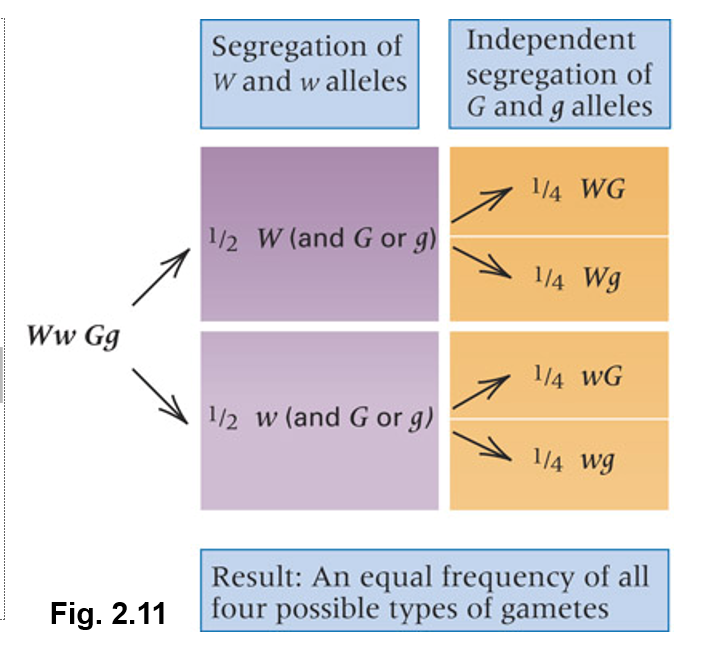
Alleles sorted into sex cells independently
indepedant seggregation
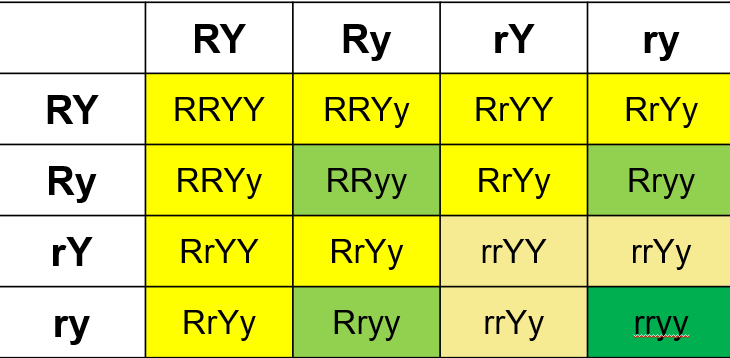
Dihybrid cross
Mendeks dihybrid cross
Round Yellow x Wrinkled Green
Is behavior of one set of genes dependent on the other set of genes
No

Chi-squared
Purpose of Chi-squared
Compares Observed numbers with Expected numbers
Importance of Chi-Squared
Confirms whether your experiment is according to expectation or not.
The significance of Chi-Square can be assessed using a Chi-square table with appropriate degrees of freedom.
Degree of Freedom = No of Categories -1 (for 2x2 tables)
Others: ( No of Cat-1) X (No of Classes-1)
Significance of Chi-squared
If the observed Chi-value is greater than the Table value then the differences are Significant. If Less, then the differences are NOT SIGNIFICANT, i.e., Results are as expected.
Perturbations
Changes made to a biological system that affect its normal function.
Incomplete dominance
the phenotype of the heterozygous genotype is intermediate between the phenotypes of the homozygous genotypes
Codominance
means that the heterozygous genotype exhibits the traits associated with both homozygous genotypes
Penetrance
refers to the proportion of organisms whose phenotype matches their genotype for a given trait. A genotype that is always expressed has a penetrance of
Epitasis
§refers to a gene interaction that results in a modified F2 dihybrid ratio other than 9 : 3 : 3 : 1. One gene essentially masks the expression of the other.

Epistaisis
Nucleic acids
Macromolecules made out of neculeotides

Nucleotide
Open chain
Linear
Closed chain
cyclic
Hydroxy group on ribose
On bottom
Hydroxy group on deoxyribose
No hydroxy group
in aqueous solutions
High levels of interconversion
Pyramadine
Single ring- CUT
Purines
double ring structure- AG

Purines
Pirymidines

Alpha or beta links dependant on
Position of hydroxy groups
N-Glycosidic bond
covalent bond that connects a nitrogenous base to the pentose sugar in a nucleotide.
Location of N-glycosidic bond
between C1′ of the pentose sugar and N1 of the pyrimidine base or N9 of the purine base joins the pentose sugar to the nitrogenous base

Reaction that form N-glycosidic bond
Condensation reaction
nucleosides
Nitrogenous base and Pentose sugar with no phosphate group
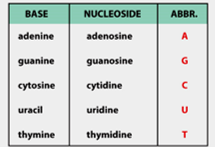
Nucelosides
Phosphate groups/bonds
Easily hydrolysed, so “high energy bond”

Phosphate ester
Which carbon are phosphates bonded to
P5
Neculeotides
5' phosphate esters of nucleosides
Nucleotide triphosphates
the universal currency of energy in biological systems (ATP)
Adenine nucleotides
components of the coenzymes, NAD(P)+, FAD, and CoA
Nucleotides in metabolic reactions
c-AMP is a common mediator of hormonal actions
nucleotides as activated intermediates
UDP-glucose to glycogen
Phosphodiester bonds
3’ OH to 5’ phosphate (5’ to 3’)
Direction of phosphate bonding
3’ to 5’

Sugar phosphate backbone
multistep process driven by ATP hydrolysis
DNA and RNA synthesis
C-G
3 H bonds
A-T
2 H bonds
Ratio of bonds
affects stability of DNA polymers
James Watson & Francis Crick (1953)
Double helix of anti-parallel strands
Held together by hydrogen bond formation
Purine with Pyrimidine
Guanine - Cytosine
Adenine - Thymine
Bases stack inside the helix
Complete turn of helix
34Å or 3.4nm
Which DNA groove is most commonly used for protein binding?
The major groove, because it is wider and exposes more information from the base pair
What causes major and minor grooves in DNA?
The two sugar-phosphate backbones are not directly opposite each other, creating alternating wide and narrow grooves.
Van der Waals distance
distance at which two molecules are attracted to each other
DNA helix
It contains two polynucleotide strands wound around each other
The backbone of each consists of alternating deoxyribose and phosphate groups
The phosphate group bonded to the 5' carbon atom of one deoxyribose is covalently bonded to the 3' carbon of the next
The two strands are "antiparallel"; that is, one strand runs 5′ to 3′ while the other runs 3′ to 5′
The DNA strands are assembled in the 5′ to 3′ direction and, by convention, we "read" them the same way
The purine or pyrimidine attached to each deoxyribose projects in toward the axis of the helix
1’ carbon
n-glycosidic bond to the nitrogenous base