Liners, Sockets, and Suspensions
 Call Kai
 Learn
 Practice Test
 Spaced Repetition
 Match
 Flashcards
 Knowt Play
1/57

There's no tags or description
Looks like no tags are added yet.
58 Terms
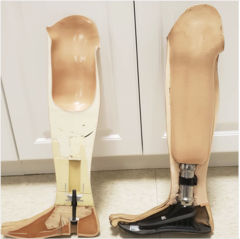
Exoskeletal design (crab)
______: prosthesis where the OUTSIDE of the structure provides durability, support, and structure

Endoskeletal design (show your mettle!) -- lighter than the exoskeletal version
______: prosthesis where a pylon (vertical support rod that is sometimes hollow, sometimes w/ a charger cord inside) provides durability, support, and structure
- w/ or w/o outer cover
- either structural or cosmetic covering
Suspension
______: method by which the prosthesis is held to the residual limb
Amputation level, body habitus, activity levels, activity choices
What are factors that impact suspension?
Lanyard
State the type of suspension.

Pros: Works w/ a long limb, minimal space needed for clearance.
Cons: Needs to be connected or disconnected each time the leg is donned or doffed. Easy to bottom out and distal end weight bear on residuum.
Describe pros/cons of lanyard suspension systems.

Lanyard strap is manually fed through a hole in the distal end of the socket and secured to the outside of the socket w/ velcro. Minimal alignment of the sleeve needed during donning as the limb will be drawn down by tension in thel lanyard. Also eases the force required to push into the socket. Limb will decrease in girth under tension.
How do you don a lanyard suspension?
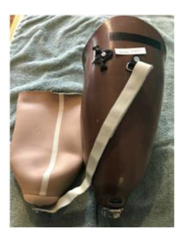
Pin lock mechanism
State the type of suspension.

Pin lock works in conjunction w/ a locking mechanism built into the distal end of the socket that engages with the pin.
To remove the prosthesis, they must disengage the pin via a button to release the catches while pulling the socket off.
Most offer an audible "click" to indicate that the pin has engaged (clutch mechanism -- smooth pin -- much less common).
Describe the pin lock mechanism.

Pros: once you're in and get the hang out it, you're in!
Cons: not uncommon to hear an additional "click" or two as you spend more time WB. Easy to bottom out and distal end weight bear. Some wearers experience frustration, as it can be difficult to align the pin correctly.
What are the pros/cons of the pin lock mechanism?
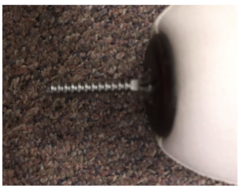
Suction -- NOT COMMON
State the type of suspension.

Liner may or may not be worn and will require don/doff in standing (only in AKA/TFA). TTA/BKA NOT generally utilizes.
Describe suction suspension.

An external sleeve provides the suspension w/ an internal liner. Modern sleeves are referred to as "sealing sleeves" bc they are made of nonporous materials that seal the proximal end of the socket against the skin and liner so that no air can flow into the socket to break the seal.
- One-way air valves used to allow air that is trapped during donning to escape
- Needs about 5 cm of contact w/ skin to seal
Describe the suction w/ sleeve combo.

Seal ins
State the type of suspension.
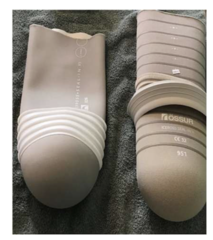
Skin must be free from deep scars or invaginations in that areas, as they would provide a path for air.
Suspension from the level of the seal > distal end of limb. Some static, some adjustable positions.
Describe seal in suspension.
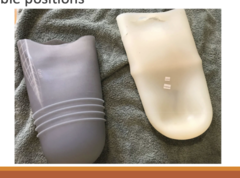
Pros: Annular rings or a ring w/ gill-like structures to create the seal and close the system. Do NOT allow for much volume changes.
Cons: no active pulling of air out of the system = passive system (vs. a vacuum).
Describe pros/cons of seal in suspension systems.

Vacuum
State the type of suspension.

Used w/ a well shaped, fairly strong residual limb. Usually younger and active patients. To be called vacuum, something must actively draw air out of the system. Limb is drawn out to the edges w/ a vacuum pump (electric or mechanical).
Describe vacuum suspension.

Pros: electric pumps are able to accurately control the level of vacuum within the socket by turning on and off at present thresholds
Cons: highly susceptible to failure as a consequence of leaks
Describe pros/cons of vacuum suspension.

Elevated vacuum
State the type of suspension.

Mechanical pumps use the natural cycle of compression during stance and distraction during swing to pull air from the socket during gait.
- maintains limb volume by preventing fluid loss that occurs during prolonged WB
- socket environment has decreased motion, fewer skin problems, improved prosthetic control, better balance, lower impact forces
- requires a sealing sleeve
Describe elevated vacuum suspension.

Pelite inner 'liner'
State the type of suspension.

Slightly compliant, usually peach colored foam material that is used as an inner socket to provide contact and WB to pressure tolerant areas.
NOT used w/ a silicone type liner. Only used with socks. Suspended by alternative means (anatomic, belt, corset).
NOT commonly used in TT/TF. Can be used for Symes/Boyd. Also seen w/ long congenital TT amputations or those w/ supracondylar or suprapatellar suspension.
Describe pelite inner 'liner' suspension.
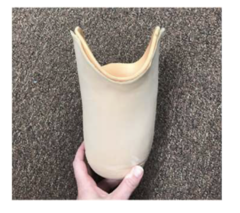
Belt and strap -- RARE usage
State the type of suspension.

Used for those that are unsuccessful w/ pin, suspension, seal in, or frame type sockets. Also used for immediate post-op prosthesis. Usually combined w/ a rigid removable dressing.
Describe belt and strap suspension.
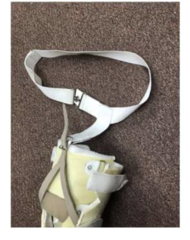
Silesian Belt
State the type of suspension.

Used for hemi-pelvectomy and hip disarticulation. Also used for secondary suspension in TFA (AKA).
Describe the Silesian Belt for suspension.

Hard
State the type of socket.

Past: direct contact b/w socket and residual limb (wood, plastics, laminate)
Now: carbon fiber in most recent prosthetics are worn w/ liner that is gel, silicone, or similar -- exceptions for much longer limbs and those w/ anatomical suspension (ex: long TTA, Symes, Boydes)
Describe hard sockets.

Flexible socket inner liner w/ full socket
State the type of socket.

Secondary mold = cushion or suspension; can be made with petite, thermoplastic material (most common), or leather
Describe socket sockets.

Flexible socket liner w/ frame socket
State the type of socket.
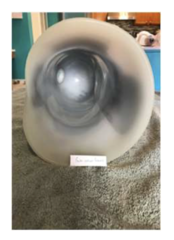
Worn b/w the hard socket and the residual limb and sometimes used with another type of suspension or the suspension is attached to the liner (made w/ silicone, urethane, silastic elastomer, gel)
NOTE: these are usually donned on first
When/how are liners used?
Hemipelvectomy
State the type of socket.

Total embracing socket: held on by lateral strapping mechanism or door w/ additional suspension via shoulder strap (if needed)
Describe the hemipelvectomy socket.
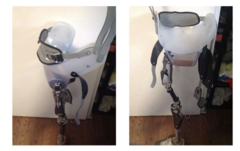
Cons: poor long-term use, hygiene and toileting are severely limited, heavy use of alternative ADs
Describe pros/cons of the hemipelvectomy socket.

Quad socket (TFA)
State the type of socket.

RARE -- going out of style.
- wider ML dimensions (lateral wall higher vs. anterior wall, anterior wall higher vs. medial wall)
- narrower AP dimensions (high anterior wall providers counter pressure for posterior wall)
- allows for some muscle contractions
- set in 10 degrees of ADduction
Describe a quadrilateral (quad) socket.

A component of the quad socket that maintains the ischial tuberosity on the ischial seat by providing counter pressure against the posterior wall and reducing chance of injury in Scarpa's triangle
What is Scarpa's bulge?

While it increases stability, it puts the gluteus medius at a disadvantage
What is a negative consequence of a high lateral wall?
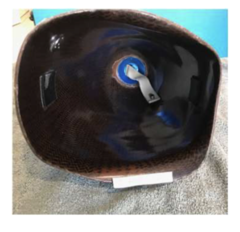
Ischial ramus containment (IRC) (TFA)
State the type of socket.

Most used socket for transfemoral amputees.
- wider AP dimensions
- narrower ML dimensions
- ischial tuberosity it ALWAYS contained
- most designs do not include pubic rami containment
Describe an IRC.
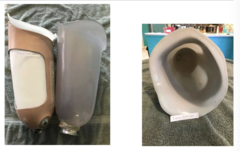
Pros: allows for muscle contractions and stability on the bony prominences, provides more room and better hip ROM vs. the quad socket
Describe pros/cons of an IRC.

Subischial (TFA)
State the type of socket.
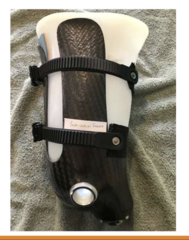
Usually better for longer limbs; created by lowering proximal trim lines while maintaining stability
- newer vacuum and suction suspension technology can lead to additional reductions in brim heights or trim lines --> potential to provide increased hip ROM and muscle activation w/ less pistoning and more comfort
- proximal trim line is DISTAL to the ischial tuberosity --> increased tissue health and proprioceptive input
- the tighter = the lighter
Describe an subischial socket.

Plug and corset (TTA)
State the type of socket.

Open-end or plug socket made of carved wood and a thigh strap system. Distal end is open leaving no contact w/ the residual limb. Significant problems w/ distal end edema.
Corset straps - used leather buckles to suspend/hold prosthesis.
Describe the plug and corset socket.

Boyd or Symes
Which amputations are plug and corset sockets MOST applicable for?

Patellar tendon bearing (TTA)
State the type of socket.

Closed distal end of the socket to provide better edema control vs. open plug socket. Medial and lateral walls about 2/3 up the femoral condyles. CAN at times have a soft pelite or inner socket and/or use cuff straps.
Describe a patellar tendon bearing socket.
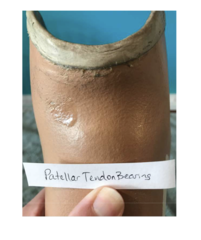
Pros: posterior wall pushes the limb towards the anterior portion of the socket to allow for patellar tendon WB and attempts take pressure off hamstrings and place into the calf.
Cons: socket relies on excess loading in pressure tolerant areas and it may be easy to 'bottom out' w/o adequate sock ply.
Describe pros/cons of a PTB.

Total contact (TTA)
State the type of socket.

3D-printed "check socket" to determine if the socket fits well.
- WB distributed in pressure tolerant areas, less WB in areas w/ less tolerance
- may have a flexible inner plastic duplicate of the socket for improved customizability
Describe a total contact socket.

Pros: less WB in areas with less tolerance, less bottoming out
Cons: skin break down w/o adequate sock ply
Describe pros/cons of a total contact socket.

Supracondylar suprapatellar (SC-SP) socket
State the type of socket.

Takes advantage of the femoral condyles and soft tissue
- medial lateral walls/brim rise above and encompass the condyles
- anterior wall encompasses the patella at least 3/4
- usually a quadriceps bar (indentation to prevent full knee extension into recurvatum)
- must have wedge or some other way to don/doff
Describe the SC-SP socket.

Symes/Boyd
State the type of socket.

Depending on the length, these can give some PTB for pressure relief or WB distribution. Doors, windoms, or custom liners.
Describe the Symes/Boyd socket.