Biology 343 Exam 2 - Talia
 Call Kai
 Learn
 Practice Test
 Spaced Repetition
 Match
 Flashcards
 Knowt Play
1/80

There's no tags or description
Looks like no tags are added yet.
81 Terms
Can genes on the same chromosome still undergo independent assortment
Yes, crossing over during prophase
What would make genes less likely to independently assort
if the two genes are super close together on the same chromosome
What is needed for genes on the same chromosome to independently assort
-need to be far apart
-crossing over is then more likely
-chiasmata impact genes differently because they are in different parts of the chromosome
recombinant offspring
have alleles not found in OG parental chromosome
-due to cross over event in gamete formation in at least 1 parent
If genes are close together on the same chromosome
-less likely to cross over separately
-law of independent assortment is violated
-genes are linked
Genetic Linkage
the genes close together` on a chromosome tend to be transmitted as a unit
-changes inheritance patters from expected
how did we figure out genetic linkage?
1905 Bateson and Punnett tried to cross sweet peas looking at flower color and pollen shape
-concluded that traits are linked but no clue as to mechanism

linkage groups
group of genes whose inheritance is physically linked, must be on a single chromosome
-whole chromosome defined as a linkage group
Thomas Hunt Morgan doing 3 factor crosses with X linked traits in flies
-body color, eye color, wing length
-how we found out different genes are physically on the same chromosome and can be linked
-raised two questions
--why are the traits present in the P generation much more common in F2 than expected
--If they are linked why are there so many recombinant patterns

What is happening with the chromosomes in Morgan's experiment?
Some genes are more closely linked than others, leading to much variation, and why we see recombination as well as linked genes
Why are there more recombinant offspring between wing length + eye color vs body color and eye color?
Wing length and eye color genes are closer together than eye color and body color

Variations in recombination rates
-number of cross over events is variable
-chaisma don't always form in the same place
-can be sexual dimorphism in recombination rates
what can we use linage groups to study?
evolution
chi square analysis
tests "goodness of fit"
-how similar is the observed data to the expected data predicted by the null hypothesis

p-value
probability you get the results you did if the null hypothesis is true
-0.05 threshold = we are ok with a 5% chance of falsely rejecting the null
degrees of freedom
number of categories that are independent of each other
genetic mapping
determining linear order and distance of genes linked together on a chromosome
-aka linkage mapping
Map distance equation
units are map units (mu)
-1 mu = 1% recombination frequency
-up to 50%

order of frequency
-nonrecombinant phenotypes, then single cross over phenotypes then double cross over phenotypes
which traits are in the double cross over recombination tell us which gene in the middle
1. see which phenotype has the least number of offspring
2. compare it to the parent phenotypes (most number of offspring)
3. the one trait that is different in the recombinant offspring is the gene in the middle
modern genetic mapping
-sequence across lineage, see what markers are almost always present with phenotype
why do we care about gene distance
figure out wheat causes disease, inform breeding/ artificial selection choices in agriculture, knowing where a gene is and surrounding regulatory regions is very useful
why do we look at recombination specificially
highly repetitive DNA sequences mess up genome assembly
recombination rates/linkage don't just depend on distance
-different species/taxa have different number of chiasmata
-same distance does not mean the same level of linkage in different speices
how are chromosome number and structure different
between species
-if variation occurs within species: often harmful
--if not important for speciation events
how do chromosome structure vary
size, centromere position (p vs q)
-G-banding: macroscopic level, stained
deletions
segment of chromosome removed
-from breaks in chromosome
duplications
segment of chromosome is repeated
indel
insertion/deletion of DNA segmentt
is duplication, indel or deletions worse for fitness
deletion - results in loss of potential gene function needed for survival
chromosome deletion
usually harmful
-genes missing = dosage problem
-how harmful depends on if the region has several duplicated genes and how big the deletion is
how do deletions cause a loss of heterozygestity
-inherit mutant tumor suppressor allele and wildetype allele
-functional tumor suppressor allele is deleted
-no longer have working tumor suppression
chromosomal duplication
-rarely associated with disease
-size still determines phenotypic consequences
--less harmful than deletion of same size
-important evolutionary force
gene families
-caused by small chromosomal duplication
-genes similar in sequence
-proteins have similar functions
-using gene families to understand ecosystem degradation and inform restoration
pseudogene
used to be functional but lost function
subfunctionalization
gene duplication produces gene copies that diverge and divide the work initially undertaken by the gene before duplication
neofunctionalization
duplicated genes diverge and one copy takes on new function
changes to chromosome structure
rearranging genetic material withing and among chromosomes
inversion
change in direction of genetic material
4-3-2-1 to 4-2-3-1
-generally few phenotypic consequences except if it breaks at an essential gene
-can make deletions/duplications more likely
translocation
segment of one chromosome becomes attached to another
-crossing over of non-homologous chromosomes
reciprocal translocations
2 non-homologous chromosome that exchange genetic material
-abnormal crossover
-chromosomal breaks + DNA repair
what do balanced translocations lead to
translocation cross in meiosis = incorrect segregation
best case scenario for balanced translocations
2 homologs with translocations and split together (same amount of DNA in each gamete)
best of the worst scenario
each daughter cell gets one normal and one translocated, leading to unbalanced translocation
-often not viable leading to semi sterility
worst of the worst case scenario
chromosomes do not separate properly at all, everyone is missing 1 chromosome and have 1 extra
unbalanced translocation
translocation causes significant duplication or deletion of genetic material
-often see phenotypic abnormalities
-these are often not viable
familial down syndrom
-either 3 extra copies of chromosome 21 or extra partial copy of chromosome 21 from unbalanced translocation
-a person with a balanced translocation is a carrier of down syndrom
--1/3 normal, 1/3 carrier, 1/3 familial down syndrome, other half die
euploid
chromosome number is even multiple of chromosome set
polyploid
organism with 3+ sets of chromsomes
impact of chromosome number depends on
species, even vs odd
aneuploid
variation in chromosome number not even multiple of a set
-almost always causes an abnormal phenotype
--either too much (triploidy) of a gene or too little (monoploidy)
aneuploid in humans
-large chromosome aneuploidy = lethal
-small chromosome aneuploidy = better tolerated expecially if trisomy
meiotic nondisjunction in meiosis 2
chromosomes don't separate correctly in anaphase 2

meiotic nondisjunction in meiosis 1
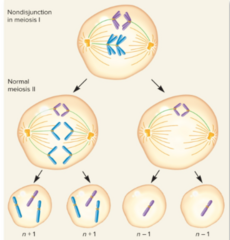
what does complete nondisjunction result in
triploid individuals
what percent of the human genome in unique
41%
where is the highly repetitive DNA located
near telomeres and centromeres
telomere
protective end cap that prevents important DNA from being degraded
-important for replication and stability
histones
protein associated with DNA
-wrap and pack DNA with
nucleotide structure
-phosphate group
-5 carbon sugar
-a base
purine bases
adenine and guanine

pyrimidine bases
thymine, cytosine uracil

DNA backbone
5' carbon of one nucleotide attached to 3' carbon of another via phosphate group
-all sugars go in the same direction (5' to 3')

chargaff's rule
[A]=[T] and [G]=[C], they pair up across from one another forming two strands also called base pairing.
who discovered the double helix structure
Watson and Crick, Rosalind Frankin
what 2 grooves are on DNA
major groove and a minor groove
what are grooves for in DNA
binding sites for proteins
RNA structure
-have uracil not thymine
-usually 1 strand not 2
-base pair within RNA molecule = double stranded regions
what do the double stranded regions of RNA form
-ribosomes
-tRNA
-pinlock structure
DNA replication basics
-unzip
-each strand used as a template
-in duplicated DNA have 1 daughter and 1 parental strand
DNA replication - bacteria
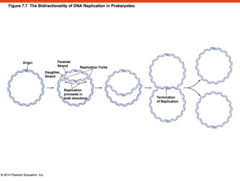
initiation of bacterial DNA replication
-1 origin of chromosomal replication (AT-reich region with DnaA boxes)
-separating the strands (bind with DnaA, DNA helicase does the rest)
what do single strand binding proteins do in DNA replication
keep the strands of DNA separate
replication forks in Bacterial DNA
-move in opposite direction

primase
enzyme that makes RNA primers for DNA synthesis
-leading strand: 1
-lagging strand: multiple
DNA polymerase III
synthesizes daughter strand
-only can attach 5' to 3'
replicates DNA with high fidelity (stability of base pairs, structure of DNA poly III active site, proofreading function of DNA poly III)
leading strand
going 5' to 3' away from origin, same direction as replication fork
lagging strand
3' to 5' away from the origin
-away from fork
-DNA polymerase can't go this way, so goes in chunks
Bacterial replication complex

how do we make the lagging strand if it goes 3' to 5'
-loop the DNA
-DNA polymerase will synthesize Okazaki fragments
--finish fragments: release strand
--add new RNA primer
--reloop
--make another fragment
polymerase 1
takes off all the RNA primers, replaces with DNA