Fungal skin infections
 Call Kai
 Learn
 Practice Test
 Spaced Repetition
 Match
 Flashcards
 Knowt Play
1/35

There's no tags or description
Looks like no tags are added yet.
36 Terms
What are the types of fungal skin infection?
Type | Cause | OTC self-care? |
|---|---|---|
Tinea | Dermatophytes (fungi) | ✅ Certain types |
Candida | Yeast | ❌ Refer |
Tell me about Fungi
Fungi thrive in warm, moist, dark environments.
Spread through infected people, animals, soil, or contaminated objects (fomites).
The 3 tinea infections appropriate for OTC self-care are corporis, cruris, and pedis.
Fungal skin infections
Pathophysiology - the process
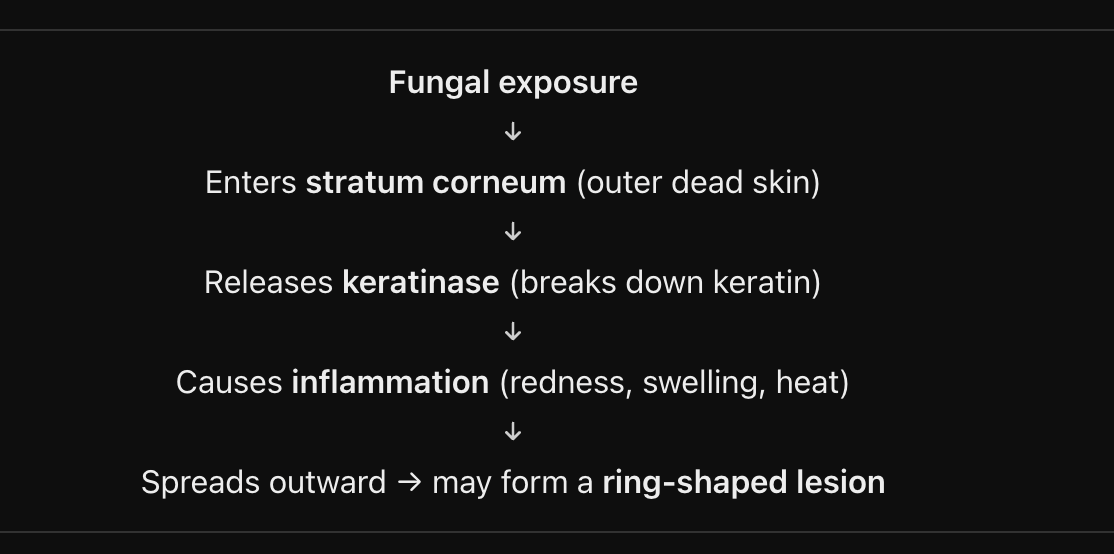
Fungal skin infections
Pathophysiology - general facts
The immune system can sometimes clear the fungus naturally.
Infection develops or persists when fungal growth exceeds normal skin turnover.
Immunocompromised patients have greater risk of severe or widespread infection.
Fungal skin infections
Risk factors
isk factor | Why? |
|---|---|
Diabetes | Glucose can encourage fungal growth |
Immunosuppression | Weaker immune defense |
Poor circulation | Reduced local defense |
Obesity | Skin folds may trap moisture |
Tight shoes/clothing | Trap heat and moisture |
Sweating/humid climates | Favor fungal growth |
Poor nutrition/hygiene | Weaker skin barrier |
📌 Professor also mentioned SGLT2 inhibitors can increase genital fungal infections because they increase glucose in urine.
Types of tinea - chart
Infection | Location | OTC? |
|---|---|---|
Tinea corporis (ringworm) | Trunk, arms, legs | ✅ |
Tinea cruris (jock itch) | Groin/upper thighs | ✅ |
Tinea pedis (athlete's foot) | Feet | ✅ |
Tinea capitis | Scalp | ❌ |
Tinea unguium | Nails | ❌ |
Tinea barbae | Beard/mustache | ❌ Refer |
Types of tinea
Tinea corporis
Circular, red, scaly lesion
Border
Raised, darker border
May itch or have vesicles/pustules at border
Darker skin may show hyperpigmentation
Risk: children, contact sports, humid climates
Types of tinea
Tinea cruris
Both upper thighs (bilateral); Often very itchy; may be painful
borders: Well-defined, slightly raised
Penis/scrotum usually spared
More common in adults and men
Types of tinea
Tinea pedis
Most common tinea infection
Cracking/peeling between toes
May be white, wet, soggy, or smelly (normal presentation of athlete's foot)
Possible itching, stinging, pain, or blisters
Risk: public pools, showers, running, tight shoes
🚨 EXAM ALERT
Recognize that athlete's foot can have different appearances.
Types of tinea
Tinea capitis
Small scalp lesions, possible hair loss
May spread through hats/toys
More common in children
Refer: Prescription treatment needed
Types of tinea
Tinea unguium
Yellow, thick, rough, brittle nails
OTC topicals poorly penetrate the nail
Oral antifungals generally preferred
Refer
Types of tinea
Tinea barbae
Facial-hair infection
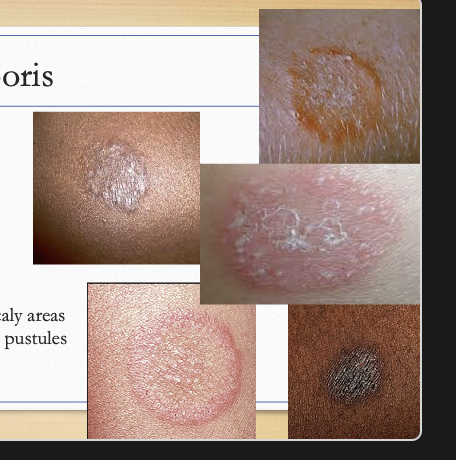
Tinea corporis
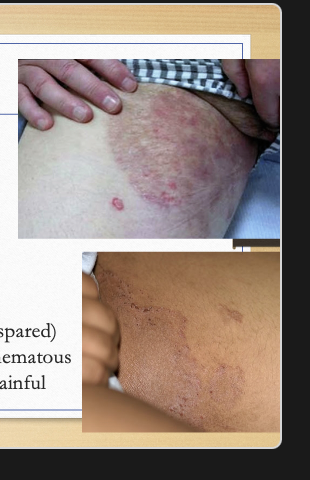
Tinea cruris

Tinea pedis

Tinea capitis

Tinea unguium
What are some signs or no signs that suggest cartain types of infection?
Green/yellow purulent drainage (pus) suggests bacterial infection → REFER.
Sweaty or smelly feet without skin changes do not automatically indicate fungus.
Types of tinea
Why scalp and nail infections require referral?
Capitis (scalp):
may cause hair loss.
Prescription therapy needed;
Unguium (nails):
OTC topical antifungals poorly penetrate the nail
oral therapy is generally preferred.
Fungal vs. other skin conditions
Fungal | Contact dermatitis | Bacterial |
|---|---|---|
Scaling, cracking, soggy skin | Allergen/irritant rash, vesicles | Pustules, ulcers, warmth |
Antifungal | Avoid trigger/manage dermatitis | Antibiotics/Medical evaluation |
Fungal vs. other skin conditions
important fact
You don't need 100% certainty before an appropriate OTC trial.
OTC self-care
Typical corporis, cruris, pedis |
No warning signs |
Appropriate for OTC label |
🚨 REFER
Age under 2 |
Face, scalp, nails, mucous membranes, genital structures |
Fever/malaise |
Purulent drainage |
Severe, widespread, debilitating symptoms
|
Significant immunocompromise/uncontrolled diabetes
|
Worsening or failed complete treatment |
🚨 REFER
Professor clarifications:
Recurrence alone ≠ automatic referral.
Treatment goals:
Symptom relief → Eliminate fungus → Prevent recurrence.
OTC medications
Drug (Brand) | Ringworm | Jock Itch | Athlete's Foot |
|---|---|---|---|
Clotrimazole / Miconazole (Lotrimin products) | BID × 4 wk | BID × 2 wk | BID × 4 wk |
Terbinafine (Lamisil) | Daily × 1 wk | Daily × 1 wk | BID × 1–2 wk |
Butenafine (Lotrimin Ultra) | Daily × 2 wk | Daily × 2 wk | BID × 1 wk OR daily × 4 wk* |
Tolnaftate (Tinactin) | BID × 4–6 wk | BID × 2 wk | BID × 4–6 wk |
Undecylenic Acid (Funginail) | BID × 4 wk | BID × 2 wk | BID × 4 wk |
Drug differences
Drug | Must know |
|---|---|
Clotrimazole/Miconazole ((Lotrimin products) |
|
Terbinafine (Lamisil)) |
|
Butenafine (Lotrimin Ultra) |
|
Tolnaftate (Tinactin) |
|
Undecylenic acid (Funginail) |
|
Choosing an antifungal
Best product =
Effective + patient can finish treatment.
Choosing an antifungal
Situation | Consider |
|---|
Situation | Consider |
|---|---|
Shorter course | Terbinafine |
Prevention | Tolnaftate |
Wet/soggy skin | Spray/gel |
Moist area | Powder |
Dry/scaly skin | Cream/solution |
Cannot manage BID | Appropriate daily regimen |
antifungal - major counseling fact!
🚨 Finish FULL course even if symptoms disappear.
What to avoid for fungal infections? why?
Corticosteroids — Avoid for for OTC self-care
Worsen fungus.
Cause skin thinning (atrophy).
Increase recurrence/incomplete treatment.
What can be used with antifungal?
Aluminum acetate (Domeboro) = Astringent (drying agent).
Use WITH antifungal, not alone.
NO antifungal activity.
For wet/soggy athlete's foot.
Soak/wet dressing; soak before antifungal.
Do not ingest.
Prevention
Prevention |
|---|
Keep skin clean/dry |
Shower after exercise |
Hot wash/dryer when fabric-safe |
Don't share towels/clothes |
Separate towel; dry infected area last |
Avoid tight/wet shoes/clothing |
Wear shower shoes |
Shoe powder/change insoles |
Patient counseling
Patient counseling |
|---|
Finish FULL course |
Wash hands before/after use |
Apply to clean, dry skin |
Minor redness/itching possible |
Massage in creams |
Tolnaftate may sting |
Refer if worsening or unresolved |
Improvement may begin in first week |
Complementary products — Lower priority
Product | Know |
|---|---|
Tea tree oil | May cause dermatitis |
Bitter orange | May increase sunburn risk |
Garlic | Insufficient evidence |
Vicks VapoRub | Weak nail-fungus evidence |
Fungal Nail Revitalizer | Improves discoloration; doesn't kill fungus |
OTC antifungals - fun fact to know
Funginail/Fungicure: Despite their marketing, NOT approved for nail fungus; Treat certain fungal skin infections