ECE361 Midterm 1: e. Medium Access Control (MAC) protocols
 Call Kai
 Learn
 Practice Test
 Spaced Repetition
 Match
 Flashcards
 Knowt Play
1/30

There's no tags or description
Looks like no tags are added yet.
Name | Mastery | Learn | Test | Matching | Spaced | Call with Kai | Chat |
|---|
No analytics yet
Send a link to your students to track their progress
31 Terms
what are medium access control (mac) protocols used for?
sharing the use of transmission media that can be accessed concurrently by multiple users
what is transmission media
physical pathway that data travels on
what are the 2 sublayers of the link layer
logical link control and medium access control
who are the senders and receivers during MAC protocol
logical link sublayer packet → encapsulates into frame → sends to physical layer
physical layer bits → encapsulates into frame → sends to logical link sublayer as a frame
what does it mean by contention based MAC protocols
multiple nodes compete or “contend“ for access to a shared communication medium in an uncoordinated manner
what are 5 different aspects considered during contention based mac protocols
no coordination: stations transmit whenever they have data to send (eg. ALOHA)
carrier sensing (listening before transmitting): stations sense the channel before transmitting a data packet (eg. CSMA)
listen before and during transmission: stations listen before transmitting and stop if noise is heard while transmitting (CSMA/CD)
collision avoidance (floor acquisition): stations carry out a handshake to determine which one can send a packet (eg. IEEE 802.11)
handshake: automated process where 2 stations exchange signaling messages, a connection, and rules
collision resolution: stations determine which one should try again after a collision
what are aspects of conflict free protocols
fixed assignment (eg. TDMA, FDMA)
reservations
polling
token passing
dynamic transmission scheduling
what is ALOHA
first MAC protocol using packet switching
transmits at will — poor performance
has 2 frequency bands: up link (sending data) and downlink (ack)
what is the pure ALOHA protocol

what is the equation for throughput of pure aloha
(only consider uplink)
S = G * e^(-2G)
G = average channel load
how does the channel use work with pure ALOHA
packets have the same length
system is in equilibrium
after a success, channel can go back to being successful at some time
system cannot be silent indefinitely
what is the vulnerability of a frame in pure ALOHA
2 * packet time period
what is slotted aloha
improving the throughput of ALOHA by reducing the time a packet is vulnerable by using a slotted channel — discrete time slots
stations can start transmitting only at the beginning of time slots
physical layer takes care of time synchronization for slotting
what is the slotted aloha protocol

what is the throughput of slotted ALOHA
S = Ge^(-G)
what are the limitations in ALOHA results
real throughput is uplink and downlink channels, not just uplink
how do priority ACKs work
all stations can transmit at well unless hearing an ACK
what does CSMA stand for and how does it work
carrier sense multiple access
reduces the vulnerability period to one propagation delay by listening before transmitting
what is the carrier sense multiple access protocol

what is non persistent carrier sensing
station senses shared channel before deciding to transmit
when busy: back offf for a random period of time before attempting to sense and transmit again
max propagation delay much smaller than packet lengths
throughput for CSMA
S = Ge^(-aG)/G(1 + 2a) + e^(-aG)
S = Normalized throughput (the average number of successful packet transmissions per packet transmission time)
G = Normalized offered traffic load (total packet arrival rate
a = normalized propagation delay a = max propagation delay/packet transmission time
vulnerability of non persistent CSMA
one propagation delay
what is the limitation of CSMA that CSMA/CD addresses
once a packet is sent, feedback to the sender occurs a round trip time since it waits for the ACKK
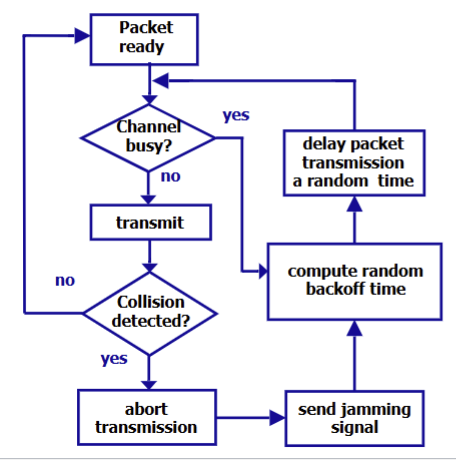
what is the CSMA/CD protocol
(assume)
all stations hear each other
propagation delay is much smaller than packets
what problem does collision avoidance address
hidden terminal problem where terminals cannot hear each other’s transmissions to a receiver, causing interference
what is half duplex
type of communication that allows data to travel in both directions but only one direction at a time
how does collision avoidance work
stations exchange small control packets to determine which sender can transmit to a receiver
how does sender initiated collision avoidance work
RTS (s to r) → CTS (r to s) → data (s to r) → ACK (r to s)
RTS = request to send
CTS = clear to send
RTR = ready to receive
how does receiver initiated collision avoidance work
RTR (r to s) → data (s to r) → ACK (r to s)
how does floor acquisition multiple access work
no acks, stations use carrier sending to send any packet
S sends RTS packet to R
if R receives packet successfully, reply with a CTS packet back to S
CTS is much longer than an RTS
if another sender tries to send an RTS, it will cause interference with ongoing CTS, backs off
what is non persistent CSMA/CA protocol?
