L9: Microevolution Part I
 Call Kai
 Learn
 Practice Test
 Spaced Repetition
 Match
 Flashcards
 Knowt Play
1/22

There's no tags or description
Looks like no tags are added yet.
23 Terms
Changes of the word “evolution”
gradually became more advanced → from “descend with modification” to “any change in the allele frequency" of a populations” (inclusion of advanced words like allele”
Difference between Artificial vs Natural Selection
artificial selection = human selection of specific traits (i.e. dog breeding)
natural selection = nature selecting traits that are advantageous for survival
Phenotypic Variation
the observable characteristics and traits that are different/vary among individuals in a population
Quantitative/Continuous Variation
individuals differ in small changes that can be measured on graphs (bell curve graph)
Example: measuring height, you can be 5ft or 6ft (can vary)

Qualitative/Discrete Variation
described by the frequency of each trait, how physical traits appear in a population (you either have the trait or you do not)
Example: measuring human blood types, you either have this blood type or not

How can variation be described?
a normal bell-shaped distribution
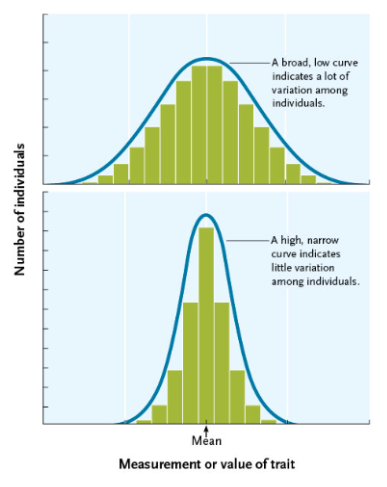
What is true about the variation of genes?
an organism’s genetic makeup does not have a strict one-to-one relationship result
multiple genetic codes can produce the same physical outcome; same genetic code can result in different outcomes
What is true about the genotype and the environment?
the phenotype (observable trait that you end up having) is often the product of interaction between its genotype (genetic makeup) and its environment)
Example: how tall you are is due to DNA and also your environment (how much you eat, nutrients, etc)
What are phenotypic variation within populations caused by?
genetic differences
differences in environmental factors
interactions between genetics and the environment
5 agents of evolution (and define each one)
mutation
- spontaneous and heritable change in DNAgenetic flow/migration
- physical moving of genetic material from one place to another (i.e. - squirrel moving acorn into Europe when it’s never been there)genetic drift
- sharp population decline due to natural disasters or human actions → population bottleneck
- random chances in allele frequencies due to chance because the natural disaster is unpredicted and randomnonrandom mating/sexual selection
natural selection
What does the Hardy Weinberg Equilibrium measure? Why is it considered an incorrect way to measure populations (in relations to evolution?)
measures population change in a large, random breeding population. Suggests that allele frequencies will remain the same from generation to generation, however, that is impossible because we are always experiencing evolution
What is the Hardy-Weinberg equation? What does each variable represent? What conditions need to be met in order for it to happen?
p2 + 2pq + q2 = 1 (frequency of homozygous/heterozygous genotypes)
p + q = 1 (dominant and recessive alleles)
For a population to be in Hardy-Weinberg equilibrium, that means none of the evolutionary agents are working.
What are Homozygous alleles?
same allele traits
AA (dominant)
aa (recessive)
What are Heterozygous alleles?
different allele traits
Aa
How do we consider reproductive success? Can you consider reproductive success the same way across all organisms?
considering relative fitness (number of surviving offspring that an individual produces compared with number left in the population)
The test for reproductive success is different for every organism (i.e. humans who experience menopause vs wolves that are always in sexual production)
Explain the difference between gene flow and genetic drift
Genetic Flow = flowing/flying organisms = river and people use rivers or fly to migrate → new genes migrating to new places
Genetic drift = a boat drifting in water = goes whenever random chance or sudden storm takes it = alleles change purely by random change or population bottleneck
Deleterious mutations
change an individual’s structure/function/behavior in harmful ways
Lethal mutations
kill all carriers (if dominant) or only homozygous carriers (if recessive)
How do you calculate Allele frequency?
the number of alleles of one type in a population divided by the total number of alleles in the population. Allele frequencies always sum up to 1.
How do you calculate genotype frequency?
the number of individuals with a given genotype divided by the total number of individuals in a population. Genotype frequencies always sum up to 1.
What is the difference between genotype and alleles?
Allele = single variant form of a gene (ex: A)
Genotype = the actual pair/set of alleles (ex: AA)
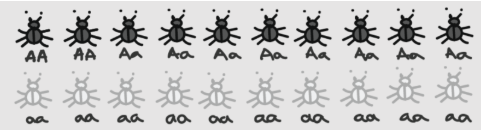
Calculate the frequency of each allele and genotype using the picture

Founder effect
old alleles might disappear in new population (due to bottleneck) and alleles that were “rarer” in the old population now has high frequency in the new population