MGT 247 Exam 2
 Call Kai
 Learn
 Practice Test
 Spaced Repetition
 Match
 Flashcards
 Knowt Play
1/179

There's no tags or description
Looks like no tags are added yet.
180 Terms
Core competency
A unique strength embedded deep within a firm that lets it differentiate its products and services from rivals
Prahalad and Hamel (1990) core competency test
A core competency must make a disproportionate contribution to ultimate customer value and provide a basis for entering new markets.
Resources
Any assets a firm can draw on when formulating and implementing strategy
Capabilities
Organizational and managerial skills needed to orchestrate and deploy a diverse set of resources strategically; expressed in structure
Activities
Distinct and fine-grained business processes
Tangible resources
Visible, physical attributes (labor, capital, land)
Intangible resources
Invisible, non-physical attributes (culture, knowledge, intellectual property)
Characteristics of Capability
Cannot be readily observed
Not tradable separately from whole unit
Contribute to higher value, lower cost, or both
Developed by people through coordinated action
Less stable than a resource
Human resources (skills)
The skills and efforts of people that drive success; they cannot be owned by the firm but are required for success.
Resource-based view (RBV)
A model that sees a firm's resources as the key to superior performance
RBV Objectives
Identify core competencies, know the strengths and weaknesses of your own team, highlights the importance of the Internal Environment
Two Critical Assumptions of the RBV
Resource heterogeneity
Resource Immobility
Resource heterogeneity
A firm is a unique bundle of resources and capabilities. These bundles differ across firms
55% of success is attributed to
The firm and it’s resources and capabilities
Resource immobility
Resources don't move easily from firm to firm, are difficult to replicate, and can last for a long time
Strategy objective
To match a firm’s resources and capabilities (internal) to opportunities in the external environment
Strategic fit
Alignment of a firm's resources
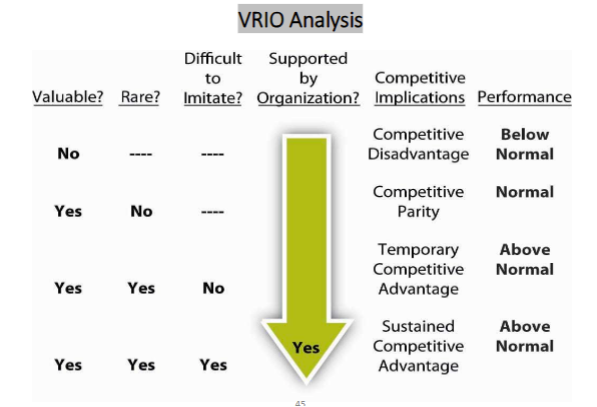
VRIO framework
A tool for evaluating firm resource endowments: a resource must be Valuable, Rare, Costly to Imitate, and Organized to capture value
Valuable (VRIO)
The resource helps the firm exploit an opportunity or offset a threat.
Rare (VRIO)
Only one or a few firms possess the resource.
Costly to imitate / Inimitable (VRIO)
Competitors can't develop the resource at a reasonable price
Organized to capture value (VRIO)
The firm is organized to capture value through effective organizational structure and coordinating systems.
VRIO decision tree
A sequence of four yes/no questions (valuable, rare, imitation costly, organized to capture value

Dynamic capabilities
A firm’s ability to adapt resources over time, modify and leverage its resource base, and gain and sustain competitive advantage in a constantly changing environment
Dynamic capabilities objectives
Develop resources, capabilities, and competencies
Create a strategic fit with the firm’s environment
Change in a dynamic fashion
4 factors of dynamic markets
Technological change
Deregulation
Globalization
Demographic shifts
Value chain
A template firms use to determine which activities or capabilities are truly fundamental for adding value and which are not
Two components of a value chain
Primary activities
Support activities
Primary activities
Direct: making & selling goods or services
Support activities
Indirect: infrastructure and everything else
Value chain function
Shows how a product moves from raw-material stages to the final customer along with the necessary support functions
Shows which parts of operations create value and which do not
Helps the firm understand which activities contribute most to cost and value (margin)
Identify multiple means for implementing a chosen business-level strategy

Types of Primary Activities
Inbound logistics
Operations
Outbound logistics
Marketing and sales
Service
Primary activties objective
Transform inputs into outputs as the firm moves a product or service horizontally along the internal value chain
Competitive disadvantage
Outcome when a resource is not rare, valuable, costly to imitate, or organized for value creation
Competitive parity
Outcome when a resource is valuable but not rare.
Temporary competitive advantage
Outcome when a resource is valuable and rare but not costly to imitate, or when a resource is valuable, rare, and costly to imitate but not organized for value creation
Sustained competitive advantage
Outcome when a resource is valuable, rare, costly to imitate, and organized for effective deployment
Isolating mechanisms
Barriers to imitation that prevent rivals from competing away a firm's advantage.
Better expectations of future resource value
Isolating mechanism: acquiring resources cheaply because the firm forecast their future value more accurately
Path dependence
Isolating mechanism: the options in a current situation are limited by decisions made in the past
Causal ambiguity
Isolating mechanism: the cause and effect of a phenomenon are not readily apparent
Social complexity
Isolating mechanism: different business and social systems interact in ways that are hard to copy
Intellectual property (IP) protection patents
Isolating mechanism: designs, copyrights, trademarks, trade secrets
Resource stocks
The firm's current level of intangible resources (ex. new product development, engineering expertise, innovation capability, reputation for quality, etc.)
Resource flows
The firm's level of investment to maintain or build a resource.
Bathtub metaphor
Model in which water level is an intangible resource stock with inflows and outflows. Inflows contributing to the stock are investments in resources. Outflows taking away from the stock are forgetting, or “leakage” (the resource is no longer private to the firm).

Inbound logistics
Activities used to receive, store, and disseminate inputs
Operations
Activities necessary to convert inputs into the final products
Outbound logistics
Activities involved with collecting, storing, and physically distributing product
Marketing and sales
Activities that facilitate purchase of products and induce consumers to do so
Service
Activities designed to enhance or maintain a product's value
Types of Support Activities
Procurement
Technology development
Human resources
Firm infrastructure
Support activities objective
Necessary to sustain primary activities
Procurement
Activities completed to purchase inputs.
Technology development
Activities completed to improve the product and the processes used to manufacture it
Human resources (value chain)
Activities involved with recruiting, hiring, training, developing, and compensating personnel
Firm infrastructure
Activities that support the entire value chain: identifying external opportunities and threats, identifying resources and capabilities, supporting core competencies

Value system
The larger system of suppliers' value chains

SWOT analysis
A framework assessing internal factors (strengths, weaknesses, opportunities, threats)

Strengths
Internal factors that allow a firm to compete effectively and are unique or valuable.
What allows us to compete effectively?
How are we unique?
What do we have that few others have that provides value?
Weaknesses
Internal factors that hold a firm back from competing effectively; what it lacks.
What holds us back from competing effectively?
What do we lack?
Opportunities
External factors that might change in the firm's favor and allow growth or higher profit.
What external factors might change in our favor that may allow us to grow the business or become more profitable?
Threats
External factors that might hinder the firm's growth or profitability.
What external factors might hinder our growth or profitability?
Core rigidity
A former core competency that has become a liability because the environment changed and it no longer fits
Characteristics of a core rigidity
A former core competency turned into a liability
This occurred as a result of an environment change
The former competency no longer fits in the external environment
Turns a resource from an asset to a liability (ex. 35 MM film and Kodak)

VRIO Framework
To be the basis of a competitive advantage, resources must be valuable, rare, costly to imitate, and the firms must be organized to capture the value of the resource.
Competitive advantage
When two or more firms compete in the same market, a firm possesses a competitive advantage over its rivals when it earns a higher rate of profit
Cost advantage
Competitive advantage from using core competencies and capabilities to produce standardized products at lower cost than competitors.

Differentiation advantage
Competitive advantage from producing unique products that differ from competitors' products.
Three Standard Performance Dimensions of a Firm
What is the firm’s accounting profitability
How much shareholder value does the firm create
How much economic value does the firm generate
Accounting profitability
A performance measure using standardized accounting metrics (GAAP)
GAAP
Generally Accepted Accounting Principles; standardized accounting rules.
FASB
Financial Accounting Standards Board; sets the accounting standards behind GAAP.
Form 10-K and 10-Q
Annual (10-K) and quarterly (10-Q) financial statements public companies file.
Return on invested capital (ROIC)
Net profits divided by invested capital; measures how effectively a firm uses its total invested capital (shareholders' equity plus interest-bearing debt).
Invested capital
Shareholders' equity from selling shares plus interest-bearing debt from lenders and bondholders.
Net operating profit after tax (NOPAT)
A profitability measure of operating profit after taxes.
Return on equity (ROE)
A profitability ratio measuring profit relative to shareholders' equity.
Return on assets (ROA)
A profitability ratio measuring profit relative to total assets.
Return on revenue (ROR)
Net profits divided by revenue; how much of each sales dollar becomes profit
Working capital turnover
An ROIC element showing how effectively capital is used to generate revenue.
COGS / revenue
Cost of goods sold divided by revenue; how efficiently a company produces a good.
R&D expense / revenue
How much of each dollar earned is invested in research and development.
SG&A expense / revenue
How much of each dollar earned is invested in selling
Working capital / revenue
How much working capital the firm has tied up in its operations.
PPE / revenue
The share of revenue dedicated to plant
Book value
Accounting measure of the firm's actual cost of assets minus depreciation.
Market valuation
Value based on future expectations of a firm's growth potential and performance.
Intangibles (accounting limits)
Items such as innovation
Off-balance-sheet items
Obligations not shown in standard accounting data
Shareholders
Owners of shares of stock; the legal owners of the firm.
Risk capital
Money provided to a firm in exchange for an equity share.
Total return to shareholders
Stock price appreciation plus dividends.
Market capitalization
Dollar value of total shares outstanding: number of outstanding shares times share price.
Shareholder value creation
Performance measured by total return to shareholders; limited by stock price volatility
Economic value creation
The difference between a buyer's willingness to pay for a product or service and the firm's total cost to produce it (V minus C).
Risk capital
Money provided for an equity share
Total return to shareholders
Stock price appreciation + dividends
Market capitalization
Number of outstanding shares * share price
Limitations of shareholder value creation
Stock prices can be volatile
Macroeconomic factors affect stock prices
Stock prices can reflect the mood of investors