The Impact of Digital Technology
 Call Kai
 Learn
Learn Practice Test
 Spaced Repetition
 Match
Match Flashcards
 Knowt Play
1/41

There's no tags or description
Looks like no tags are added yet.
Name | Mastery | Learn | Test | Matching | Spaced | Call with Kai | Chat |
|---|
No analytics yet
Send a link to your students to track their progress
42 Terms
alternative text (alt text)
Descriptive text added to an object. Also called alt text.

Americans with Disabilities Act (ADA)
Law that requires any company with 15 or more employees to make reasonable attempts to accommodate the needs of physically challenged workers.

artificial Intelligence (AI)
A scientific field that focuses on creating machines capable of performing activities that require intelligence when they are done by people.

audio books
The technological use of logic and prior experience to simulate human intelligence.

augmented reality (AR)
A type of virtual reality that uses an image of an actual place or thing and adds digital information to it.

BYOD (bring your own device)
Policy that enables employees to use their personal devices to conduct business.
chip-and-pin technology
An improvement in card technology that stores data on an embedded chip instead of a magnetic stripe.

computer
a machine for performing calculations automatically
computer literacy
The ability to use computers for basic tasks, such as developing documents, sending emails and searching the internet for information.
computer-aided manufacturing (CAM)
the use of computers to plan and control manufacturing processes

data
evidence; information gathered from observations

Digital assistants
Apps like Amazon's Alexa or Apple's Siri that use natural language processing to respond to your verbal commands or questions, using search technology to provide answers or perform a task, such as adding an item to a grocery list.

digital citizen
a daily Internet user with broadband (high-speed) home Internet access and the technology and literacy skills to go online for employment, news, politics, entertainment, commerce, and other activities

digital divide
The term "digital divide" refers to the gap between individuals, households, businesses and geographic areas at different socio-economic levels with regard to both their opportunities to access information and communication technologies (ICTs) and to their use of the Internet for a wide variety of activities.

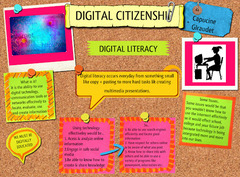
digital literacy
Having a current knowledge and understanding of computers, mobile devices, the web, and related technologies.

embedded computer
A computer that functions as one component in a larger product, and which has a specific purpose.

enterprise computing
Information systems that support company-wide data management requirements, such as airline reservations or credit card billing systems.

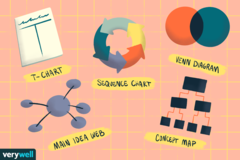
graphic organizers
A visual framework or structure for capturing the main points of what is being read, which may include concepts, ideas, events, vocabulary, or generalizations. Graphic organizers allow ideas in text and thinking processes to become external by showing the interrelatedness of ideas, thus facilitating understanding for the reader. The structure of a graphic organizer is determined by the structure of the kind of text being read.
green computing
Environmentally conscious computing consisting of three major components: power management, virtualization, and e-waste management.

hardware
The machines, wiring, and other physical components of a computer or other electronic system

Individuals with Disabilities Education Act (IDEA)
Provides a free appropriate public education for students with disabilities

information
Data that has been processed to become meaningful.

Information Technology (IT) department
responsible for managing the technology used throughout the business

integrated circuits
Developed in the 1960s, packed the equivalent of thousands of vacuum tubes or transistors into a silicon chip about the size of your thumb.

intelligent workplace
Definition:
Uses technology to enable workers to connect to the company's network, communicate with each other, use productivity software and apps, meet via web conferencing, and more.

intelligent classroom
Classroom in which technology is used to facilitate learning and communication.

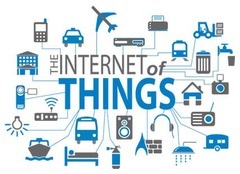
Internet of Things (IoT)
The idea that objects are becoming connected to the Internet so they can interact with other devices, applications, or services.
kiosk
A freestanding booth usually placed in a public area that can contain a display device used to show information to the public or event attendees.

learning management system (LMS)
Online system that provides a variety of assessment, communication, teaching, and learning opportunities

machine-to-machine (M2M)
Using computers to monitor computer assembly lines and equipment. Wired and wireless communication between similar devices.

microprocessor
The part of the computer that executes the instructions of a computer program.

mobile health (mHealth)
medical and public health practice supported by mobile devices, such as mobile phones, patient monitoring devices, personal digital assistants and wireless devices

natural language processing
A form of data input in which computers interpret and digitize spoken words or commands.
personal computer (PC)
Computers designed for personal use, as opposed to commercial or industrial use.
robotics
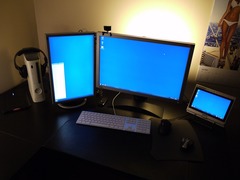
The science and technology of robots, their design, manufacture, and application.

screen reader
a device used by individuals with visual impairments to convert written text on a computer monitor to spoken words

software
The programs and apps that instruct the computer to perform tasks. Software processes data into meaningful information.

smart devices
A device that can communicate, locate, and predict; part of the Internet of Things (IoT).

speech recognition programs
Software that helps a user to input data or information verbally.
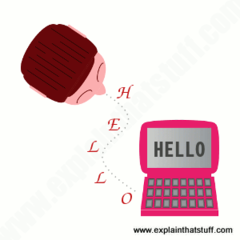
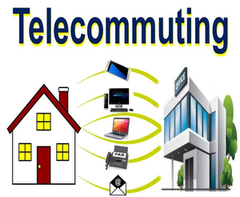
telecommuting
work from home, making use of the Internet, e-mail, and the telephone.
transistors
Smaller, cheaper, and more reliable replacement for vacuum tubes in the second generation of computers.

virtual reality (VR)
The use of computers to simulate a real or imagined environment that appears as a three-dimensional (3-D) space.
