cell neuro exam 1
 Call Kai
 Learn
Learn Practice Test
 Spaced Repetition
 Match
Match Flashcards
 Knowt Play
1/131

There's no tags or description
Looks like no tags are added yet.
Name | Mastery | Learn | Test | Matching | Spaced | Call with Kai | Chat |
|---|
No analytics yet
Send a link to your students to track their progress
132 Terms
Explain the function of receptors on a neuron
They receive CHEMICAL input from the environment of other neurons and translate that information into ELECTRICAL signals, helping to relay information within the nervous system.
what are the two key mechanisms that allow a neuron to integrate the information that the some receives from the receptors? Explain each one
spatial summation and temporal summation
Explain spatial summation. When is an action potential triggered during spatial summation?
spatial summation - multiple presynaptic inputs fire at the same exact time at various locations on the neuron. The EPSP/IPSPs travel to the soma and their voltages add electrically.
An action potential is generated when the combined membrane potential reaches threshold at the axon hillock.
Explain temporal summation.
Temporal summation occurs when a single presynaptic neuron fires multiple signals in quick succession at a single synapse. Because post-synaptic potentials (EPSPs/IPSPs) last longer than the interval between impulses, the individual membrane potential changes overlap and add together over time. If the cumulative voltage reaches threshold at the axon hillock, an action potential is generated.
How do neurons transmit output signals to target cells, and what effects can these signals have?
Neurons transmit signals to target cells by releasing chemical messengers called neurotransmitters.
Once delivered, the neurotransmitter produces either an excitatory or inhibitory effect on the target cell (with modulatory effects also possible depending on the receptor).
What is a modulatory effect?
Instead of turning a neuron directly ON (EPSP) or OFF (IPSP), a modulatory effect acts like a volume knob. It changes how sensitive or reactive the neuron is to other incoming signals over a longer period
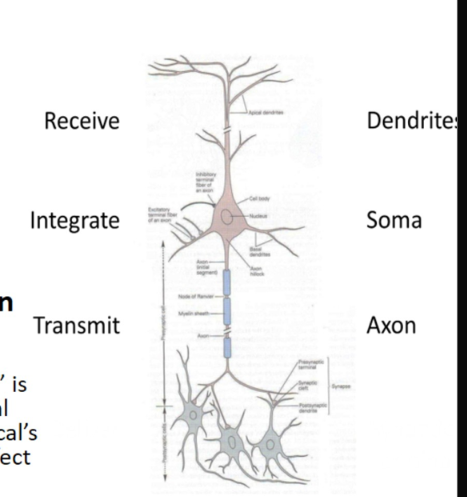
Name the anatomical structure that correlates to each process:
Receive info
Integrate information
Transmit information down an axon
dendrites
soma
axon
When information is delivered to the target from the axon terminus, what is the nature of the signal (chemical/electrical)?
chemical
What is divergence ?
divergence is the degree to which an axon delivers to target cells and is when one presynaptic neuron branches (fans) out to send its signal to multiple postsynaptic cells.
1 neuron → many neurons (fan-out)
what determines if an effect is inhibitory or excitatory?
The type of receptor that is present on the postsynaptic neuron.
What is a synapse?
the point of contact between a neuron and its target and acts as a point of information delivery to the target cell.
What are the three main structural classes of neurons
unipolar, bipolar, multipolar

what class of neuron is this
unipolar

What class of neuron is this?
bipolar

What class of neuron is this picture?
multipolar
What is convergence
Convergence is when many different neurons send their signals to one single neuron and is typically found in dendrites.
It works like a funnel: multiple incoming messages come together into one place so that cell can summarize all the info.
What do you call a cluster of neuron cell bodies in the CNS vs PNS
CNS: Nucelus
PNS: Ganglion
What do you call a bundle of parallel axons traveling together in the CNS vs. the PNS?
CNS- tract PNS- nerve
What are Brodmann Areas/ Cortical areas?
The cerebral cortex is organized into distinct functional regions called cortical areas. The most famous map is the Brodmann Areas, which is a map of 52 distinct functional regions in the cerebral cortex, classified based on their cellular structure (cytoarchitecture).
What are anatomical units
neurons that do the same function but are clustered together
How are neurons classified by axon length?
Local neurons (interneurons): Short axons that stay within a local area
Projection neurons: Long axons that extend to distant brain or spinal cord regions (far places)
How are neurons classified by direction of communication (function)? (3)
Sensory (Afferent): Transmit signals from the external world to the CNS
Motor (Efferent): Transmit signals away from the CNS to muscles/glands.
Interneurons (Association): more involved with relaying information between sensory inputs
How are neurons classified by their synaptic effect on target cells?
Excitatory: Depolarizes target cells (EPSP).
Inhibitory: Hyperpolarizes target cells (IPSP).
Modulatory: Tunes overall cellular sensitivity/volume over time.
afferent versus efferent neurons and give examples of each
Afferent - conducts information toward the CNA or CNS structure . sensory pathways are an example of this
Efferent - conducting information away from the CNA or CNS structure. Motor pathways are an example of this.
What are glia ("glue"), and what are their four main functions?
glia are importatn support cells that ensure neurons have the appropritate environment to function
Maintain environment: Keep the extracellular space at homeostatic levels.
Immune response: Participate in active immune responses.
Cell precursors: Serve as precursor cells for new neurons and other glia.
Classification: Depending on the source, there are 4 to 6 glial cell types (the course focuses on the 4 most prominent)
What are the four types of glia
astrocyte, microglia, oligodendrocytes, Schwann cells
What are the primary functions of astrocytes in the CNS?

What are the key features and functions of microglia?
Act as motile, macrophage-like cells in the CNS
Migrate to sites of injury or infection
Ingest cellular debris and foreign material
What is the primary function of oligodendrocytes?
Myelinate axons in the CNS to assist in electrical conduction
A single cell myelinates several axons passing through its area of influence
Primarily target projection neuron axons
How do Schwann cells function in comparison to oligodendrocytes?
Myelinate axons in the PNS to assist in electrical conduction
A single Schwann cell myelinates a single portion of only one axon
What is a neural circuit (or network
Ensembles of neurons that process specific types of information to perform a function.
Named according to the specific function or region they are involved in (for example, a "motor circuit").
Range from simple circuits (like reflex arcs involving sensory inputs) to complex interconnected networks.
That are the two functional rules of neurons?
A neuron has a fixed identity based on the effect (excitatory,inhibitory, or modulatory) it has on its targets
All of the targets of a neuron’s axons are given the same signal
Same chemical is realeased at all of teh synaptic terminals that that chemical has the same effect at target
Can a single neuron release excitatory neurotransmitters from some terminals and inhibitory neurotransmitters from others?
No, A neuron has a fixed functional identity (excitatory, inhibitory, or modulatory).
All of its synaptic terminals release the same neurotransmitter.
It produces the same effect at every single target cell it connects to
Define excitatory, inhibitory, and modulatory neuron
excitatory - excites target towards action
inhibitory - inhibits target from being active
modulatory - neurons change the target’s state for some period of time ( like the magnitude or duration of its response to other inputs)
What is the functional default for primary sensory and motor neurons, and how do they communicate with their targets?
They are excitatory neurons.
They communicate by delivering excitatory signals when activated.
When not actively exciting their targets, they sit quietly at rest rather than releasing inhibitory signals
What is a primary motor neuron, and how does it act on its target?
It is a neuron that innervates skeletal muscle fibers directly to generate force and movement.
It is excitatory in nature, releasing neurotransmitters that stimulate muscle contraction when active.
When inactive, it sits quietly at rest rather than sending an inhibitory signal directly to the muscle.
sensory neurons
take signals from external environemtn and deliver excitatory signal to target

identify and label the diagram with the terms laid out in the picture

why for the knee jerk response does the interneuron need to be inhibitory?
The interneuron needs to be inhibitory because in order for our leg to extend one muscle needs to be relaced while the other needs to contracted. This can only happen when one of the two pathways (the two motor pathways ) is inhibited. Since both motor pathways are excitatory in nature, an interneuron is needed to inhibit one while the other is excited, allowing extension of the leg
How do the electrical responses in the extensor motor neuron vs. the flexor motor neuron differ during the knee-jerk reflex?
Extensor Motor Neuron: Experiences an excitatory postsynaptic potential (EPSP) (depolarization) that reaches threshold to fire an action potential.
Flexor Motor Neuron: Experiences an inhibitory postsynaptic potential (IPSP) (hyperpolarization), preventing it from firing an action potential.
On a neural recording graph (raster plot) showing vertical tick marks over time, what do dense clusters of tick marks indicate compared to widely spaced tick marks?
Dense clusters: High firing rate / high frequency of action potentials (strong excitation).
Widely spaced / gaps: Low firing rate or inhibition (few or no action potentials).
In a knee-jerk reflex raster plot, the trace that shows a sudden decrease or complete disappearance of tick marks immediately following the hammer tap belongs to the {} due to {}.
flexor motor neuron , reciprocal inhibition
: Which two neurons in the knee-jerk reflex circuit display increased spike density at the exact same time during the hammer tap?
interneuron, extensor motor neuron, and sensory neuron

What is the resting membrane potential of a typical neuron, and what does the negative voltage value mean?
It is typically around −60 mV to −80 mV. The negative sign indicates that the inside of the cell membrane is negatively charged relative to the outside environment.
What does it mean when we say that neuronal membranes are polar?
There is an electrical difference (potential) between the inside and the outside of the cell membrane (membrane potential)
Name the three types of membrane potentials
receptor, synpatic, action
receptor potential
result from activation of sensory neurons from external stimuli (lgiht touch sound)
synaptic potentials
occur at synaptic contacts
action potentials
are generated by neurons and can travel along axons to distal targets
What is the fundamental unit of communication in nervous systems?
action potential- sufficient exitatory input to a neuron results in an action potential down the axon to the axon terminal causing the release of chemical signals on the target
What is an electrical potential?
When electrical charges are separated across a barrier, it creates an attractive force between them and generates an electrical potential
that is there is some amount of potential energy between the two areas
What does "membrane potential" actually measure in a cell?
It measures the difference in electrical charge inside the neuron compared to the outside across a membrane.
What does a negative membrane potential like -60mv tell you about the cell?
It means the inside of the neuron is 60 mV more negatively charged than the fluid outside the cell.
The magnitude of the electrival difference (potential) between the two points is measured in units called
volts
Define concentration gradient and simple diffusion
concentration gradients represent a kind of stored energy where solutes will diffuse from areas of high to low concentration.
Selective permeability
when ions cannot cross the membrane without the help of membrane proteins called ion channels
Why is membrane potential (Vm) considered an emergent property?
Because voltage is not produced by any single element alone; it only emerges when concentration gradients, selective permeability, and electrical forces interact simultaneously across the membrane. This property is a central characteristic of biological systems
What is the main difference between active transport and facilitated diffusion
active transport - moves ions against their concentration gradient and thus requires the use of ATP
ion channel - allow ions to diffuse down their concentration gradient and are selectively permeable to ions (need a channel to help them get through )
Function of transporters
establishing and maintaining concentration gradients
Function of ion channels
passive diffusion of ions down concentration gradient
How is the Resting Membrane Potential Established and Maintained?
Concentration Gradient: There is an unequal concentration gradient of ions across the membrane.
Diffusion Force: Ions are able to move across the membrane down their concentration gradient.
Voltage Potential Force: The electrical charge moving with those ions generates a voltage across the membrane.
What determines the directionality of the chemical force versus the electrical force acting on an ion?
The charge of the ion and the charge distribution across the membrane.
Positive ions are pulled toward negatively charged areas.
Negative ions are pulled toward positively charged areas.
Driven by electrostatic attraction (opposites attract, like charges repel).
electrochemical equilliibrium
the point at which the forces of diffusion and voltage are exactly balanced
Nernst equation formula

What is the nernst equation used for?
predict the equillibrium potential for a given ion

Why is there no net movement (zero net current) of K+ across the membrane when the voltage is held at −58 mV in this setup?
At -58mv, the electrical force pulling positive K+ into the negatively charged cell perfectly balances the chemical force (concentration gradient) pushing K+ out.
Because influx equals efflux, individual ions still cross the membrane, but total net flux is zero.
In a resting neuron which ions are located extracellularly primarily and which ones intracellularly?
extracellularly - sodium, chloride, calcium
intracellularly, potassium
Why is a neuron's resting membrane potential (around -65 to -70 mV) slightly less negative than the equilibrium potential for potassium (around -90 mV)?
selective for K+ alone.
A small background leak of Na+ enters the cell, adding positive charges that pull the resting potential slightly higher than Ek
Which ion is the membrane most permeable to at reast
potassium
what is the Goldman equation and what is its formula
an equation that allows us to describe and predict the membrane potential while considering all the permeant ions

How does resting membrane permeability to Sodium (Na+) and Chloride (Cl-) compare to Potassium (K+)?
Sodium (Na+) is about 25 times LESS permeable than Potassium at rest.
Chloride (Cl-) is a little more than 2 times LESS permeable than Potassium at rest
What is the final piece of the puzzle that contributes to a neuron's resting membrane potential?
The Na+/K+ ATPase pump. By actively pumping 3 Na+ out for every 2 K+ in, it maintains the concentration gradients and directly contributes a few negative millivolts to the resting potential.
What would happen to a neuron's resting membrane potential if the Na+/K+ ATPase pump were blocked?
The concentration gradients would slowly dissipate over time as Na+ leaked in and K+ leaked out, eventually causing the membrane potential to collapse to zero.
define conduction
ease with which something can move from one place to another (opposite of resistance)

Draw a graph of what Vm would be during an action potential where Na channels open and K+ remain clsoed
this process is called depolarization
can also think of increasing P value of Goldberg equation

What is the relationship between opening voltage-gated Sodium channels and increasing Sodium permeability?
hey are two sides of the same event. Opening voltage-gated Na+ channels provides physical pathways through the lipid membrane, which directly causes Sodium permeability (P_Na) to increase.
What woudl a membrane potential graph look like for an action potential that has potassium channels open and Na+ channels close
The process of going back to resting membrane potential is repolarization. can also think if decreasing P value of goldberg

What happens if both na+ and K+ channels open?
the membrane potential will be zero because equilibrium is achieved
During an action potential, the mebrane becomes more permeable to which ion
first sodium and then potassium soon after
What happens when a neuron receives a stimulus that does not reach the threshold potential?
It produces a passive response where the voltage change is small, proportional to the stimulus size, and fades out without triggering an action potential.
Why is an action potential described as an "all-or-none" event?
because if the voltage reaches threshold, the neuron fires a full-size action potential every time; if it falls short of threshold, no action potential fires at all.
What is the threshold potential in a neuron?
The critical voltage level (around -50 mV) that membrane potential must reach to trigger an action potential.

what type of summation is this
spatial because different arrows are on different regions of the neuron. If it was temporal there would be only one arrow point ing to a single spot on a single dendrite and show multiple pulses hitting that exact spot in quick succession.,
What ere the three types of channels
Channels that are always open (like K+ leak channels).
Channels that open in response to a chemical stimulus (synpatic neuron).
Channels that open and close in response to changes in voltage (action potential).
What are the four major phases of an action potential labeled on a voltage graph?
Rising phase
Overshoot phase
Falling phase
Undershoot phase
What occurs during the "overshoot phase" of an action potential?
The membrane potential rises above 0 mV, becoming temporarily positive inside relative to the outside.
Which ion channel activity drives the rising and overshoot phases of the action potential?
The opening of voltage-gated Sodium (Na+) channels, which increases Na+ conductance.
Which ion channel activity drives the falling and undershoot phases of the action potential?
The inactivation of Na+ channels alongside the opening of delayed voltage-gated Potassium (K+) channels, which increases K+ conductance.
What causes the "undershoot phase" (hyperpolarization) following repolarization?
Voltage-gated Potassium (K+) channels remain open briefly after the membrane potential returns to rest, pulling the voltage even closer to E_K than normal resting potential.
current
movement of p
resistance
opposition to the flow of electric current and is measured in ohms
permeability
capability for an ion to move across a membrane
relationship between I and V
Voltage is the force responsible for the current. The magnitude of V is related to the electromotive force inducing the current
Name the task of a neuron

Why are neurons considered poor conductors of passive electrical current?
because electrical current leaks out through the cell membrane ("leaky current") as it travels, causing the magnitude of the membrane potential change to decline over distance.

How does the site of synaptic contact affect a synapse's ability to trigger an action potential?
Proximal synapses (closer to the cell body/axon hillock) exert a stronger influence because their current travels a shorter distance and suffers less passive decay compared to distal synapses (farther away on the dendrites)
Why do distal synaptic inputs lose strength before reaching the axon hillock?
Because passive current decays over distance (due to current leaking across the membrane, as described by the length constant).
How does an action potential move down an axon?
Na+ enters one spot, and the electricity slides down the inside of the axon to open the next set of Na+doors further down.

Why can an action potential only move forward and not backward?
The Na+ doors behind it temporarily lock shut (refractory period), so the signal cannot turn around.

What can we do to incraese the conduction velocity of neurons if they are considered poor conductors
Make the axon wider (reduces internal resistance, like a wider pipe).
Insulate the axon with myelin (prevents electricity from leaking out through the membrane).