Macro Invertebrates/ Pond Life
 Call Kai
 Learn
 Practice Test
 Spaced Repetition
 Match
 Flashcards
 Knowt Play
1/20

There's no tags or description
Looks like no tags are added yet.
21 Terms
macroinvertebrates
small aquatic animals and the aquatic larval stages of insects; small organisms that lack a backbone and are large enough to be seen with the naked eye

Chlorella (green algae)
single celled green algae that occurs in clumps or as single cells loosely aggregated

Filamentous algae (green algae)
Single algae cells that form long visible chains, threads, or filaments. Often occurs in floating green masses, slimy to the touch. Filaments may be up to many centimeters long.

Pediastrum (green algae)
Floating (planktonic) algae. Colony of cells

Water net (Hydrodictyon) (green algae)
Forms flat sheets or cylindrical colonies several inches wide

Desmids (green algae)
Made up of two semi cells with an isthmus in the middle

Volvox (green algae)
Spherical colonies of single cells. Each cell has an eyespot and two flagella. Volvox rotates and rolls through the water.

Euglena (green algae)
Euglena are a type of green algae that get food and energy through photosynthesis, like a plant, but can also swim freely with a flagella (a thin, hair-like appendage that whips back and forth). They have a red eyespot, which does not help them see like our eyes do, but instead detects the presence or absence of light.

Cladocerans (crustaceans)
commonly known as water fleas, are a type of zooplankton that swim using a pair of enlarged antennae. They filter feed, sweeping in food by waving their legs. They are a huge food source for fish. Cladocerans migrate up and down in the water - they come to the surface at night and spend the days in deeper down in the pond, hiding from predators.

Copepods
Copepods use their long antennae as paddles to help them swim. Larger organisms feed on them, such as larger zooplankton, macroinvertebrates, and fish. A single copepod may eat up to 373,000 diatoms in a single day.

Nematodes
Nematodes are tiny aquatic worms. You’ll know you’ve found a nematode because it moves in an “S” shaped thrashing motion. Some nematodes are parasitic - they steal nutrients from other organisms. Others are predators and eat other microscopic animals, and some feed on plants
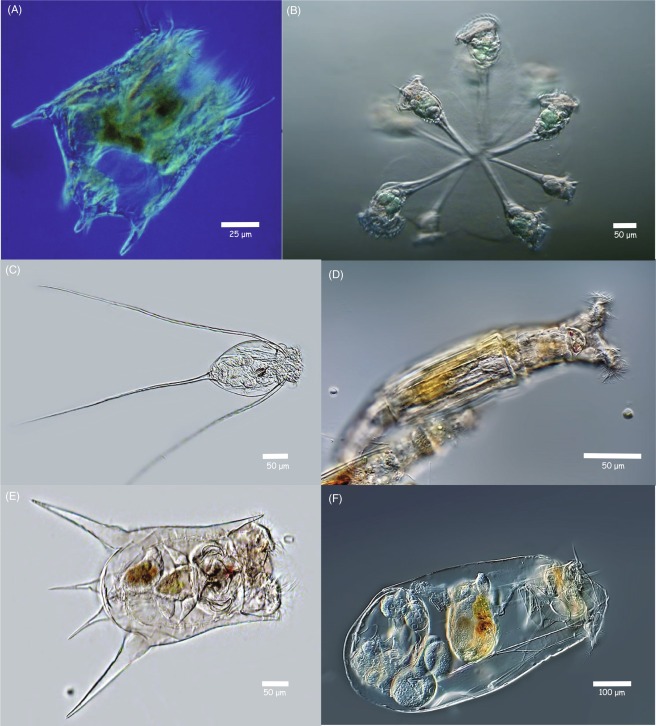
Rotifers
Rotifers are transparent microorganisms that have tiny hairs called cilia to help them move. They contract and stretch as they move around. They can be quick; if you blink you might miss them! If their pond dries up and they have no water to live in, they can create a gelatinous covering and remain dormant until water returns.

Diatoms
Microscopic, single celled, yellow-green algae
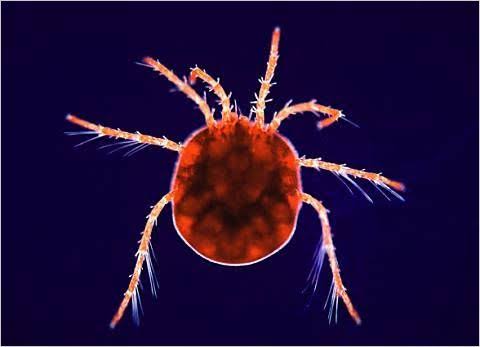
Water mites
0.5- 2 mm (0.002 -0.08 in)
Plankton
tiny organisms that drift or wander throughout a body of water
Zooplankton
animal plankton
Phytoplankton
plant plankton, can photosynthesize. Includes Green Algae and Diatoms
Cell
An independent, self-replicating unit that may exist on its own (a unicellular organism), or as sub-unit in a multicellular organism that performs the necessary functions to sustain life.
Colony
A group of single cells that live and work together to meet the same goal, such as getting food or moving throughout the water
Flagella
A threadlike appendage that assists single celled organisms in motion
Cilia
Similar to flagella but shorter, cilia are tiny hairs that surround an organism that help it move