14.3 Regulation of blood glucose concentration
 Call Kai
 Learn
 Practice Test
 Spaced Repetition
 Match
 Flashcards
 Knowt Play
1/61

There's no tags or description
Looks like no tags are added yet.
62 Terms
Without control, what would blood glucose levels range from?
range from very high levels after a meal, to very low levels several hours later
Blood glucose concentration in a healthy human?
80 – 120mg/100cm3
What can happen when there is a decrease in blood glucose?
Cells may run out of blood glucose for respiration
What can happen when there is an increase in blood glucose?
May upset the normal behaviour of cells
Why do blood glucose levels never remain constant?
they oscillate above and below a required level due to the time delay between the change and the onset of corrective actions
3 things that can increase blood glucose concentration?
Diet, Glycogenolysis and Gluconeogenesis
How does diet increase blood glucose concentration?
hen you eat carbohydrate-rich foods (which are rich in starch) and sweet foods (which contain high levels of sucrose), the carbohydrates they contain are broken down in the digestive system to release glucose. The glucose released is absorbed into the bloodstream
Glycogenolysis?
glycogen stored in the liver and muscle cells is broken down into glucose which is released into the bloodstream increasing blood glucose concentration
Gluconeogenesis?
the production of glucose from non-carbohydrate sources - This glucose is released into the bloodstream and causes an increase in blood glucose concentration.
Example of the production of glucose from non-carbohydrate sources?
the liver is able to make glucose from glycerol (from lipids) and amino acids
2 factors that decrease blood glucose concentration?
Respiration and Glycogenesis
Respiration decreasing blood glucose concentration - what is required to perform normal body functions?
some of the glucose in the blood being used by cells to release energy
Respiration decreasing blood glucose concentration - why does exercise lead to a further decrease?
during exercise, more glucose is needed as the body needs to generate more energy in order for muscle cells to contract - The higher the level of physical activity, the higher the demand for glucose and the greater the decrease of blood glucose concentration
Glycogenesis?
the production of glycogen - When blood glucose concentration is too high, excess glucose taken in through the diet is converted into glycogen which is stored in the liver
Your cells also need an exact level of glucose in the blood - what can happen if glucose is too low?
hypoglycaemia can happen
Your cells also need an exact level of glucose in the blood - what can happen if glucose levels are too high?
hyperglycaemia can happen
What is insulin produced by?
the β cells of the islets of Langerhans in the pancreas
What do the β cells do if the blood glucose concentration is too high?
β cells detect this rise in blood glucose and respond by secreting insulin directly into the bloodstream
Virtually all body cells have insulin receptors on their cell surface membrane - example of the exception?
red blood cells
What does insulin cause when it binds to a body cell’s glycoprotein receptor?
it causes a change in the tertiary structure of the glucose transport protein channels - This causes the channels to open allowing more glucose to enter the cell
Main way insulin lowers blood glucose concentration?
the rate of conversion of glucose to glycogen (glycogenesis)
How does insulin increasing the rate of glycogenesis help to lower blood glucose concentration?
insulin stimulates the liver to remove glucose from the blood by turning the glucose into glycogen and storing it in the liver and muscle cell
When insulin combines with the receptors on the cell surface, what two things does it cause?
increases number of carrier molecules in the cell surface membrane and activates enzymes in the liver that converts glucose to glycogen and fat (glycogenesis).
Result - how else does insulin lower blood glucose concentration: what does it do to the respiration rate?
increases respiration rate of cells - this increases their need for glucose and causes a higher uptake of glucose from the blood
Result - how else does insulin lower blood glucose concentration: what does it increase the conversion rate of?
Rate at which glucose is converted to fat and stored in adipose tissue increases
Result - how else does insulin lower blood glucose concentration: what does it increase the absorption rate of?
the rate of absorption of glucose by cells, in particular skeletal muscle cells
Result - how else does insulin lower blood glucose concentration: what does it inhibit the release of?
glucagon from the cells Of the islets of Langerhans
The action of insulin on liver cells: what does insulin bind to?
the receptor on the target cell
The action of insulin on liver cells: what does insulin binding to he receptor on the target cell activate?
tyrosine kinase
The action of insulin on liver cells: what does tyrosine kinase cause?
phosphorylation on inactive enzymes in the cell
The action of insulin on liver cells: what does phosphorylation on inactive enzymes in the cell initiate?
a cascade of enzyme controlled reactions
What is insulin broken down by?
enzymes in the cells of the liver (Therefore, to maintain its effect it has to be constantly secreted)
How does insulin lower blood glucose concentration: what do the β cells do when they detect that blood glucose concentration had returned to normal?
When it falls below a set level, the cells reduce their secretion of insulin
What is the secretion/stopping of secreting of insulin by β cells an example of?
negative feedback
What does a negative feedback system ensure?
that changes are reversed and returned back to the set level
What do α if they detect that the blood glucose concentration is too low?
they secreting glucagon directly into the bloodstream
Unlike insulin, what are the only cells in the body which have glucagon receptors?
liver cells and fat cells - therefore these are the only cells that can respond to glucagon
Main way Glucagon raises blood glucose concentration: what does it cause enzymes to increase the conversion of?
glycogen to glucose (glycogenolysis - the liver breaks down its glycogen store into glucose and releases it back into the bloodstream)
How else Glucagon raises blood glucose concentration: what does it cause enzymes to reduce?
the amount of glucose absorbed by the liver cells
How else Glucagon raises blood glucose concentration: what does it activate enzymes to increase the rate of?
gluconeogenesis - increasing the conversion of amino acids and glycerol into glucose in the liver
When the blood glucose levels rise above a set level what do the α cells do?
reduce their secretion of glucagon
This is another example of negative feedback - what does The feedback cause?
the corrective measures to be switched off, returning the system to its original (normal) level
What type of messenger is glucagon?
secondary messenger
How glucagon works - secondary messenger: what does Glucagon binding to a receptor on the cell surface membrane cause?
activates a G protein
How glucagon works - secondary messenger: what does the G protein activate?
an enzyme which converts ATP into cAMP
How glucagon works - secondary messenger: what does the cAMP then act as?
a secondary messenger which activates another enzyme to convert glycogen into glucose
What do we do when glycogen supplies are depleted?
Gluco neo genesis - Creating glucose out of new (non-glucose / glycogen stuff)
Gluco meaning?
glucose
Neo meaning?
new
Genesis meaning?
the creation of
Gluco neo genesis: what are protein broken down into?
proteins → amino acids
Gluco neo genesis: what are amino acids changed into?
amino acids → pyruvate
Gluco neo genesis: what are pyruvate changed into?
pyruvate → glucose production
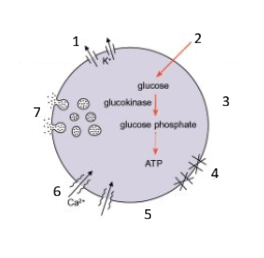
Insulin secretion: 1 - at normal blood glucose concentration levels, what are open in the plasma membrane of β cells?
K+ channels are open - so potassium diffuses out of cell

Insulin secretion: 1.2 - due to this, what is the potential of the inside of the cell compared to the outside?
-70mV
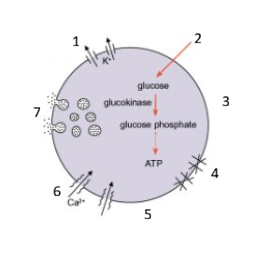
Insulin secretion: 2 - what happens when glucose levels are high?
glucose enters the β cell - by a glucose transporter

Insulin secretion: 3 - what happens to this glucose?
it is phosphorylated and then metabolised inside the mitochondria to produce ATP
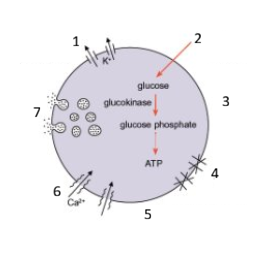
Insulin secretion: 4 - what does the presence of extra ATP cause?
ATP binds to potassium (K+) channels and causes them to close (They are known as ATP-sensitive potassium channels)

Insulin secretion: 5 - why does the potential difference change?
potassium ions can no longer diffuse out of the cell

Insulin secretion: 5.2 - what is the membrane potential decrease to?
around -30mV (depolarisation occurs)

Insulin secretion: 6 - what opens in response to the change in membrane potential?
Ca2+ ion channels (which are normally closed) open and calcium ions rush into cell (depolarisation occurs)

Insulin secretion: 7 - what do these Ca2+ ions cause?
the secretory vesicles to release insulin by exocytosis