R21 - clinical therapeutics treatment of asthma
 Call Kai
 Learn
 Practice Test
 Spaced Repetition
 Match
 Flashcards
 Knowt Play
1/27

There's no tags or description
Looks like no tags are added yet.
28 Terms
What are the main triggers of asthma?
Allergens: Pollen, dust mites and pets.
Environmental: Air pollution and mould.
Smoking: Active smoking, passive smoking and vaping.
Respiratory infections.
Exercise and stress.
Medications: Beta-blockers and NSAIDs.
Hormonal changes.
What are the main aims of asthma treatment?
The main aim is to achieve good asthma control by:
Preventing daytime and night-time symptoms.
Preventing asthma attacks (exacerbations).
Minimising the need for rescue medication.
Maintaining normal lung function.
Allowing normal activities and exercise.
Minimising treatment side effects.
What are the main drug classes used to treat asthma?
Drug class | Examples | Main action |
|---|---|---|
ICS | Beclometasone, budesonide | Reduces airway inflammation |
LABA- long acting | Formoterol, salmeterol | Long-lasting bronchodilation |
SABA- short acting | Salbutamol, terbutaline | Rapid bronchodilation |
LTRA | Montelukast | Blocks leukotriene receptors |
LAMA | Tiotropium | Blocks muscarinic receptors |
Systemic corticosteroids | Prednisolone | Reduces inflammation during exacerbations |
How do inhaled corticosteroids (ICS) work in asthma?
Examples: Beclometasone and budesonide.
Reduce chronic airway inflammation.
Reduce airway hyperresponsiveness.
Help prevent asthma symptoms and exacerbations.
Side effects: Oral thrush and, at higher doses, systemic corticosteroid effects.
Counselling: Rinse the mouth after using an ICS inhaler.
How do long-acting beta-2 agonists (LABAs) work in asthma?
Examples: Formoterol, salmeterol and vilanterol.
Stimulate β₂-adrenoceptors on airway smooth muscle.
Cause smooth muscle relaxation.
Produce prolonged bronchodilation, improving airflow.
Side effects: Tremor, tachycardia, headache and muscle cramps.
Important: LABAs must not be used without an ICS in asthma.
How do short-acting beta-2 agonists (SABAs) work?
Examples: Salbutamol and terbutaline.
Stimulate β₂-adrenoceptors.
Rapidly relax airway smooth muscle.
Produce bronchodilation and relieve breathlessness and wheezing.
Side effects: Tremor, tachycardia, palpitations and hypokalaemia at high doses.
Key point: SABAs relieve bronchoconstriction but do not treat the underlying airway inflammation.
How do leukotriene receptor antagonists (LTRAs) work?
Example: Montelukast.
Block cysteinyl leukotriene receptors.
Reduce leukotriene-mediated bronchoconstriction.
Reduce airway inflammation and mucus production.
Use: Add-on treatment when asthma remains uncontrolled, with an 8–12-week trial in relevant treatment pathways.
What are the important side effects and counselling points for montelukast?
Montelukast can cause neuropsychiatric adverse effects, including:
Nightmares and sleep disturbances.
Anxiety, depression and aggression.
Changes in mood or behaviour.
Thoughts of self-harm.
Speech impairment and obsessive-compulsive symptoms.
Counselling: Patients should stop montelukast and seek medical advice immediately if these symptoms occur. Suspected reactions should be reported through the MHRA Yellow Card scheme.
How do long-acting muscarinic antagonists (LAMAs) work in asthma?
Example: Tiotropium.
Block muscarinic receptors in airway smooth muscle.
Reduce acetylcholine-mediated bronchoconstriction.
Produce prolonged bronchodilation.
Use: Add-on treatment for selected patients aged 12 years and over with uncontrolled asthma despite optimised ICS/formoterol treatment.
Side effects: Dry mouth and headache; caution in patients with glaucoma or urinary retention.
What is the role of theophylline in asthma treatment?
Theophylline is a xanthine drug used in selected patients under specialist care.
Has bronchodilator effects.
Usually given as modified-release tablets twice daily.
Has a narrow therapeutic window, so blood concentrations must be monitored.
According to the lecture:
Measure levels 5 days after starting treatment.
Recheck at least 3 days after dose changes.
Usually take blood samples 4–6 hours after a dose.
Important: Smoking affects theophylline concentrations.
Why are asthma guidelines moving away from SABA-only treatment?
Asthma is a chronic inflammatory disease. SABAs only relieve bronchoconstriction.
They do not treat underlying airway inflammation.
Frequent SABA use can be associated with increased airway reactivity.
Over-reliance on SABAs can delay appropriate anti-inflammatory treatment and increase the risk of severe exacerbations.
Key point: Current guidelines emphasise early use of ICS-containing treatment.


Treatment of asthma pathway
summary table - for dugs used in asthma
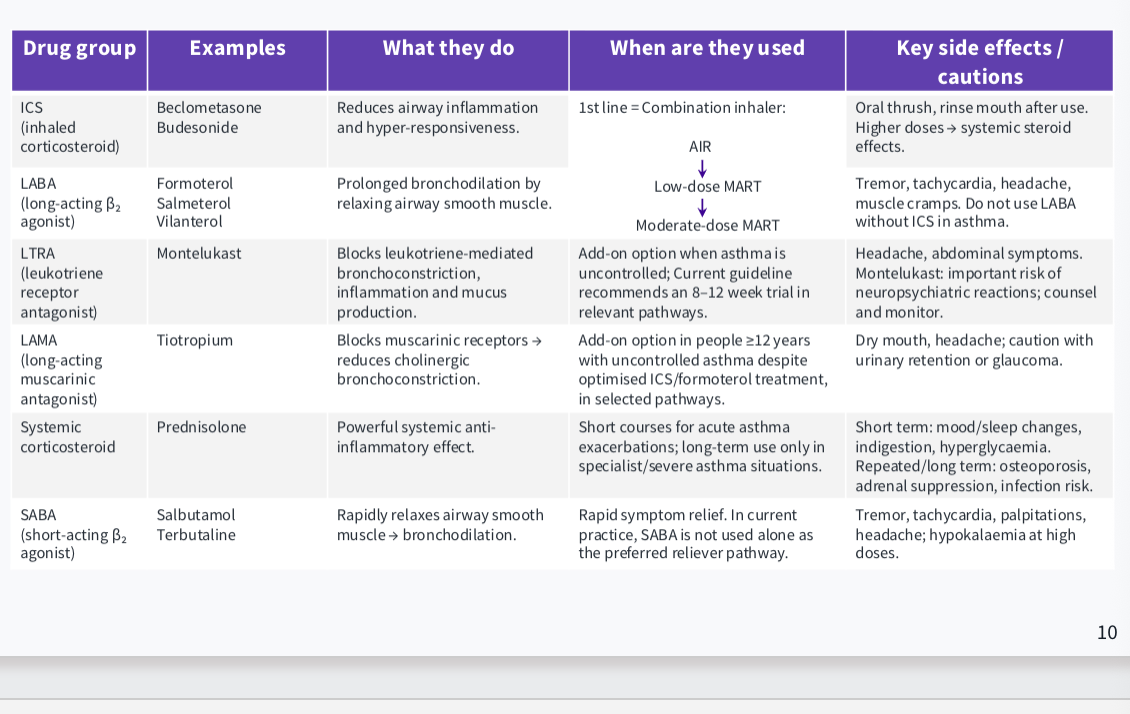
What is AIR therapy, and how does it work?
AIR = Anti-Inflammatory Reliever therapy.
It involves using a low-dose ICS/formoterol combination inhaler as needed.
ICS: Reduces airway inflammation.
Formoterol (LABA): Provides rapid bronchodilation.
Benefit: Patients receive anti-inflammatory treatment whenever they use their reliever.
What is MART therapy, and how does it differ from AIR?
AIR | MART |
|---|---|
Used only when needed | Used regularly and when needed |
Low-dose ICS/formoterol | Low- or moderate-dose ICS/formoterol |
Initial option for newly diagnosed asthma in people aged 12+ | Used when regular maintenance treatment is needed |
Why is formoterol used in both AIR and MART therapy?
Formoterol is a LABA with:
Rapid onset of action: Relieves bronchoconstriction quickly.
Long duration of action: Provides prolonged bronchodilation.
This makes it suitable for both regular maintenance and as-needed relief when combined with an ICS.
Important: Not all LABAs have a sufficiently rapid onset for AIR/MART treatment.
What is the stepwise treatment approach for asthma in patients aged 12 years and over?
The treatment pathway shown:
Step 1: AIR
Low-dose ICS/formoterol as needed
Step 2: Low-dose MART
Regular maintenance + as-needed doses
Step 3: Moderate-dose MART
Increase the maintenance ICS dose
Step 4: Add-on treatment trials
Consider LTRA or LAMA and specialist assessment as indicated
Remember: Before stepping up, check adherence, inhaler technique and possible triggers. Consider stepping down when asthma is well controlled.
What treatments may be used for severe asthma under specialist care?
LAMA: Tiotropium.
Theophylline: Requires therapeutic drug monitoring.
High-dose ICS.
Continuous oral corticosteroids: In selected patients.
Immunotherapy.
Monoclonal antibodies: Specialist treatments for selected severe asthma phenotypes
What non-pharmacological treatments can help control asthma?
Avoid triggers such as allergens, smoke and air pollution.
Stop smoking and avoid vaping.
Maintain a healthy weight.
Improve diet, including fruit and vegetable intake.
Practise breathing exercises.
Manage stress.
Keep an asthma diary to monitor symptoms.
What is a Personalised Asthma Action Plan (PAAP), and why is it important?
A PAAP is a written self-management plan developed with a healthcare professional.
It explains:
How to manage asthma every day.
Which inhalers to use and when.
How to recognise worsening symptoms.
What to do during an asthma attack.
When to seek urgent medical help.
Benefit: Improves self-management and helps patients respond appropriately to worsening asthma.

How does asthma treatment differ in children aged 5–11 years?
First-line: Twice-daily low-dose ICS, with a SABA reliever.
If uncontrolled, assess suitability for paediatric MART.
Alternatively, consider adding an LTRA.
Escalate treatment or refer to a specialist if asthma remains uncontrolled.
Key difference: Unlike the initial AIR approach in people aged 12+, children aged 5–11 generally start with regular low-dose ICS.
How is asthma treated in children under 5 years old?
For suspected asthma requiring maintenance treatment:
Consider an 8–12-week trial of twice-daily low-dose ICS, with SABA as needed.
Review symptoms, inhaler technique and adherence.
Consider stopping treatment if symptoms resolve, followed by reassessment.
If symptoms recur, consider restarting ICS.
If asthma remains uncontrolled, consider adding an LTRA or referring to a specialist
What is an acute asthma exacerbation?
An acute asthma exacerbation is a sudden or progressive worsening of asthma symptoms.
Symptoms may include:
Increasing breathlessness.
Wheezing and coughing.
Chest tightness.
Reduced peak expiratory flow (PEF).
Increased need for reliever medication.
Severe attacks can be life-threatening and require emergency treatment.

How are mild-to-moderate, severe and life-threatening asthma attacks distinguished?
Severity | Key clinical features | PEF |
|---|---|---|
Mild–moderate | Able to speak in phrases, not agitated | Greater than 50–75% |
Severe | Cannot complete sentences in one breath, increased respiratory rate | 33–50% |
Life-threatening | Silent chest, confusion, exhaustion, cyanosis or poor respiratory effort | Less than 33% |
Important: Life-threatening asthma may also involve hypoxaemia or a normal PaCO₂ despite severe respiratory distress. Clinical severity should not be judged by PEF alone.
What is the first-line treatment for an acute asthma exacerbation in adults?
Oxygen: Target saturation 94–98%.
High-dose inhaled SABA: Salbutamol, using a spacer or nebuliser as appropriate.
Oral corticosteroid: Prednisolone 40–50 mg daily for at least 5 days.
The slide describes salbutamol via a spacer as one puff every 30–60 seconds, up to 10 puffs initially, with reassessment and repeat treatment as needed.
Key point: Acute severe or life-threatening asthma requires immediate emergency management.
What additional treatments may be used in severe or life-threatening asthma attacks?
Nebulised ipratropium bromide (SAMA): Added to SABA for severe attacks or poor initial response.
IV magnesium sulfate: May be considered in severe attacks with an inadequate response to initial treatment.
IV aminophylline: Specialist treatment in selected cases.
Antibiotics: Only when there is evidence of a bacterial infection requiring treatment, not routinely for asthma attacks.
What follow-up is required after an asthma attack, and how can pharmacists improve asthma care?
Follow-up after an attack:
Inform the GP practice within 24 hours of discharge.
Arrange GP review within 2 working days.
Provide a written asthma action plan.
Arrange specialist follow-up after severe attacks requiring admission.
Review asthma at least annually.
Role of pharmacists:
Check and demonstrate inhaler technique.
Assess adherence and medicine use.
Identify excessive reliever use.
Provide medicines reviews and New Medicine Service support.
Offer smoking cessation and vaccination services.
Encourage appropriate inhaler disposal and sustainable prescribing.
Summary - drug classes
Drug class | Example | Most important point |
|---|---|---|
ICS | Budesonide | Reduces inflammation |
LABA | Formoterol | Long-lasting bronchodilation |
SABA | Salbutamol | Rapid symptom relief, not anti-inflammatory |
LTRA | Montelukast | Blocks leukotriene receptors; neuropsychiatric warning |
LAMA | Tiotropium | Blocks muscarinic receptors |
Systemic steroid | Prednisolone | Treats inflammation during exacerbations |
Xanthine | Theophylline | Narrow therapeutic window |