non viral vectors in nucleic acid delivery
 Call Kai
 Learn
 Practice Test
 Spaced Repetition
 Match
 Flashcards
 Knowt Play
1/18

There's no tags or description
Looks like no tags are added yet.
19 Terms
what are non viral vectors
delivery systems that transport nucleic acids without using viruses
examples of non-viral vectors
lipids
polymers
peptides
hybrib systems
main advantage of non-viral vectors
more acceptable than viral vectures
better safety profile
cheaper to manufacture
can have higher loading capacity
disadvantages of non-viral vectors
low delivery efficiency so little clinical benefits
lack specificity
ineffective at promoting nuclear uptake
why are non-viral vectors particularly promising for delivering mRNA and siRNA
these nucleic acids act in cytoplasm rather than needing to enter nucleus which means non-viral delivery systems are suitable for mRNA and siRNA
what are the 4 main components of lipid nanoparticles (LNPs)
Ionisable lipids.
Phospholipids.
Cholesterol.
PEGylated lipids.

what is the function of ionisable lipids in LNPs
ionisable lipids are positively charged at certain pHs
they interact with negatively charged RNA through electrostatic interactions
help RNA escape from endosomes into cytoplasm
how does the charge of ionisable lipids change in different environments
they are neutral at physiological pH but become protonated in acidic endosomes, helping with endosomal escape
what are the potential adverse effects of ionisable lipids
they may stimulate pro-inflammatory cytokine secretion and the production of reactive oxygen species (ROS)
what is the function of phospholipids in LNPs
they support packaging and structural stability, enhance transfection efficiency and help LNPs fuse with cell membranes
what is the function of cholesterol in LNPs
It supports LNP structure and improves particle stability by modulating membrane integrity and rigidity. It is predominantly located in the outer shell
what is the function of PEGylated lipids in LNPs
they improve colloidal stability, reduce aggregation and interactions with serum proteins, and reduce recognition by the mononuclear phagocyte system (MPS)
what are the potential adverse effects of PEGylated lipids
they can cause hypersensitivity reactions through complement activation and anti-PEG IgE
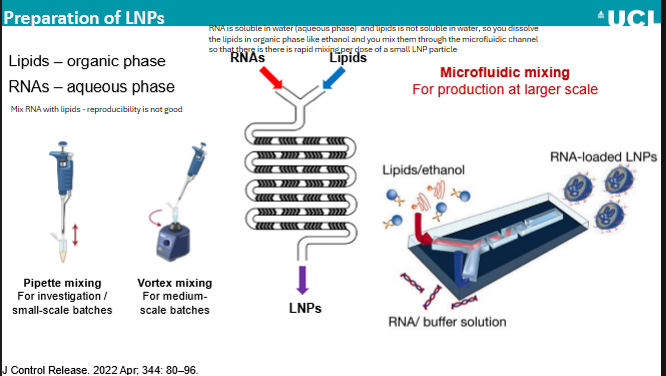
how are LNPs prepared, and what are the main mixing methods
An organic phase containing lipids is mixed with an aqueous phase containing RNA. Methods include:
Pipette mixing: small-scale batches.
Vortex mixing: medium-scale batches.
Microfluidic mixing: larger-scale production.

what causes LNP degradation, and how should LNPs be stored
Physical degradation includes aggregation, fusion and RNA leakage. Chemical degradation includes hydrolysis and oxidation. LNPs should be stored at ultra-freezing temperatures, protected from light, agitation and repeated freeze–thaw cycles. Injectable formulations are manufactured aseptically and are preservative-free.
how does GalNAc deliver siRNA specifically to liver cells
A GalNAc trimer attached to siRNA binds to the asialoglycoprotein receptor (ASGPR), which is highly expressed on hepatocytes
This triggers clathrin-mediated endocytosis and uptake into the cell
advantages and characteristics of GalNAc-siRNA delivery
Targets hepatocytes through ASGPR.
Does not require a separate carrier.
Requires extensive chemical modification to protect siRNA and reduce immune responses.
Subcutaneous administration gives better liver accumulation than intravenous administration
what are the purposes of ribose and backbone chemical modifications
Ribose 2'-OH modifications reduce immune stimulation and increase stability. Backbone modifications improve nucleic acid stability

compare viral and non-viral vectors in terms of delivery, safety, loading capacity and manufacturing
