A&P Lab 8 - Bones
 Call Kai
 Learn
 Practice Test
 Spaced Repetition
 Match
 Flashcards
 Knowt Play
1/164

There's no tags or description
Looks like no tags are added yet.
165 Terms
What is the vertebral column divided into, from superior to inferior?
Cervical vertebrae, thoracic vertebrae, lumbar vertebrae, sacrum, and coccyx.

How many cervical vertebrae are there?
Seven, C1–C7.
While there are only 7 cervical vertebrae, there are 8 pairs of cervical spinal nerves (C1 to C8)

How many thoracic vertebrae are there?
Twelve, T1–T12.

How many lumbar vertebrae are there?
Five, L1–L5.

What are C1 and C2 called?
C1 is the atlas; C2 is the axis.
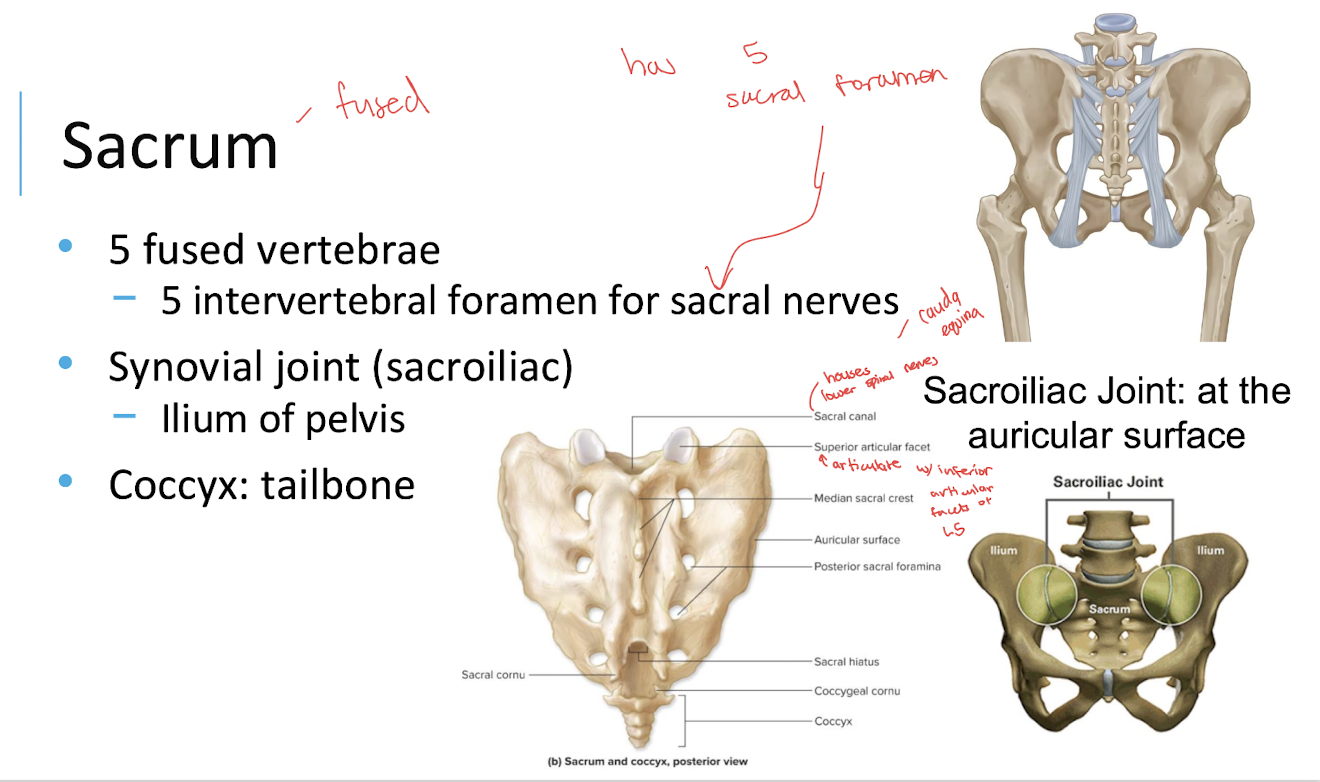
What are the sacrum and coccyx?
The sacrum is formed by five fused vertebrae. The coccyx is the tailbone.
What is the vertebral body, and what is its primary function?
The large anterior portion of a vertebra that bears weight.


What is number 1?
Vertebral foramen
inside single vertebra
forms vertical spinal canal

What is number 2?
Intervertebral foramen
between two adjacent vertebra
What is the function of an intervertebral foramen?
It provides an exit for a spinal nerves
→ side exit windows for nerves along column

What is the vertebral canal?
The continuous passage formed by the aligned vertebral foramina.

What are the pedicles?
Short bony projections that connect the vertebral body to the vertebral arch
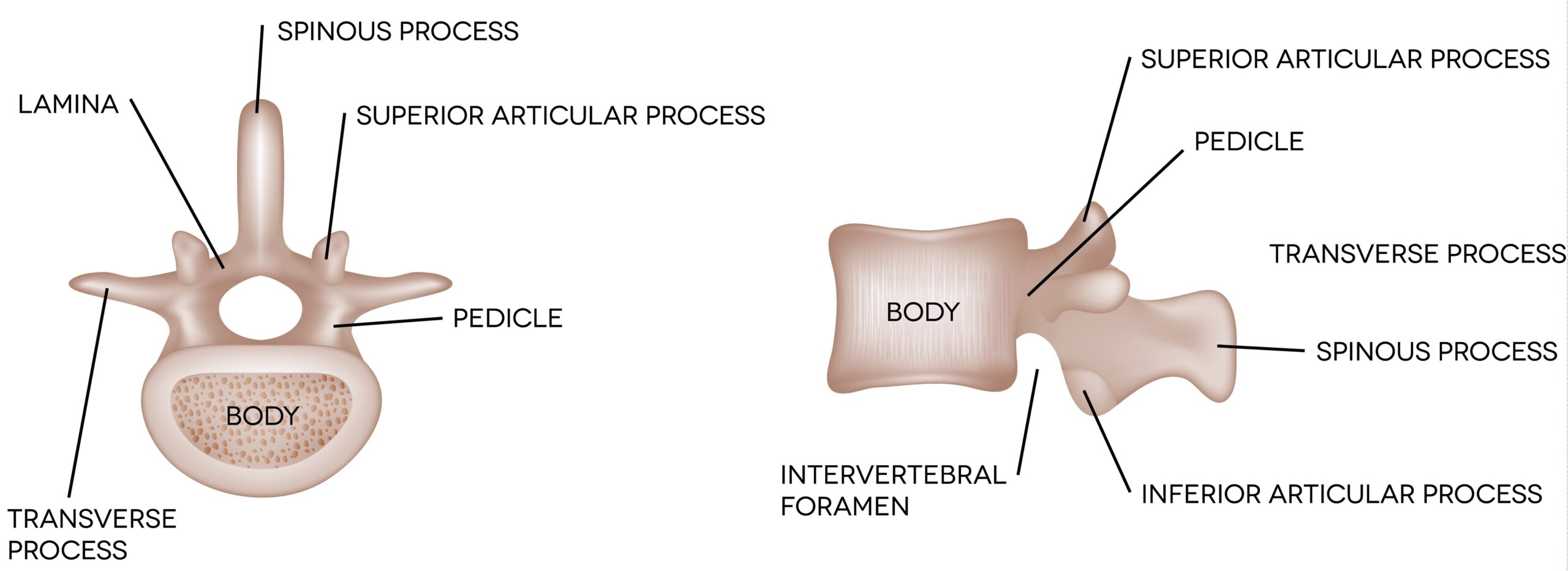
What are the laminae?
Parts of the vertebral arch that extend from the transverse processes toward the spinous process and help close the arch posteriorly.
all true vertebrae have them

What is the spinous process?
The posterior projection of a vertebra that provides attachment for muscles and ligaments.

What are the transverse processes?
Lateral projections that provide attachment points for muscles and ligaments.

What are the superior and inferior articular facets?
Surfaces on vertebrae that articulate with the articular facets of adjacent vertebrae, forming facet joints.

What is the function of the vertebral arch?
It surrounds and protects the vertebral foramen and spinal cord.

What is the difference between an intervertebral foramen and a vertebral foramen?
The vertebral foramen accommodates the spinal cord within the vertebral column; an intervertebral foramen allows a spinal nerve to exit.

Generally, what do cervical vertebrae look like?
Side profile of a fox!

Generally, what do thoracic vertebrae look like?
Side profile of a giraffe!

Generally, what do lumbar vertebrae look like?
Side profile of a moose!


C2-L5 (Roughly): What is number 1?
Body

C2-L5 (Roughly): What is number 2?
Pedicles
x2
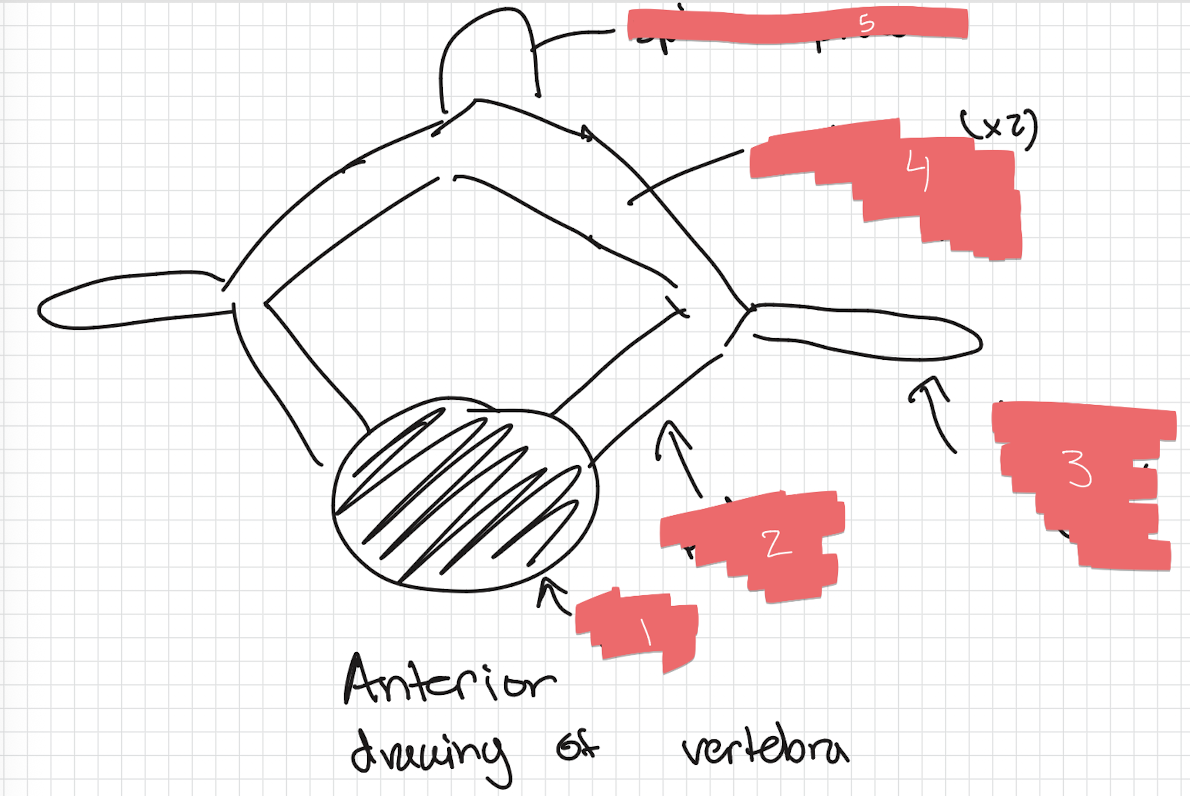
C2-L5 (Roughly): What is number 3?
Transverse process
x2

C2-L5 (Roughly): What is number 4?
Lamina
closing the ring
x2

C2-L5 (Roughly): What is number 5?
Spinous process
What are two identifying features of typical cervical vertebrae?
Bifid spinous processes and transverse foramina

What does “bifid spinous process” mean?
The spinous process is split into two projections

What is the transverse foramen?
An opening in the transverse process of a cervical vertebra.
The lecture labels it as being for cranial nerves
in standard anatomy, it primarily transmits vertebral blood vessels and accompanying sympathetic nerves.
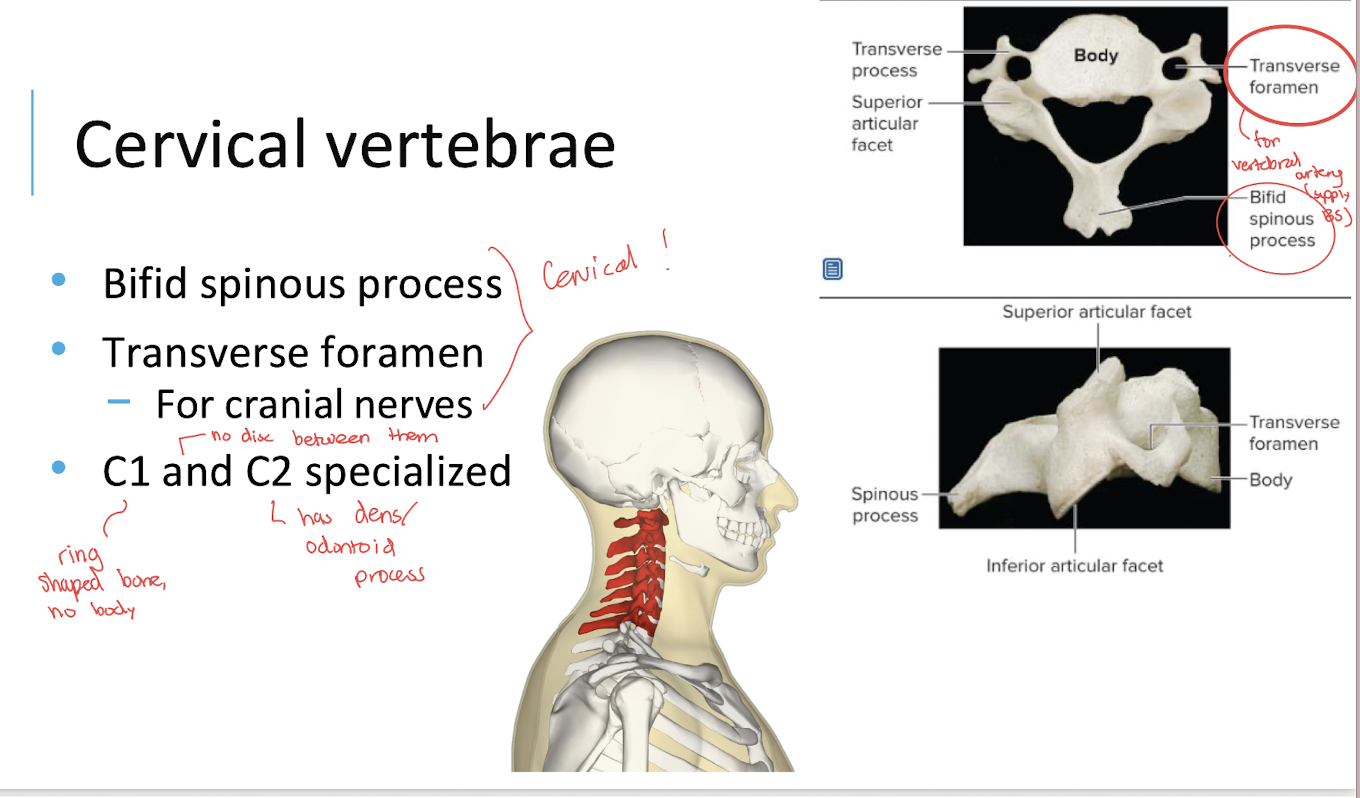
transverse foramen are found only in….
…cervical vertebra! (C1-C7)

Which two cervical vertebrae are specialized?
C1, the atlas, and C2, the axis.
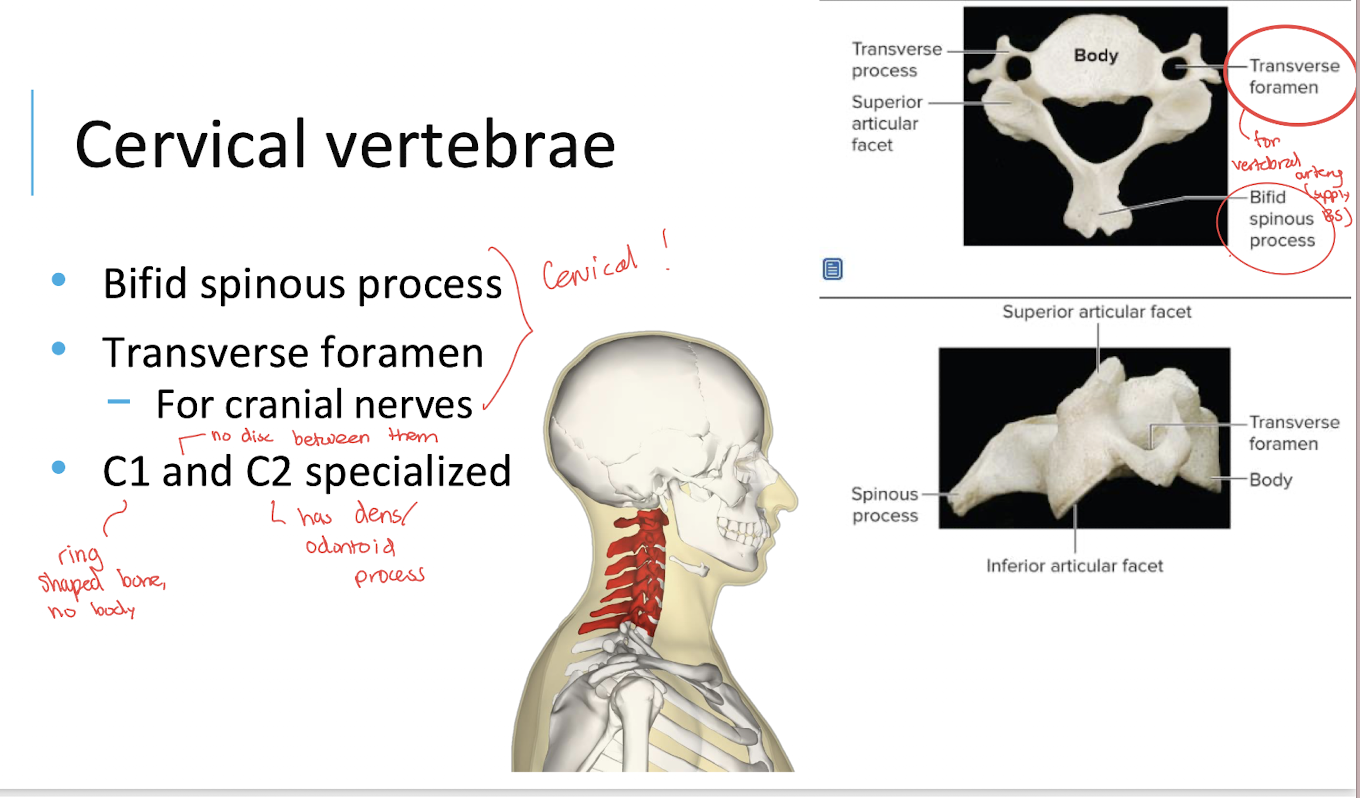
What is the primary identifying feature of the atlas (C1)?
It supports the skull and lacks a typical vertebral body.

What is the primary identifying feature of the axis (C2)?
It has the dens, which acts as a pivot for rotation of the atlas and head.

What movement is especially associated with the atlantoaxial joint?
Rotation of the head from side to side.
no disc between them!
Instead of a disc, the joint is tightly secured by strong ligaments, such as the transverse ligament


What is number 1?
Body

What is number 2?
Superior articular facet

What is number 3?
Transverse foramen

What is number 4?
Bifid spinous process

What is number 5?
Superior articular facet

What is number 6?
Spinous process

What is number 7?
Inferior articular facet
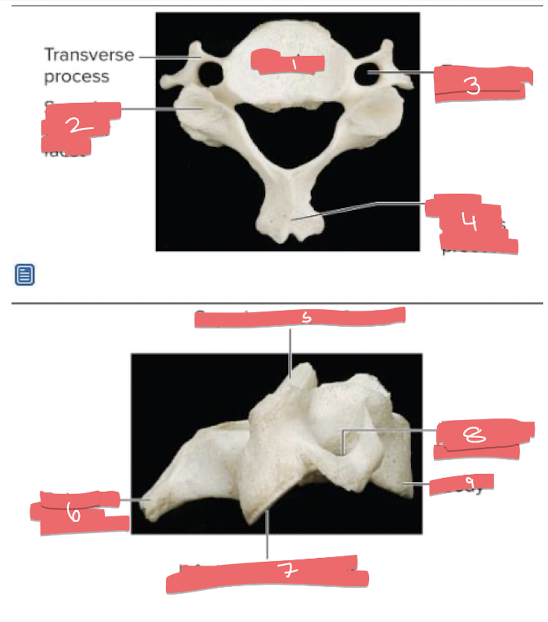
What is number 8?
Transverse foramen

What is number 9?
Body
What is a key identifying feature of thoracic vertebrae?
Costal facets for articulation with ribs.

What are costal facets?
Articular surfaces on thoracic vertebrae that articulate with ribs.
where ribs articulate with vertebral bodies

What is the typical direction of thoracic spinous processes?
Inferiorly, or downward

How do inferior-pointing thoracic spinous processes affect movement?
They help limit back extension.

How many pairs of ribs are there?
Twelve pairs.

Which ribs are true ribs?
Ribs 1–7, which attach directly to the sternum through their own costal cartilage.

Which ribs are false ribs?
Ribs 8–12
Ribs 8–10 attach indirectly to the sternum through the cartilage of the rib above
ribs 11–12 do not attach to the sternum.

Which ribs are floating ribs?
Ribs 11 and 12

What is the difference between false ribs and floating ribs?
Floating ribs are a subset of false ribs: ribs 11–12 have no anterior attachment to the sternum

What are the three parts of the sternum?
Manubrium, body, and xiphoid process

What is costal cartilage?
Cartilage that connects the anterior ends of ribs to the sternum, directly or indirectly

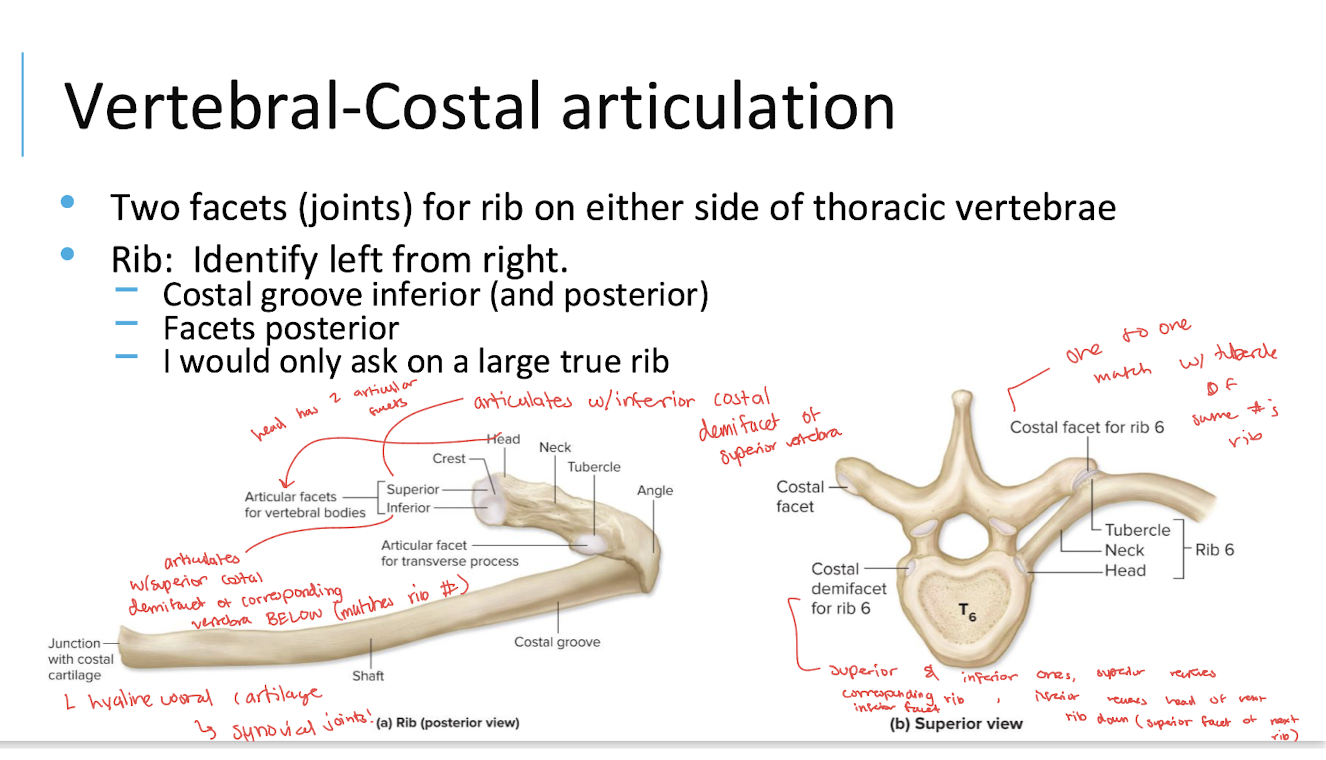
What is the vertebrocostal articulation?
The articulation between a rib and thoracic vertebrae.

How many rib facets are associated with the vertebral articulation described in the lecture?
The lecture emphasizes two facets for the rib on either side of a thoracic vertebra

How can you orient a large true rib to identify its left or right side?
The costal groove is inferior AND posterior
while the rib’s articular facets are posterior

What is the costal groove?
A groove along the inferior internal surface of a rib that accommodates intercostal vessels and a nerve

What type of joint is the first sternocostal joint?
A cartilaginous joint
hyaline cartilage

What type of joints are the second through seventh sternocostal joints?
Synovial joints
Fibrocartilage
What is the functional purpose of the rib articulations?
They permit the movement needed to change thoracic cavity dimensions during breathing while maintaining support and protection.


What is number 1?
True ribs
1-7
articulate w/manibrium/sternum

What is number 2?
False Ribs
8-12
cartilage attaches to #7
do not directly attach to sternum

What is number 3?
Floating Ribs
11-12
do not directly attach to sternum or 7 (like 8-10), just float!

What is number 4?
Manubrium

What is number 5?
Body

What is number 6?
Xiphoid process

What is number 1?
Body

What is number 2?
Costal facet

What is number 3?
Superior articular facet
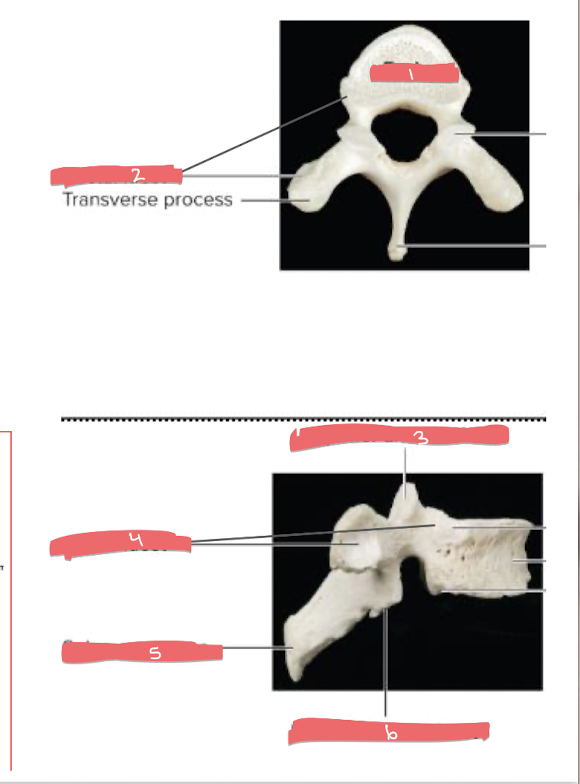
What is number 4?
Costal facet

What is number 5?
Spinous process

What is number 6?
Inferior articular facet
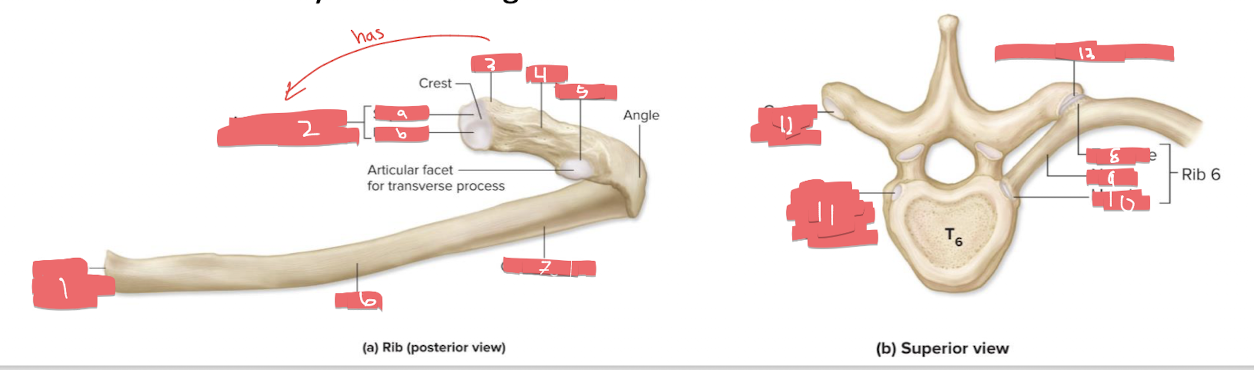
What is number 1?
Junction with costal cartilage

What is number 2a?
Superior articular facet for vertebral body
articulates w/inferior costal demifacet of SUPERIOR vertebra

What is number 2b?
Inferior articular facet for vertebral body
articulates w/superior costal demifacet of corresponding vertebra BELOW (matches rib #)

What is number 3?
Head

What is number 4?
Neck

What is number 5?
Tubercle

What is number 6?
Shaft

What is number 7?
Costal groove
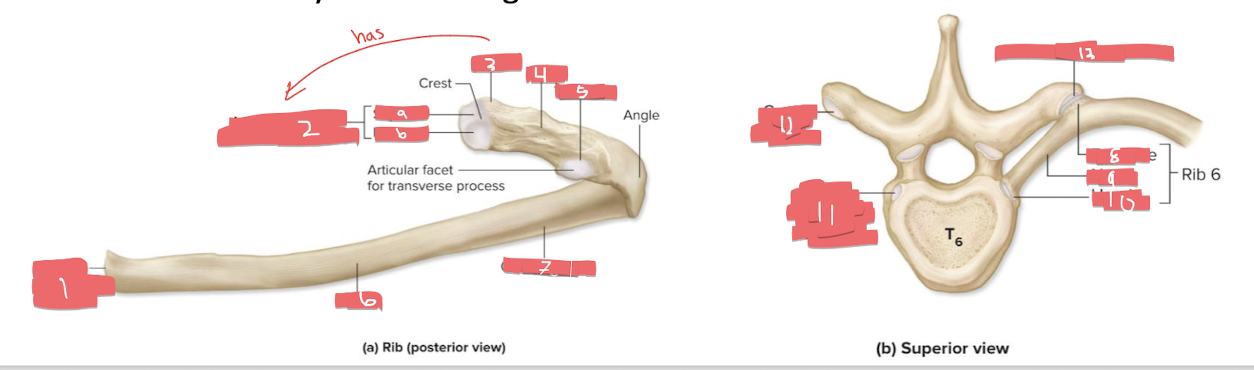
This is a….
…left rib!

What is number 8?
Tubercle

What is number 9?
Neck
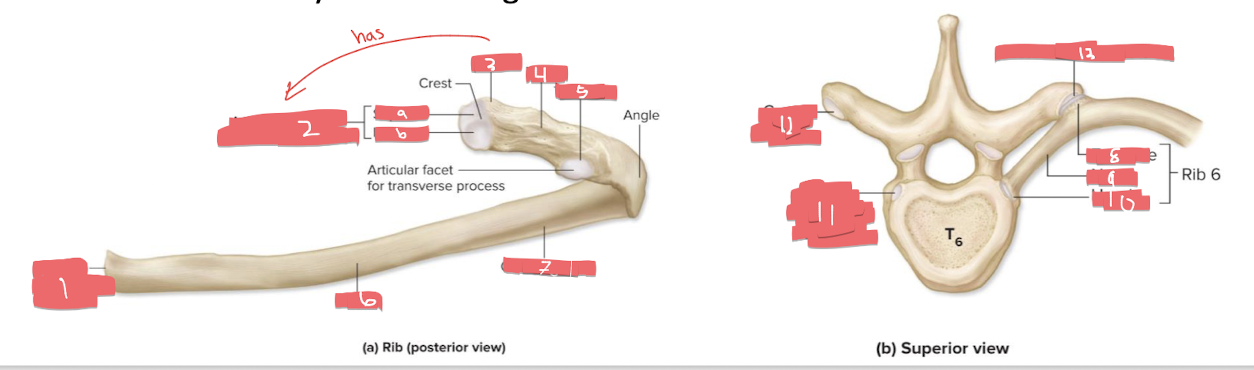
What is number 10?
Head

What is number 11?
Costal demifacet for rib 6 Costl
there are superior & inferior ones
superior receives corresponding rib inferior facet
inferior receives head of next rib down (superior facet of next rib)

What is number 12?
costal facet
receives tubercle (at transverse process)

What is number 13?
Costal facet for rib 6
one to one match w/tubercle of the same # rib (always!)
and then this matching rib as seen in the image, its inferior articular facet is what is meeting at superior costal demifacet b/c they match #’s
this specific view (b), you cannot see the superior articular facet of Rib 6 because of how the rib is oriented and cut
What are the identifying features of lumbar vertebrae?
They are thick, weight-bearing vertebrae with large muscle attachment areas
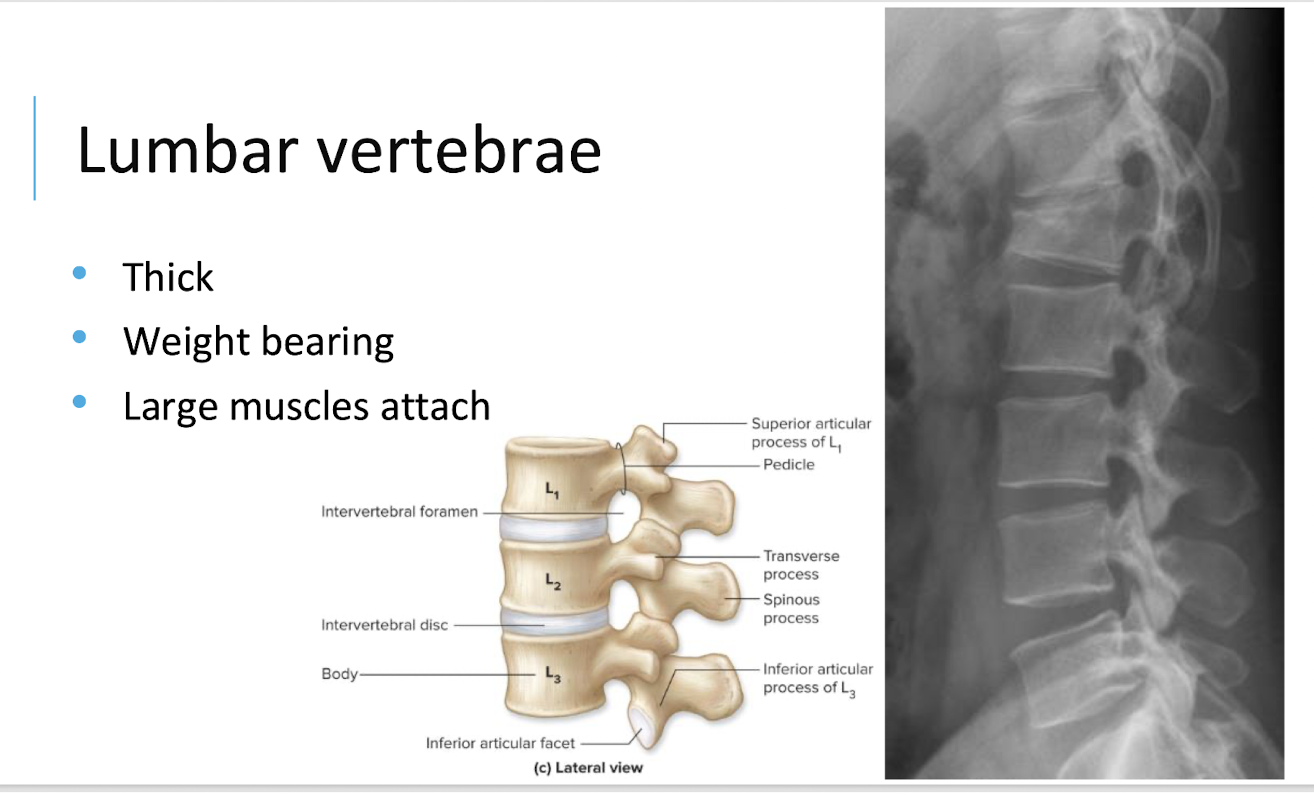
Why are lumbar vertebrae relatively large?
They bear substantial body weight.
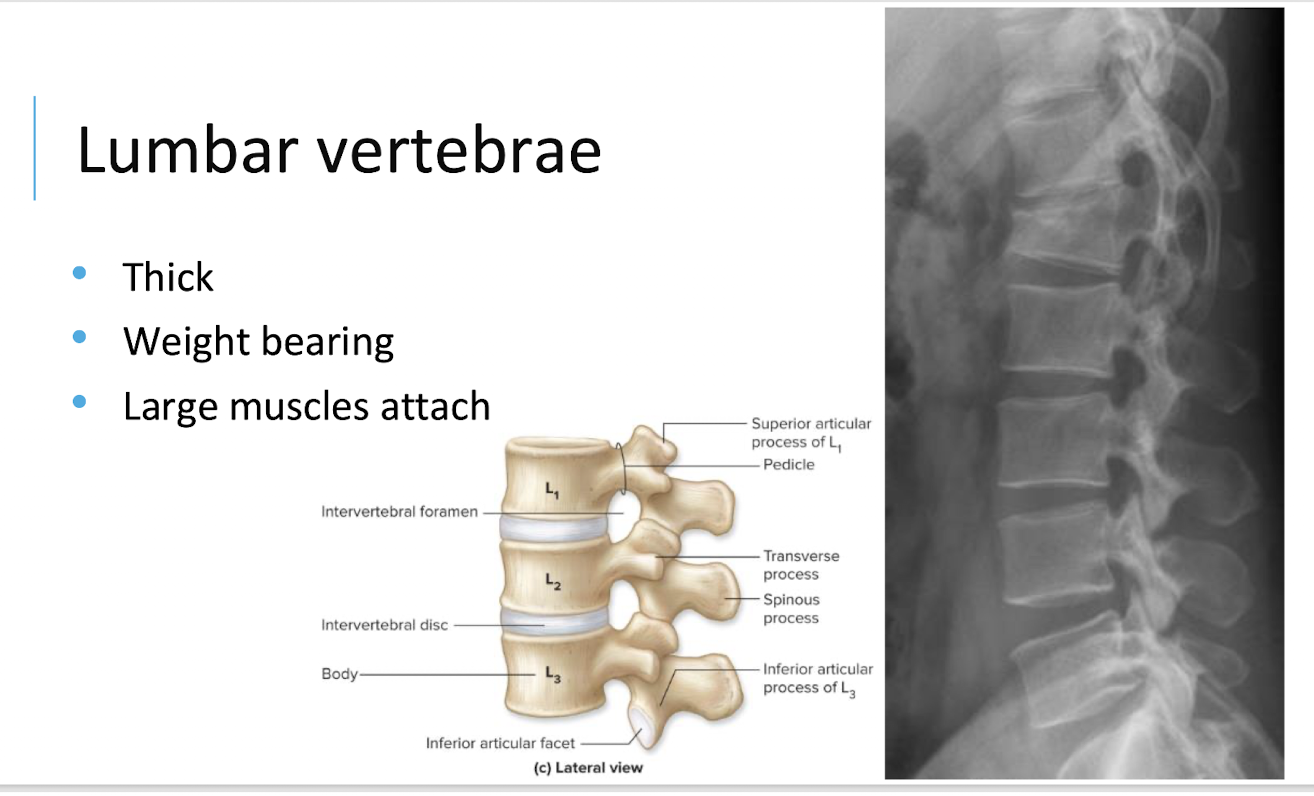
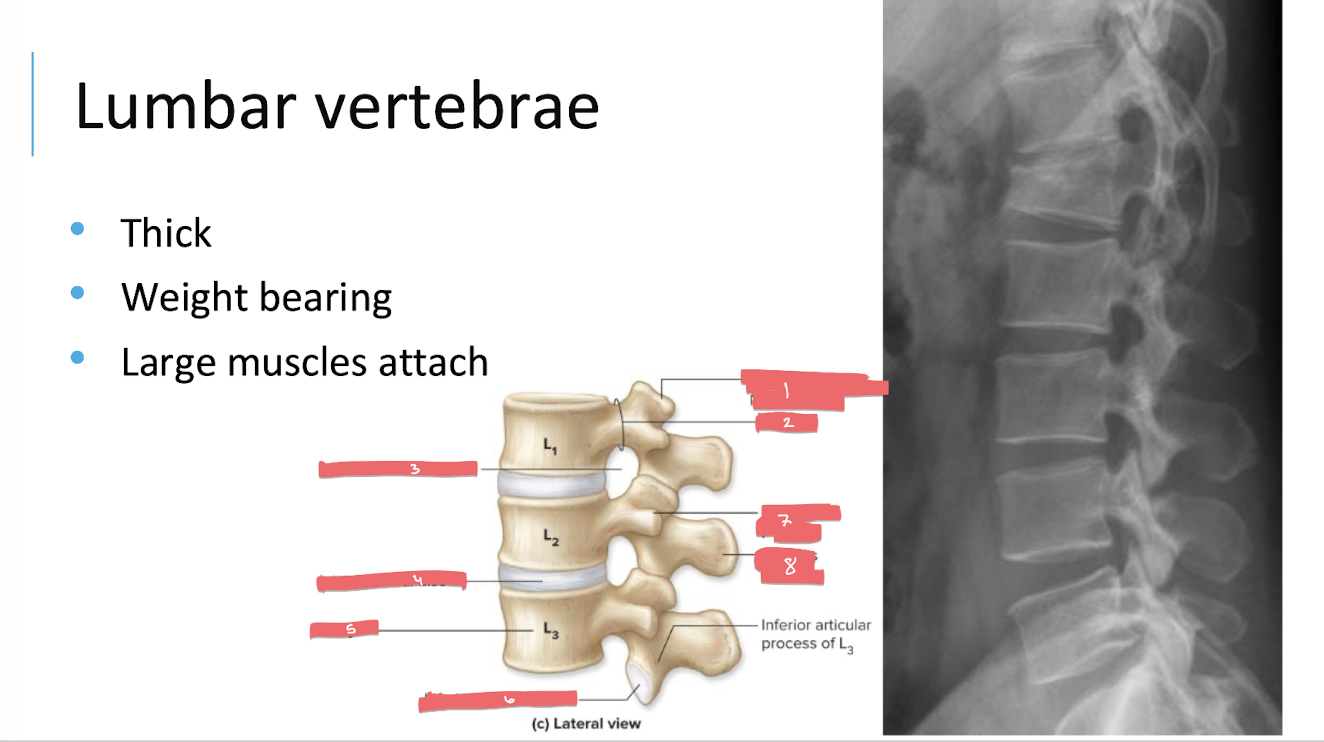
What is number 1?
Superior articular process of L1
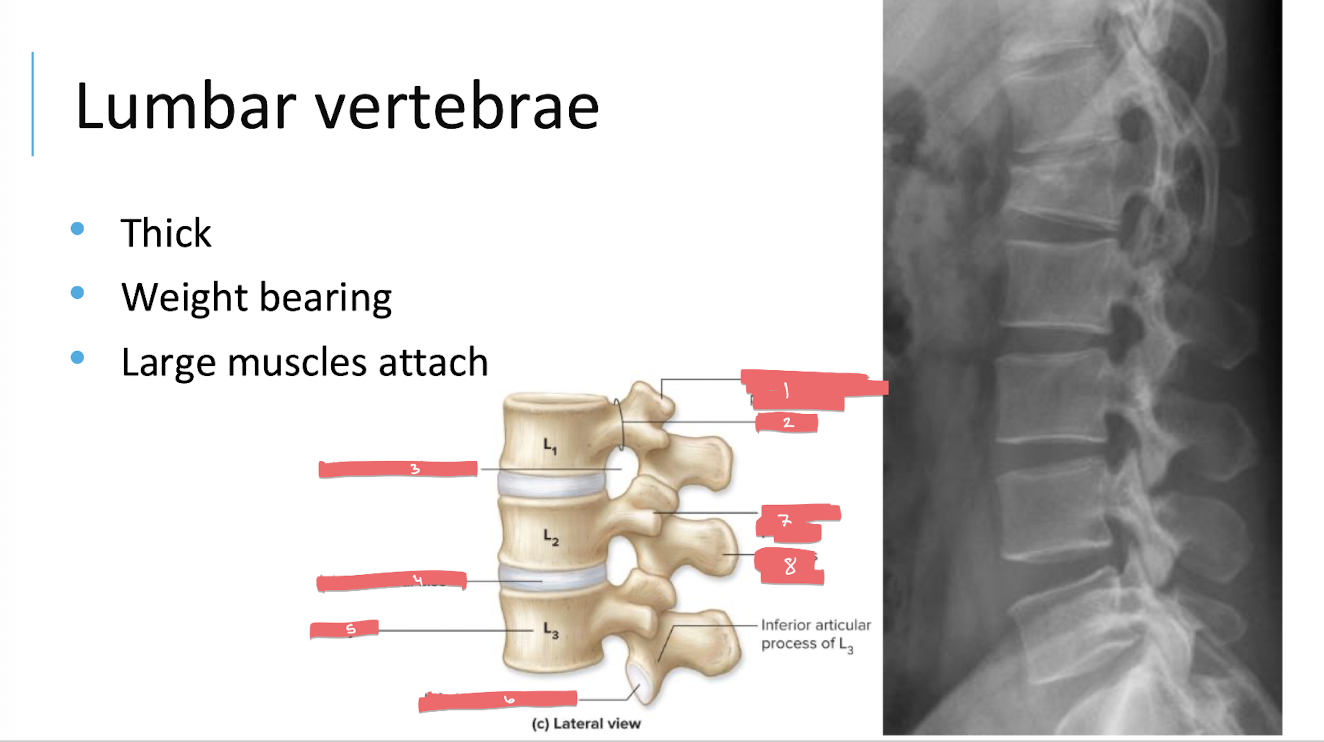
What is number 2?
Pedicle

What is number 3?
Intervertebral foramen

What is number 4?
Intervertebral disc
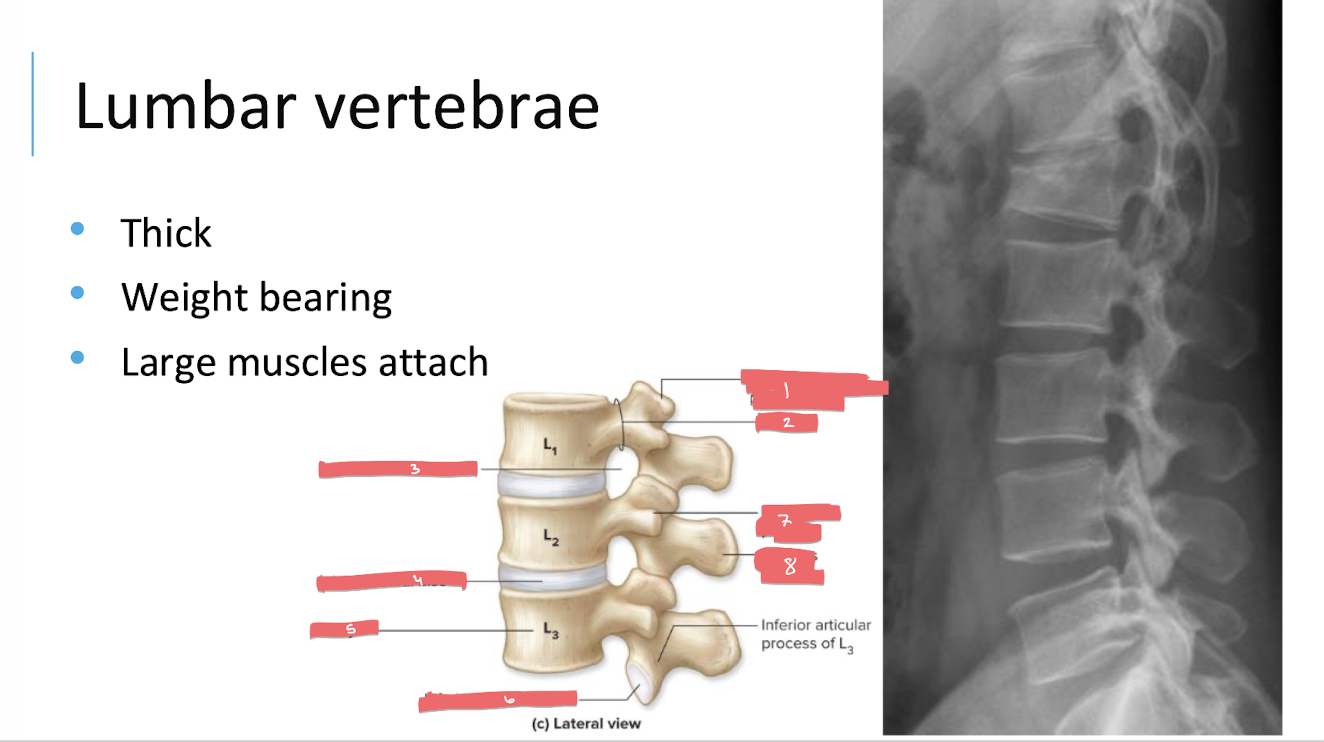
What is number 5?
Body

What is number 6?
Inferior articular facet

What is number 7?
Transverse process

What is number 8?
Spinous process
How many vertebrae fuse to form the sacrum?
Five

What passes through the sacral foramina?
Sacral nerves
5 intervertebral foramen for sacral nerves