Reconstruction Unit
 Call Kai
 Learn
 Practice Test
 Spaced Repetition
 Match
 Flashcards
 Knowt Play
1/29

There's no tags or description
Looks like no tags are added yet.
30 Terms
freedmen
men and women who had been slaves

Reconstruction
rebuilding of the South after the Civil War

Freedmen's Bureau
1865 - Agency set up to aid former slaves in adjusting themselves to freedom. It furnished food and clothing to needy blacks and helped them get jobs

Thirteenth Amendment
an 1865 amendment to the United States Constitution that bans slavery throughout the nation

black codes
Southern laws that severely limited the rights of African Americans after the Civil War

Radical Republicans
members of Congress during Reconstruction who wanted to ensure that freedmen received the right to vote
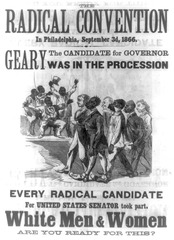
Fourteenth Amendment
An amendment to the United States Constitution that guarantees equal protection of the law and rights of citizenship to all people born or naturalized in the USA, including former slaves.

Radical Reconstruction
period beginning in 1867, when the Republicans who had control in both houses of Congress, took charge of Reconstruction

Reconstruction Act
an 1867 law that threw out the southern state governments that had refused to ratify the Fourteenth Amendment

impeach
To formally charge a public official with misconduct in office

Fifteenth Amendment
Amendment to the United States Constitution that forbids any state to deny African Americans the right to vote because of race. All males 21+ can vote.

scalawag
white Southerner who supported the Republicans during Reconstruction

carpetbagger
uncomplimentary nick-name for a northerner who went to the South after the Civil War

Ku Klux Klan
secret society organized after the Civil War to reassert white supremacy by means of violence. Founded in Tennessee by Confederate Veterans.

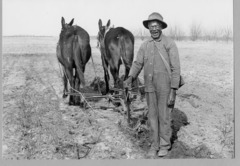
sharecropper
person who rents a plot of land from a land owner and farms it in exchange for a share of the crop
poll tax
tax required before a person can vote (Black Code)

literacy test
examination to see if a person can read and write; used in the past to restrict voting rights (Black Code)

grandfather clause
law that excused a voter from a literacy test/poll tax if his father or grandfather had been eligible to vote on January 1, 1867; established to prevent freedmen and their descendants from voting. (Black Code)

segregation
legal separation of people based on racial, ethnic, or other differences

disenfranchise
Exclude a group of people on purpose. During Reconstruction Era, to deprive men of the right to vote through Black Codes.
Suffrage
the right to vote

Jim Crow Laws
Laws designed to enforce segregation of blacks from whites

Restoration
the action of returning something to a former owner, place, or condition.
Andrew Johnson
17th President of the United States, A Southerner form Tennessee, as V.P. when Lincoln was killed, he became president. He opposed radical Republicans who passed Reconstruction Acts over his veto. The first U.S. president to be impeached, he survived the Senate removal by only one vote. He was a very weak president.

Ulysses S. Grant
an American general and the eighteenth President of the United States (1869-1877). He achieved international fame as the leading Union general in the American Civil War.

Reconstruction
1865-1877

John Wilkes Booth
was an American stage actor who, as part of a conspiracy plot, assassinated Abraham Lincoln, the 16th President of the United States, at Ford's Theatre in Washington, D.C. on April 14, 1865.

Abraham Lincoln
16th president of the United States; helped preserve the United States by leading the defeat of the secessionist Confederacy; an outspoken opponent of the expansion of slavery.

William Holden
President Johnson appointed Holden provisional governor of North Carolina. Holden called on white North Carolinian's to take the oath of loyalty to the Union.

Abraham Galloway
Risked his life behind enemy lines, recruited black soldiers for the North, and fought racism in the Union army's ranks. He also stood at the forefront of an African American political movement in North Carolina. He later became one of the first black men elected to the North Carolina legislature.