1a) Alleles and Allelic Variation
 Call Kai
 Learn
Learn Practice Test
 Spaced Repetition
 Match
Match Flashcards
 Knowt Play
1/52

There's no tags or description
Looks like no tags are added yet.
Name | Mastery | Learn | Test | Matching | Spaced | Call with Kai | Chat |
|---|
No analytics yet
Send a link to your students to track their progress
53 Terms
Allele
A form of a gene
A DNA sequence variant
Sequence alignment
Can be used to compare two or more alleles
You just line them up and compare
Variants arise through…
Mutations or,
Changes in the nucleotide sequence
Mutation does NOT imply…
That the mutation changed the function of the DNA
It implies that the DNA is different but the function is the same
It also doesn’t imply that any function is worse, better, or neutral
You only know the effect after looking at function or phenotype NOT from the word “mutation” ALONE
What is a gene product?
The functional molecule encoded (output of expression)
Protein Products !!!
Sometimes RNA (deepening on the type of gene)
When is a gene expressed
When its functional product is produced
Usually we transcribed, translated, and regulation
A gene can be expressed and not produce a functional product due to mutations
Expressions DOES NOT = functional product
Mutations are described by…
How they change DNA
How they change an encoded gene product
The amount of gene product
How they affect the products activity
Mutations that change DNA Structure
Substitution
Indel
Larger rearrangements
Mutations that change an encoded gene product
They are called “Protein Coding sequence mutations”
Ex)
Missense
Nonsence
Framshift
Mutations that change the amount of gene product
Regulatory product
Mutations that affect the products activity
Loss of function
Gain of function
Substitution
A single nucleotide change

Indel
A short insertion and/or deletion of an indel (nulceotide base)
Shortest possible indel = 1 nucleotide

Larger rearrangements
Duplications: DNA is copied twice → 1 base (frameshift) → (3 bases) add an amino acid
Deletions: DNA is lost → 1 base (frameshift) → (3 bases) lose of amino acid
Inversion: DNA is broken off and flipped
Coding sequence mutations
Missense
Nonsense
Frameshift
Missense
Mutation leading to a single amino acid change in the resulting protein
Nonsense
Mutation of an amino-acid encoding codon to a stop codon
Produces shortened proetin
Frameshift
Mutation (insertion or deletion) that alters reading frame
The amino acids encoded downstream of the mutation
Regulatory mutations
Do not affect the sequence of the encode product
Affect gene expression and this the AMOUNT of encoded product produced
Where are regulatory mutations
In NON-CODING regions of DNA
Found within DNA sequences that govern gene expression
They can change mRNA
Stability
Localization
Splicing
Mutations are found in DNA regulatory regions like
Promoters
Enhancers
Silencers
mRNA splicing signals (iN DNA sequence)
Loss of function mutations
Alleles that decrease or eliminate functional activity of a gene product
Most Loss of function alleles are recessive to functional alleles
Haplosufficient
A single copy of a functional allele produces sufficient functional activity
Haploinsufficient
Two copies of a function alallele are necessary to produce enough gene product activity for a wild-type phenotype
Loss of function alleles are dominant to functional alleles
Three molecular classes that show dominant inhertance
Haploinsufficient
Dominant negative
Gain-of-function
Exceptions to complete dominant/recessive allele relationships
Incomplete dominance
Co-dominance
Haplosufficent
A single copy of a functional allele produces sufficient functional activity
Null or Amorphic alleles
Example of a loss of function mutations
Allele whose product has no functional activity
Homozygous vs Heterozygous Null/Amorphic mutations
A loss of function mutation defines what the mutates allele does not by what the other allele does
One allele can be null/amorphic and thus has a loss of function, but the other allele can be unaffected
Only non mutated allele will produce a product and the null or amophic one wont
The organism will have less total product than a homozygous wild-type

Hypomorphic Alleles
Partial loss of function alleles
Alleles with reduced functional activity
Reduced activity of protein product
Proteins works poorly
and/or
Reduced production (expression) of product
Less mRNA or less protein

Conditional Allele
Loss of function allele
Allele with loss of function only under SOME conditions
Temperature sensitive are a common type of naturally occurring conditional allele
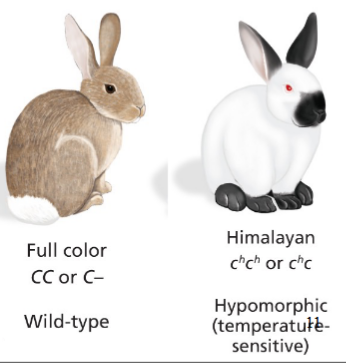
Dominant negative allele
Encodes product with functional activity that INTERFERES w/ the activity of functional allele product from the SAME gene
(The protein helps lift the coach but drops it)
Produces a loss of function phenotype
Most commonly occur for genes encoding multimeric products (ex hemoglobin)
Gain of function
Product has a new or higher activity
or
Product acts at a new time or place
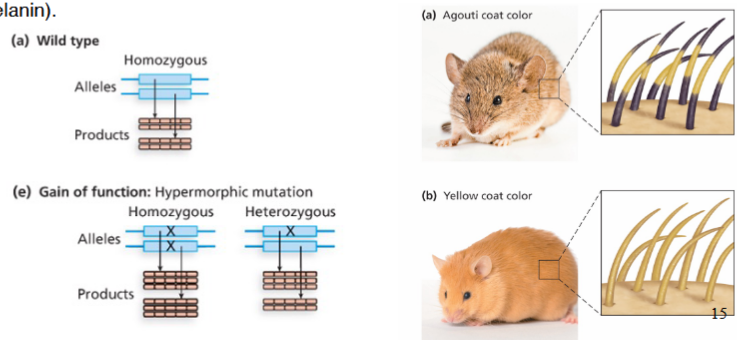
Hypermorphic allele
A gain of function allele
Allele whose produce has increased activity
Ex) Hypermorphic agouti gene produces yellow coat collor (Extra phaomelanin)
Neomorphic Alleles
A gain of function allele
Neo-morphic → New Form
Alleles whose product has a new function activity
Same product encoded but the product is express in a new PLACE or TIME
Neomorphic Allele Eyless example
Eyeless gene controls eye development only in the head
Neomorphic mutation = eyes form in a NEW location
This is not a loss of eyes but of gain of a new function
Incomplete Dominance
Blended phenotype
When the phenotype of heterozygotes is intermediate b/w the phenotypes of the two homozygotes
WW (red)
Ww (pink)
ww (white)
Codominance
Both phenotypes FULLY visible
When the phenotypes associated with both alleles show in the heterozygote
Dose-Dependece
How many functional alleles are needed to produce a wild-type phenotype
Ex
Haplosufficiency
Incomplete dominance
Haploinsufficiency
Haplosufficiency
You need a bit of expression to get W-T phenotype

Haploinsufficiency
You need a lot more expression to get to W-T phenotype

Incomplete Dominance
Above, Below 1, and Below 2
Below threshold 1 = some product is produced leading to an intermediate phenotype
Bellow threshold 2 = loss of function (mutant) phenotype

Multiple Alleles
Any diploid individual has 2 copies of each gene (MAX two alleles)
Any number of alleles can exist in a population or species
Dom?Rec relationships are specific to a particular pair of alleles
Pleiotrophy
When an allele or gene produces multiple different phenotype
Can indicate that
A gene or allele acts in MULTIPLE biological process (AY)
A gene or allele acts in a SINGLE biological process that produces outcomes we categorize as different phenotypes
EX)
Ay in mice = yellow fur AND predisposition to obesity
Lethal alleles
Lead to modified Mendelian rations in crosses
AYAY is lethal
Other determinant of phenotype (NON Genotype)
Gene - environment interactions
Incomplete penetrance
Variable expressivity
Incomplete penetrance and variable expressivity can be CAUSE by gene - environment interactions but they can be cause by other things too
Phenotypic plasticity
Reproducible
Genetically controlled phenotypic variation in response to variation in environmental condition

Polyphenism
A type of plasticity
When 2 or more distinct body forms are produced by different developmental programs under different environmental conditions
Temperature - induced
Nutrient-induced
Described by norm of reaction
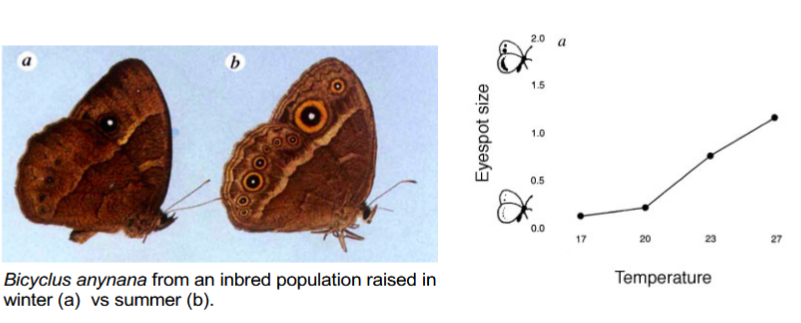
Norm of reaction
Describes polyphenism
Describes the range of pheotypes produced by one genotype depending on an environmental condition

Penetrance
Proportion of individuals that show a phenotype associated with a particular genotype
Incomplete penetrance
When not all individuals show a phenotype associated with a particular genotype
You can see this in pedigree
Expressivity
The degree that a particular genotype is expressed in the phenotype of an individual
Variable ecpressivity
All these beagles are SPSP but they vary drastically phenotypically while sharing the same genotype

Variable penetrance vs Variable expressivity
Penetrance: You have it or you don’t
Expressivity: You can have it in varying degrees
You can have both variable penetrance and variable expressivity
