L6 Sensation, perception & early cognitive devmt
 Call Kai
 Learn
 Practice Test
 Spaced Repetition
 Match
 Flashcards
 Knowt Play
1/34

There's no tags or description
Looks like no tags are added yet.
35 Terms
What is the empiricist view of infants' sensory experiences?
Infants are seen as 'tabula rasa' or blank slates.
What do nativists believe about infants' perceptual abilities?
They believe that perceptual abilities are innate.
What is the difference between sensation and perception?
Sensation is the registration of basic units of information necessary for perception, (= process of organization and interpretation.)
key research methods used to study sensory and cognitive abilities in infants
•Preference Method
•Habituation Method
•Evoked Potentials
•High-amplitude Sucking
what is preference method
seeing what they look at/prefer
what is habituation method
noticing when they get bored or react to new things
what is evoked potentials?
They use fMRI and electrodes to measure brain responses to stimuli.
What is the high-amplitude sucking method?
measures changes in sucking rates to determine infants' preferences for stimuli.
sensory capacities in early infancy
20/600, which is very blurry.
+sensitive to light and movement
+eye movements (salapetek 75)
At what age can infants discriminate all basic primary colors?
By 2 months of age.
perception of patterns in infancy
external edges, contrasting contours, symmetry
What did Fantz's experiments reveal about infant preferences?
3-month-old infants prefer to look at complex stimuli.
TO CHECK LATER SORRY What did Banks experiments reveal about infant preferences?
infants prefer to look at what they see well
What is the significance of the Gibson visual cliff experiment '60?
infants would not crawl over an apparent cliff, indicating depth perception.
What can infants discriminate in terms of auditory perception?
They can discriminate sounds based on loudness, frequency, and duration. + react to voices and languages (phonetic learning)
What are infants' taste preferences?
prefers sweet over bitter
What are infants' smell preferences?
capable of detecting bariety of odors + discriminate mother smell
What are infants' other perceptions
temperature, pain, touch
What is intersensory perception in infants?
individual sensory systems interpret info ===> infant's multimodal approach to perception +
integrated, combined and coordinated info
what studies proved intersensory perception?
Bower 71: virtual object created by polarised light
Metlzoff 79: different dummies used
Studies on environmental influences
Reisen 50: chimpanzees dont react to obj = irreversable degeneration of optic nerve (in dark room)
ft. of Piaget's Stage theory
universal, invariant, qualitative changes
What is Piaget's sensori-motor stage?
-first stage of cognitive development (0-2 years)
- 6 substages
- reflexive pb solver --> active pb solver
what are 2 important developments in sensori-motor stage
obj. permanence
deferred imitation
What is object permanence?
The realization that people and objects exist even when they cannot be seen.
What is deferred imitation?
imitating patterns imply remembering, mentally rep seq of actions
substage 1?
0-1mo, simple reflexes
substage 2:
1-4mo, primary circular reactions = repetition of interesting actions on own body
substage 3
(4-8mo) secondary circular reactions = rep of actions meant to bring impact on environment
vocalization increase + imitation begins
substage 4?
coordination of secondary circular reactions
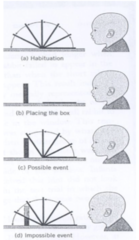
What did Renee Baillargeon's research reveal about object permanence?
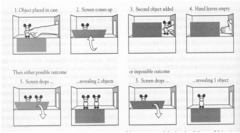
It indicated that object permanence develops earlier than Piaget proposed (8mo), as infants at 3.5 months looked longer at impossible events.
Substage 5?
12-18mo: tertiary circular reactions = deliberate variations of actions to bring desirable consequences
+ interest in understand the unexpected, mini experiments
Substage 6?
18-24mo:
symbolic thought/mental representation = internal image of a past event/ob
=> understand causality
=> can pretend (deferred imit)
pov of neo-nativism in cognitive development?
infants are born with substantial innate knowledge about the physical world.
Wynn's study
addition/substraction => stare longer at impossible outcome (but critizied as maybe just an interest and not understanding)
basic numerical expectations