Unit 7 - Vacances
 Call Kai
 Learn
 Practice Test
 Spaced Repetition
 Match
 Flashcards
 Knowt Play
1/141

There's no tags or description
Looks like no tags are added yet.
142 Terms
take the feminine singular form and add -ment
activ - active - activement
Forming an adverb from an adjective that ends in a consonant; ex: active
franc - franche - franchement
adjective: frank
adverb: frankly, honestly
heureusement
fortunately
malheureusement
unfortunately
nerveusement - elle parle nerveusement
nervously: she speaks nervously
sérieusement
seriously
dernièrement
lately
absolu - absolument
just add -ment to the end
ex: absolutely
making an adverb from an masculine adjective that already ends in a vowel
vraimenet
really
facilement
easily
poliment
politely
replace ending with -amment or -emment
constant - constamment
ex: constant/constantly
forming an adverb that ends in -ant or -ent in masc. singular
patiemment
patiently
courant - courammant
fluently
différent - différemment
differently
évident - évidemment
obviously
lent - lentement (exception)
slowly
bien
well
gentiment
nicely
mal
badly
peu
little
rapidement, vite
fast (2 options)
de temps en temps
from time to time
en général
in general
quelquefois
sometimes
before the word it modifies
ils courent très vite
where to place adverb that modifies an adjective/adverb
ex: they run very fast
immediately after the verb
elle parle bien le français.
if its really long put at end of sentence
where to put an aderb that modifies a verb
ex: she speaks French well.
short adverbs are placed before the past participle, while long adverbs are placed after
ils sont vite partis
ils ont gagné facilement
where to place an adverb in passe compose
they left quickly
they won easily
assez
la chambre est assez grande
rather/pretty
the room is pretty big

passe compose with etre & aller
ne and pas around etre
nous ne sommes pas allées à la plage.
passe compose with negation- Etre
“We didn’t go back”
naitre (né)
to be born & passe
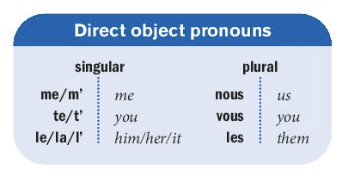
place direct object ponoun in place of a direct object noun:
tu les fais?
Place a direct object pronoun before the conjugated verb (even in passe)
les étudiants vous ont entendu.
Place direct obj pronoun between ne and the conjugated verb
Elle ne l’a pas pris à 14 heures?
When an infinitve follows a conj verb, the DOP precedes infinitive
Marcel va nous écouter.
When a DIP is used with passe, the past participle must agree in both gender and number.
Je les ai attendues à la gare.
in Q’s using Quel/quelles in passe comp, the past paritciple must agree with gender & number of quel/quelles
Quelles valises as-tu apportées?
Direct object pronouns
Are you packing them?
the students heard you
She didn’t take it at 2pm?
Marcel will listen to us.
I waited for them at the game.
which suitcases are you bringing?