ORGO 2241 Exam Correct Answers
 Call Kai
 Learn
 Practice Test
 Spaced Repetition
 Match
 Flashcards
 Knowt Play
1/54

There's no tags or description
Looks like no tags are added yet.
55 Terms
+1
The formal charge of nitrogen in the compound below is _________ (atomic number of N=7)

1,3-Diethylcylopentane
What is the systematic name of the following compound?

2, 3, 1
Rank the resonance structures given below from most (1) to least (3) stable.

covalent
The bonds in the following compounds are _______ bonds

3
How many unpaired electrons are present in ground state configuration of phosphorus atom (atomic number =15) give just the number.
What are the products for the following acid-base reaction?

5
How many sigma bonds are in the most stable lewis structure for CH3CN?
sp2-s
The C-H bond in methyl cation, +CH3 is formed by the overlap of what two orbitals?
Z
Determine if the stereochemistry of the following compound is E or Z

2-methylpropyl
What is the systematic name for the indicated branched substituent? Please don't name the whole compound

I>Br>Cl>F
Rank the order of acidity of the following molecules from strongest (1) to weakest (4)

True
The following compound is di-substituted alkene (T or F)
3-ethyl-2,4-dimethylpentane
What is the systematic (IUPAC) name for the following alkane?

homolytic
What type of bond cleavage is the following?

CH3CH2OH
What is the conjugate acid of CH3CH2O-
1 - primary amine
2 - primary alcohol
3 - secondary amine
4 - secondary alcohol
Match the functional groups with their names

Option 3
Identify the compound with the lowest pKa
A, B, and C
Which of the pi electrons shown below are delocalized?

1
How many of all constitutional isomers of C6H14 have no secondary carbon? Just give the number

NaO2, KF
Which of the following compounds have ionic bond?
BF3
Na2O
ICl
KF
32
How many valence electrons are there in HSO4-?
substitution reaction
What kind of reaction does the conversion of A to B represent?

CH3CH3
CH2=CH2
CH3NH2
Which of the following are nucleophiles?
CH3CH3
CH3NH2
CH2=CH2
+CH3
BH3
Which direction will the equilibrium favor? Right or left?
[x]= C10H14
[Y]= 2
The compound shown below has the molecular formula of [x] and has a total of [Y] sp carbon/s
3
Which step in the following energy diagram is the rate determining step?

3
How many asymmetric centers are present in the compound shown below? Please just give the number

2
Choose the major organic product/s for the following SN2 reaction

R
What is the configuration of the chirality center in the following compound? R or S

2
1
3
Rank the following alkenes in decreasing order of stability (1 most stable 3 least stable)

2 and 4
Which of the following alkanes are in staggered conformation

B
Which of the following dimethylcyclohexanes has the most stable chair conformation

D. Br-
What is the leaving group in the following reaction

constitutional isomers
Which of the following terms best describes the pair of compounds shown. Enantiomers, diasteromers, constitutional isomers or same compounds
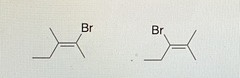
D
Which of the alkyl halides is the best choice as the starting material to make the alkene shown as the major product when treated with CH3CH2O-

D
Which Newman projection correctly represents the wedge and dash drawing

3, 1, 2, 4
Rank the carbocations from least stable (1) to most stable (4)

C and B
Which of the following are meso compounds
3
How many beta carbons are in the structure shown below?

2
How many possible alkene products can be produced in the following reaction

C
Which of the following is the staggered conformation for rotation about the C1-C2 bond in the following structure?

D
What is the major organic product for the following E2 reaction?

2
What is the major organic product for the following elimination reaction

False
SN1 is a concerted reaction true or false?
1
How many different E2 products could be formed in the following E2 reaction?

3
What is the Fischer projection of the structure given below

A
Which of the following conformations is the most stable?

II has more steric strain
Which of the following best explains the reason for the relative stabilities of the conformers shown

2
4
3
1
Rank the following substrates from most reactive (1) to least reactive (4) in an SN1 reaction

2
What is/are the major products that would be formed in the following SN1 reaction?

Which wedge and dash drawing correctly represents the chair conformation given?
Which of the following in the best nucleophile in protic solvent?
Which of the following terms best describes the pair of compounds shown?
Diastereomers
Enantiomers
Same compounds
constitutional isomers
Which of the following are protic solvents?
Which of the following is the most stable structure for trans-1-isopropyl-3-methylcyclohexane given below?