BK3B 7 Sound
 Call Kai
 Learn
 Practice Test
 Spaced Repetition
 Match
 Flashcards
 Knowt Play
1/12

There's no tags or description
Looks like no tags are added yet.
13 Terms
What are the two fundamental classifications of a sound wave?
It is a mechanical wave (requires a medium to travel) and a longitudinal wave (particles vibrate parallel to the direction of wave travel).
TRAP: Describe the velocity and displacement of particles located exactly at the centre of compression or centre of rarefaction.
Displacement is ZERO (they are at their equilibrium positions). Velocity is at its MAXIMUM (moving at the highest speed). Do NOT confuse this with particles at maximum displacement, which are momentarily at rest!

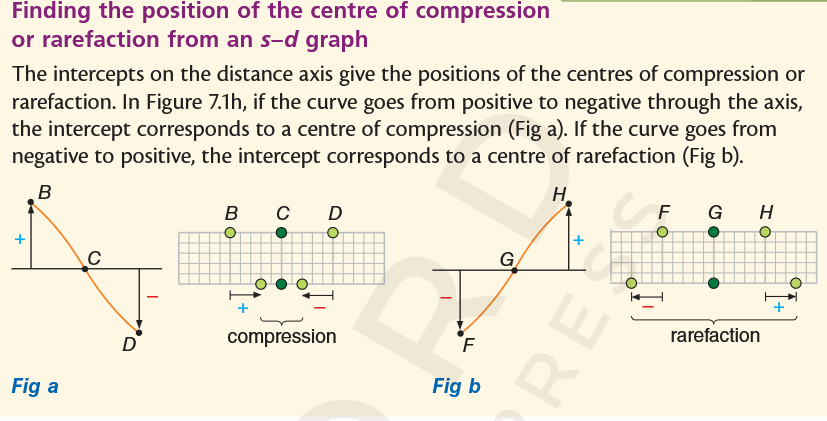
On a displacement-distance (s-d) graph where rightward displacement is positive, how do you visually identify the centres of compression and rarefaction?
Both occur at s = 0 (x-intercepts).
Centre of compression: the curve goes from positive to negative (negative slope).
Centre of rarefaction: the curve goes from negative to positive (positive slope).
State the two core wave equations linking wave speed, frequency, wavelength, and period. v = f * λ and f = 1 / T.
v = f * λ and f = 1 / T. [IN DSE FORMULA SHEET]
Compare the typical speed of sound in solids, liquids, and gases. Does the speed of sound in air depend on its frequency?
v_solid > v_liquid > v_gas. The speed of sound in air is independent of its frequency (all frequencies travel at roughly 340 m/s in air).
What is the key formula setup when calculating the distance (d) of a reflector (like a cliff or seabed) using echoes?
The sound travels to the reflector and back, so the total distance is 2d. Use the formula: 2d = v * t.
[NOT IN DSE FORMULA SHEET - MUST MEMORIZE/DERIVE]
Why can we easily hear people talking behind a doorway even if we cannot see them? (State the HKEAA marking scheme keywords)
Sound waves undergo significant diffraction after passing through the doorway because the typical wavelength of human voice is comparable to the width of the doorway.
State the path difference conditions for constructive interference (loud sound) and destructive interference (soft sound) from two in-phase coherent sound sources.
Constructive (loud): Path difference = n * λ (where n = 0, 1, 2…).
Destructive (soft): Path difference = (n + 0.5) * λ.
[NOT IN DSE FORMULA SHEET - MUST MEMORIZE/DERIVE]

TRAP: Can the fringe separation formula (Δy = λD / a) be used to find the distance between loud sounds in a typical loudspeaker interference experiment?
Generally NO. This equation is only applicable when Δy << D and a << D.
In most sound experiments, the speakers are too far apart (a is large) relative to D, so the small-angle approximation fails.
State the audible frequency range for humans and define ultrasound.
Audible range: 20 Hz to 20,000 Hz.
Ultrasound: sound with a frequency higher than 20,000 Hz.
TRAP: Compare the speed and degree of diffraction of ultrasound and audible sound when traveling in the same medium (e.g., air).
Speed: They travel at the exact SAME speed in the same medium.
Diffraction: Ultrasound diffracts LESS because it has a higher frequency and therefore a shorter wavelength (λ = v / f).
What physical wave quantities correspond to the pitch, loudness, and quality (timbre) of a musical note?
Pitch = frequency. Loudness = amplitude. Quality = waveform (caused by different combinations of frequencies).

TRAP: What is the exact physical meaning of a sound intensity level of 0 dB? Does it mean there is zero sound energy?
0 dB is the "threshold of hearing" (the lowest sound intensity level a normal human ear can hear). It does NOT mean zero sound energy; sound intensity levels can be negative e.g., -5 dB), but humans simply cannot hear them.