111 Birds after midterm 1
 Call Kai
 Learn
 Practice Test
 Spaced Repetition
 Match
 Flashcards
 Knowt Play
1/129

There's no tags or description
Looks like no tags are added yet.
130 Terms
Feeding
Key activity to fuel metabolism
High metabolic needs
Foraging itself is costly
maximize foraging efficiency (energy vs time)
Foraging itself is costly
Higher metabolic rate
Exposure to predation
Exposure to competition
Exposure to extreme environmental conditions
Foraging efficiency is determined by
Natural selection
morphology:
• Body size
• Wing size and shape
• Bill
• Feet
• Gut morphology
Behavior
Key feature of birds: lack of teeth; bills
grinding function replaced by internal gut morphology
some re-evolution of other tooth functions: grasping, killing
Structure of the avian bill
Cere (only some birds)
Rhamphotheca
Cere
fleshy cuticle surrounding the base of the bill or nares, present in some birds
Rhampotheca
vascularized keratinous covering
Bill movement
Cranial Kinesis
Prokinesis
Rhynchokinesis
Cranial Kinesis
The ability to move part of the skull relative to the braincase
Prokinesis
The whole upper bill rotates around a hinge (nasofrontal hinge)
• Increased control of gape
• Shock absorbance
• Greater speed of opening and closing bills
Rhynchokinesis
allows movement of the tip of the upper mandible
• Less substrate displacement when probing
Bills are living, sensitive structures
Herbst corpuscles
Herbst corpuscles
Mechanoreceptors in “sensory pits” in the bills of probing birds for tactile sensing while foraging
Allows for remote touch of prey via pressure differentials and vibrations
Bill types and functions
• Raptorial: killing (tomial tooth), cutting, tearing
• Parrot bills: also cutting…but mostly fruit
• “Spear-like”: stabby, and in combination with
S-shaped neck
Bill types and functions Nectar
• Nectavores – strategy 1:
Long bills (tubular; terete) for accessing nectar deep in flowers
Often co-evolved, mutualistic pollination
• Nectavores – strategy 2:
Peck and steal
Bill types and functions
Filter feeders: sift seeds and animal matter from water and sediment
Lamellae: fine teeth- or comb-like structures along the edge of the bill
Generally use the tongue as a pump to move water into and out of the bill
“Probing” shorebird bills
Usually fairly rounded, long-ish, and thin
sometimes males and females of the same species having slightly different bill lengths so pairs don’t compete
Seed-eaters
short, conical bills good for crushing
Leaf-gleaners
small, delicate, precise bills
Aerial insectivores
Wide bills with wide gape, often with rictal bristles
Woodpeckers!
Laterally-compressed, chisel-like bill
Unique tongue wraps around skull and inserts in the right nostril; helps cushion hammering and capture prey
Lingual papillae - Avian tounge
projections on the tongue that assist with capturing, gripping, and manipulating food items
Structure similar to teeth and can be used to capture, hold and direct food.
Digestion
Digestion is faster in birds
High metabolic rate, need energy quickly and need to get rid of excess weight from food
Variation in avian digestive systems


Esophagus
Where the food enters from the mouth and is propelled via muscle contraction (esophageal peristalsis) to the stomach

Crop
Modified section of the esophagus for food storage, moistening, and development of probiotic microbiota
Variation in crops
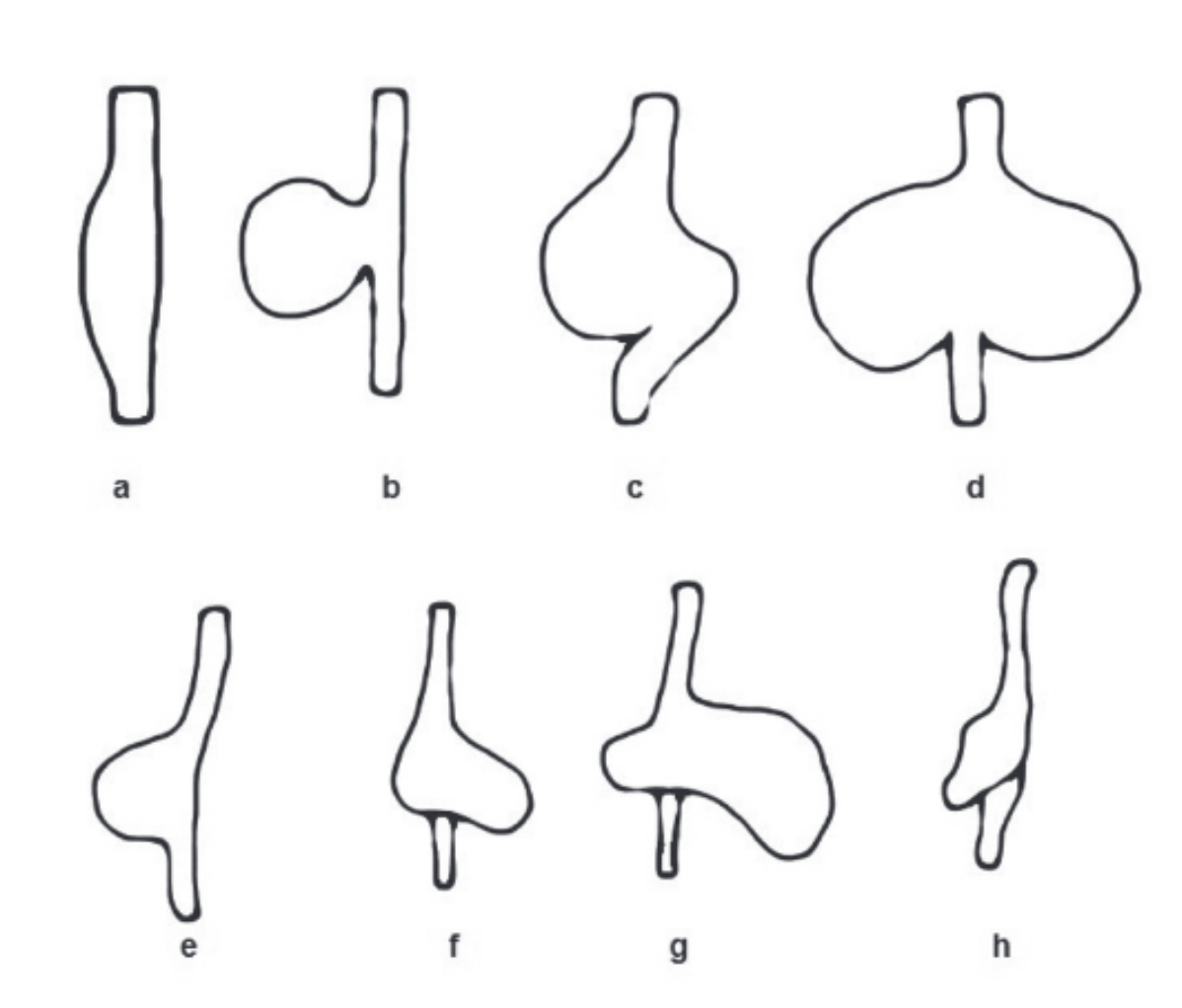
An avian ruminant
In the Hoatzin
For fermentation
Very enlarged crop


Proventriculus
chemical breakdown of foods (hydrochloric acids)

Gizzard
mechanical breakdown of foods; serves the function of grinding molars; often contains grit or pebbles to help with grinding
Proventriculus Seed-eater
Seeds & grain: developed proventriculus & well-developed gizzard
Proventriculus Fish eater
Less-developed proventriculus & well-developed gizzard
Proventriculus Fruit eater
well-developed proventriculus & less-developed gizzard
Proventriculus Hoatzin eater
Very specialized crop, reduced proventriculus & gizzard

Small intestine
Where nutrients are absorbed
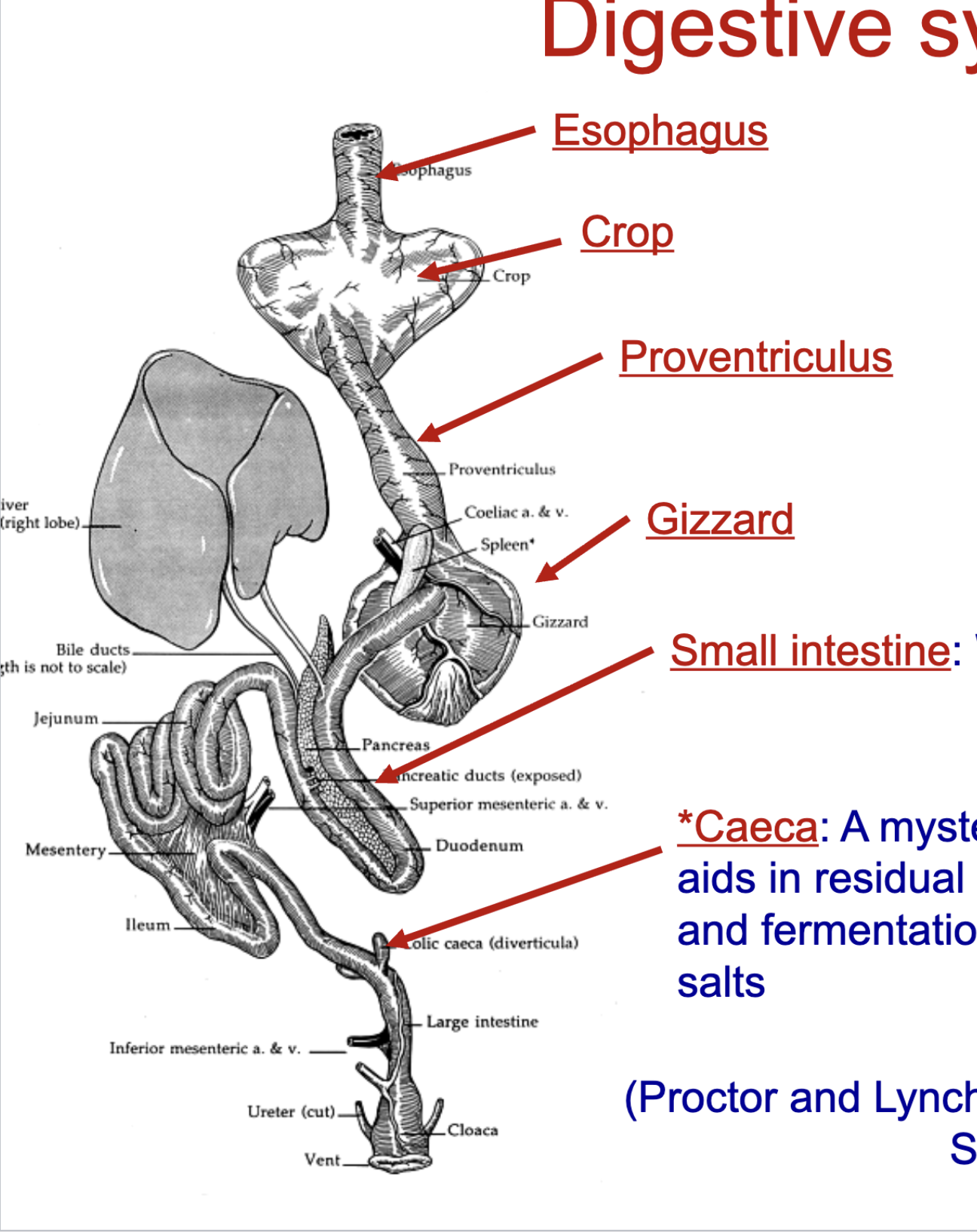
Caeca
A mysterious, multipurpose organ which aids in residual breakdown of food using bacteria and fermentation, and the reabsorption of water and salts
Variation in intestinal caeca
Gut morphology, like many things in birds, can change seasonally (as food resources change)


Large intestine
A short tract where water and electrolytes are reabsorbed (aided by antiperistalsis, or reverse muscular contractions which send waste backwards into the ceca, and undigested material is consolidated into feces and transported to the cloaca

Cloaca
Convergence of the digestive, reproductive, and urinary systems. A holding area before exiting through the vent.
Avian Reproductive System
Lay hard-shelled eggs (amniotic egg)
No viviparity (live birth)
Extensive parental care (incubation of eggs and care of young)
Large seasonal changes in reproductive tissue
Most species, females have only one functional ovary (possible adaptation for flight)
Seasonal Regression
Reproductive organs are heavy!
In all birds, reproductive organs regress to a small, non-functional state during the non-breeding season
Male reproductive system
Photoperiod stimulates release of gonadotropins, which stimulate growth of testes
Testes increase up to 300-500 times in size from fall minimum to spring maximum
Male Reproductive Tract
Sperm formation is temperature sensitive; maturation of sperm is assisted by a nocturnal drop in temp and external swellings of the seminal vesicles holding sperm
Cloacal protuberance

Copulation - bird sex
Most species lack an intromittent organ (except waterfowl, ratites)
Copulate by brief cloacal contact = “cloacal kiss”
Generally, females are in control of paternity (who is the father) of her eggs; must allow access, sperm selection
Male reproductive system
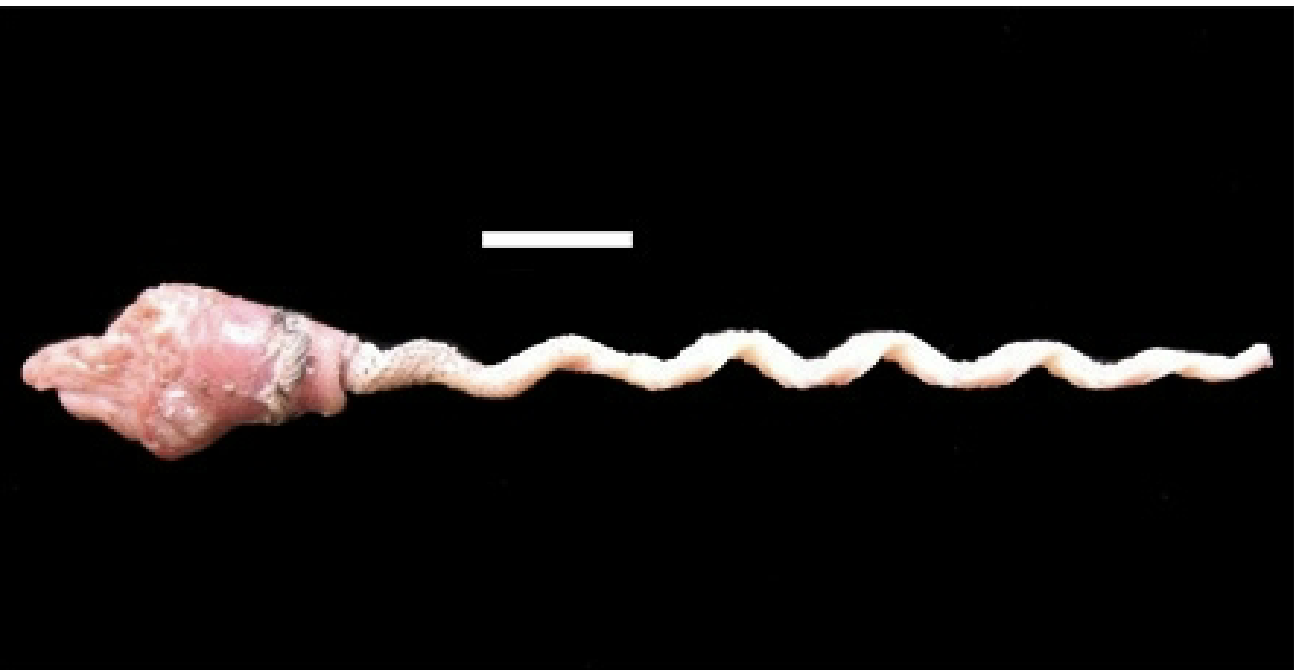
Intromittent organs are extremely rare
Phallus in waterfowl is corkscrewed counterclockwise
grooved with backward-facing spines; rapidly everts via lymph

Why do ducks do this freak ass shit
Probably evolved in response to breeding habitat (water) and mating system (extra-pair copulations)
Female reproductive system
In most species, only a single ovary (left)
except kiwis and a few exceptions
Immature birds have all primary oocytes
born with all the eggs you will have her entire life
Most species have sperm storage tubules; can store sperm for 10-24 days
they choose who the father of their offspring is
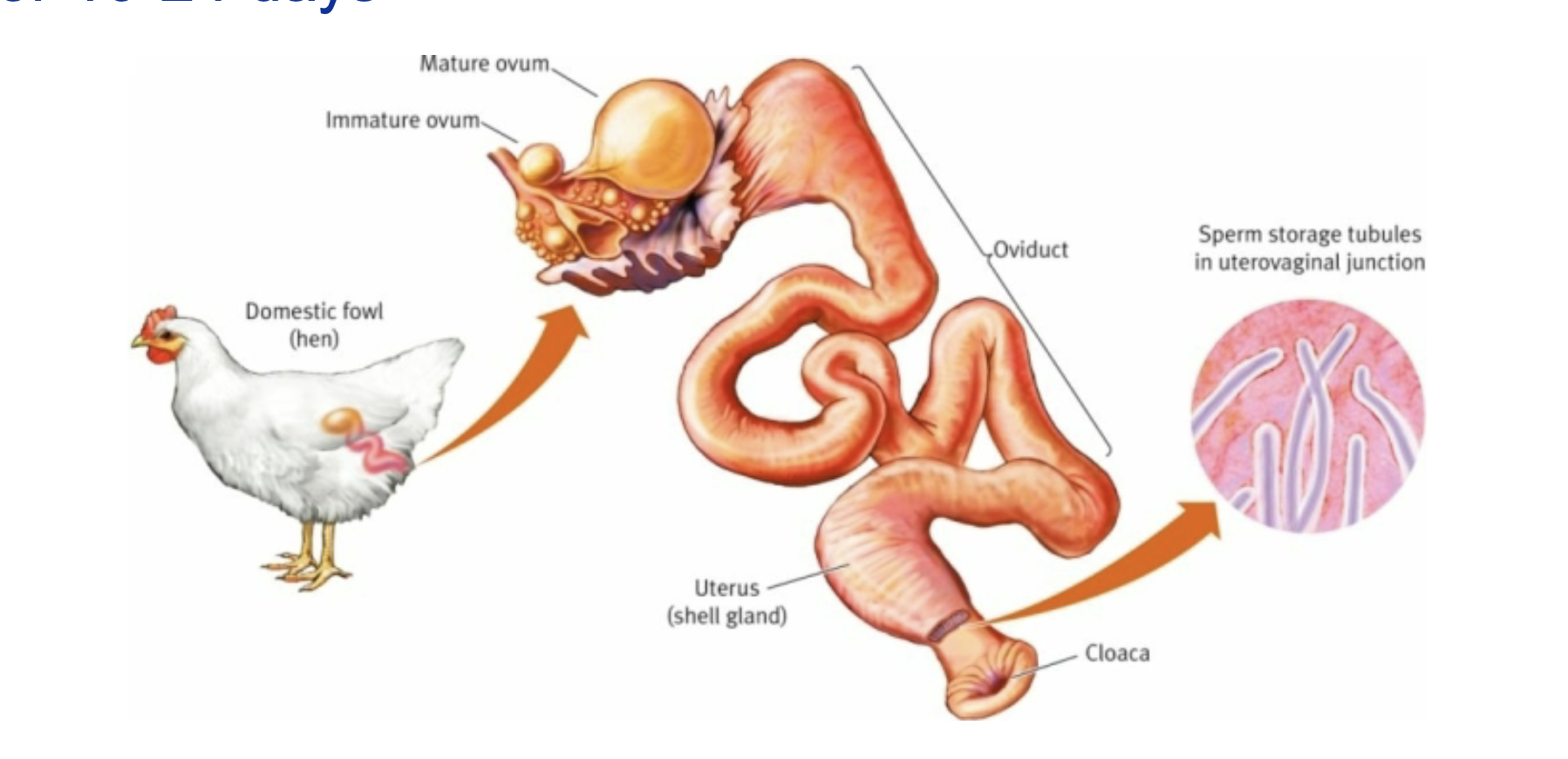
Female reproductive system - breeding seasons
Ovary enlarges enormously during the breeding season
Only the left ovary; right ovary is vestigial in most birds
Female reproduction - Rapid follicle development
each ovum matures (embryo“yolked up”) in 6-8 days
takes like a week to add the yolk
Energy expensive
Female Reproductive Tract - Anatomy (LABEL FOR EXAM)
Folliles: Get the yolk
Ostium: female birds are fertile for about an hour
Magnum: receives egg white, Albumin
Isthmus: shell membrane
Uterus: Receives shell, egg is spinning
Colaca/vagina: egg comes out

Sperm storage
2 storages of sperm in female tract
up high in Ostium
down low in Vagina
Waterfowl female reproductive system
Female vagina is also corkscrew but goes the other way (clockwise)
Don’t fit together naturally
Female has to relax and allow male to copulate for fertilization to be successful
Forced copulations end up fertilizing blind pouches
The ecology behind reproductive morphology; extra-pair copulations
Male wants to fertilize as many females as possible
Females will accept fertilization from of variety of males if he is better than her pair, or to increase diversity
females seek copulation outside of their pair
Lots of mate guarding
Importance of copulation method
generally the socially bonded male receives the most fertilization
Male reproduction for bonded males still only have less than a 5% copulation rate
Avian Egg (LABEL EGG DIAGRAM)
Nice hard shell
protection
nourishments, water
Ventilation and gas exchange
Know:
Chalazae - shock absorber of egg
Air space
Blastodisc
Vitelline membrane
Yolk
Egg white

Avian Egg - nutrition
Most fats come from the Yolk
Albumen: mostly water, with a bit of protein
Shell: gas exchange
Allantoic sac, uric acid: there’s space for non-soluble nitrogenous wastes

Gas exchange in eggs
egg must breathe, take in oxygen and release carbon dioxide
Egg can drown
Cover them in oil and the egg dies
Avian clutch size
Clutch size – the number of eggs laid in a single attempt
• Ranges from 1 (albatross, hummingbirds) to 20+ (waterfowl)
Lack’s rule – clutch size is larger at higher latitudes (resource pulse)
Clutch size
The number of eggs laid in a single attempt
clutch size declines with laying date: fewer eggs later in the season, earlier is better
Lack’s rule
clutch size is larger at higher latitudes (resource pulse)
Determinants of clutch size
Food, birds predict how many young they can feed
Parental care, time laying with resources
Nest predation risk, if it’s a risky area birds lay less eggs
Egg shelf life, maladaptive development in the tropics
Body size and life history: bigger birds tend to have smaller clutches
Clutch size exceptionalists
Species that can raise more than one brood in a season face tradeoffs
Brood parasites don’t have a clutch size
Costs of egg production
Altricial – smaller absolute egg size, less yolk, faster incubation time
Precocial – much larger eggs, more yolk, longer incubation time
Altricial
smaller absolute egg size, less yolk, faster incubation time (they are pink globs of goo)
• Offspring are nidicolous and helpless – invest more in raising them
• Almost all are income breeders – obtain nutrients to produce eggs on the breeding grounds
Precocial
much larger eggs, more yolk, longer incubation time
Offspring are nidifugous and self-sufficient
Some are capital breeders – take nutrient reserves with them from migratory staging grounds
Precocial - pros
+ Out of nest quickly (reduced nest predation risk)
+ Less parental care after hatch
Precocial - cons
– Requires chicks can find food (easy, abundant food)
– Much greater investment in eggs
– Slow growth after hatch
Altricial - pros
+ Eggs are “cheaper” (less cost losing them)
+ Faster growth after hatch
+ Continued neural development after hatch
Altricial - cons
– In nest longer (predation risk)
– Extensive parental care (feeding) after hatch
Calcium
Calcium is limiting!
Incubation physiology
Females loose feathers on chest and have warm watery area to keep chick warm
Egg turning
Birds turn eggs so eggs are equally being incubated
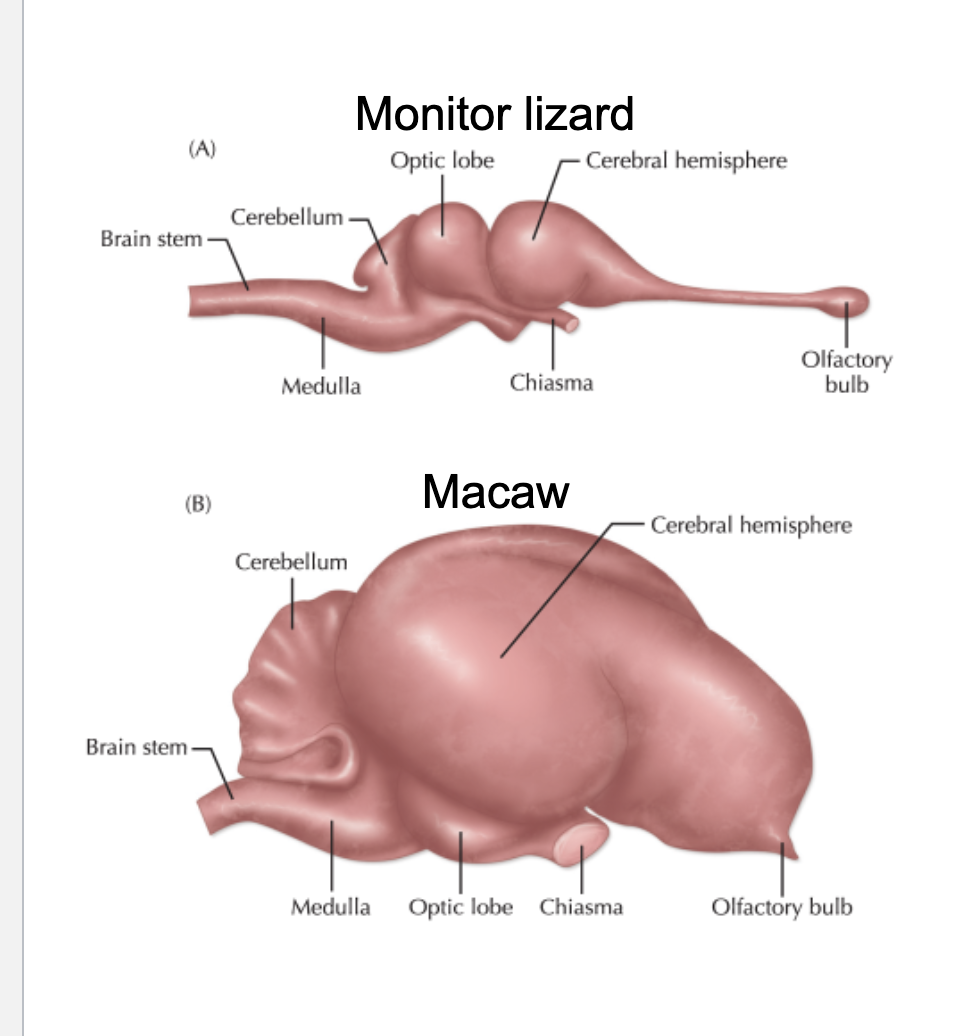
Bird vs Lizard brains (good exam slide)
1) Avian brains are LARGE compared to non-avian reptiles
2) Increase in optic lobes
3) Increase in cerebellum (balance, coordination)
4) Increase in cerebrum (higher cognition)
5) Decrease in olfactory bulb
Avian brains are WHAT compared to non-avian reptiles
Large
Avian brains have an Increase in (compared to reptile)
optic lobes, cerebellum, cerebrum
Avian brains have a decrease in (compared to reptile)
olfactory bulb
bird vs. mammal brains
Both groups have a well-developed 3-part brain:
Forebrain
Midbrain
Hindbrain
Forebrain
(basal ganglia & cerebrum) – complex behavior, instincts, learning
Midbrain
cerebellum & optic lobes) – vision, muscle coordination, physiological control
Hindbrain
(medulla oblongata) – links spinal cord and peripheral nervous system to control regions in the brain
Modern view of bird brains
Bird brains are smooth and we associate smooth brain = dumb, but in birds it’s actually differen’t tissue and they have large smooth cerebrums so they actually are still very intelligent

Important parts of bird brain
Pallial tissue
Hyperpallium
Hyperpallium
functional equivalent to cerebral cortex –higher learning
Forebrain: hyperpallium
• Center of learning/intelligence
• Best developed in crows, parrots, passerines
• Damage severely impairs behavior
• Wulst region especially important for visual perception
Forebrain: striatum
• Controls eating, eye movements, locomotion
• Controls reproductive behavior, parental care
• May play a role in vocal learning
Midbrain: optic lobes and cerebellum
• Cerebellum: balance and coordination (flight)
• Two huge optic lobes
• Both larger than mammals
Hindbrain
• Olfactory bulb – smaller than mammals
• Medulla oblongata – “housekeeping” tasks like breathing
• Hypothalamus – hunger, thirst, hormonal control
• Hypophysis – pituitary gland (“master gland” that regulates stress, growth, reproduction)
Olfactory bulb (hindbrain)
smaller than mammals
Medulla oblongata (hindbrain)
“housekeeping” tasks like breathing
Hypothalamus
hunger, thirst, hormonal control
Hypophysis
pituitary gland (“master gland” that regulates stress, growth, reproduction)
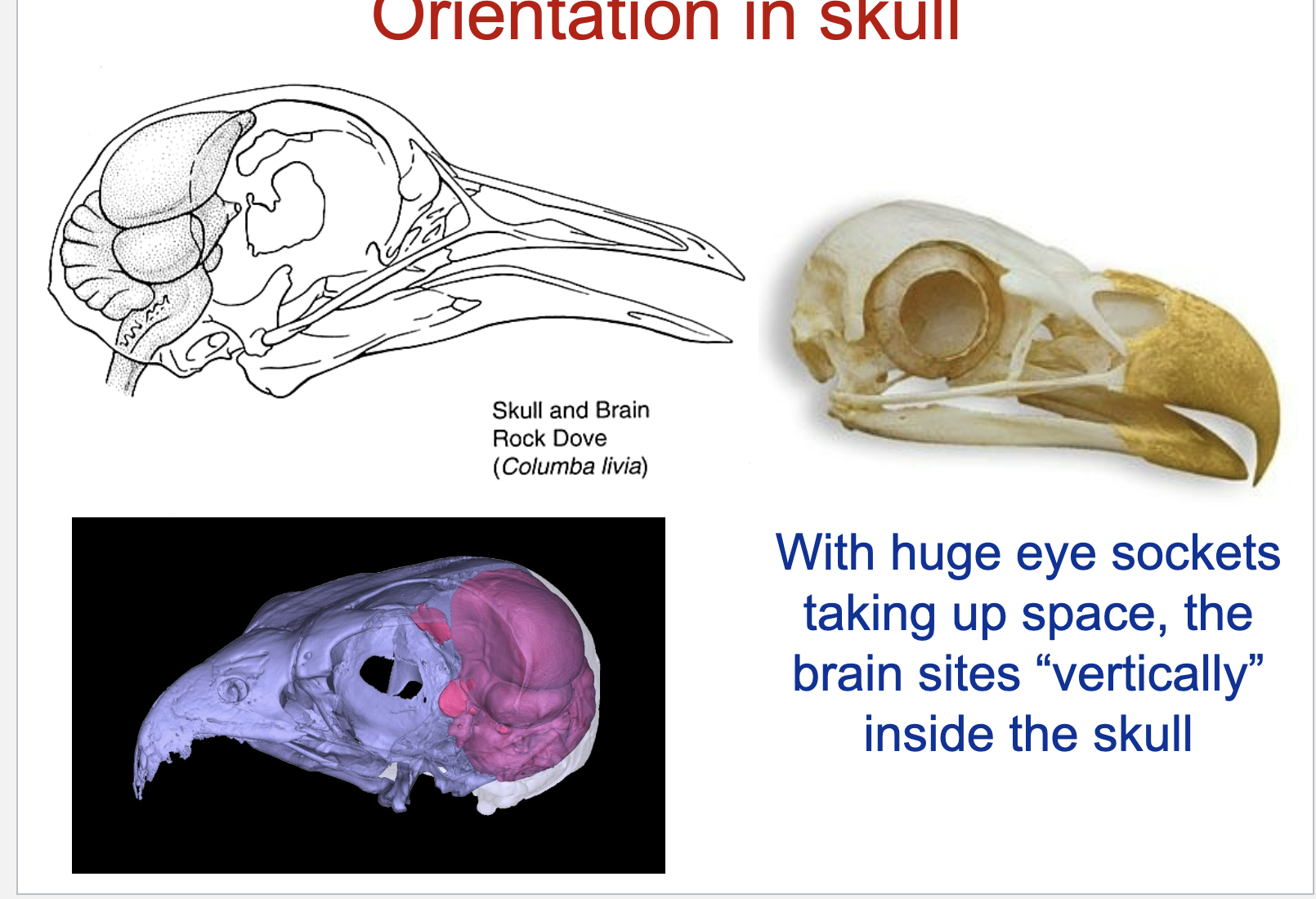
Orientation in skull
With huge eye sockets taking up space, the brain sits “vertically” inside the skull
Avian vision
The most important sense
Vision is essential for safe flight
Largest eye:body size ratio in the animal kingdom

Eyes – a review
Light travels through clear cornea and into pupil
Iris controls pupil size and how much light gets through
Lens focuses light to keep things sharp
Light hits receptors on the back of the eyeball (retina) which translates light into nerve impulses sent through the optic nerve
Eye itself is filled with aqueous humor and vitreous humor
Visual reception basics
Cones = color
Rods = light and dark
Avian eye – key differences
Larger – by a lot!
Scleral ring stabilizes eye, but reduces mobility
Nictitating membranes (third eyelid)
Two lens system of vision (cornea+lens)
Pecten provides glucose to eyeball
Multiple fovea

Size of avian eye
Lots of variation in eye size
larger in nocturnal species and raptors
Human eyes are ~1% of head mass
European Starling: ~15% of head mass
Birds also have a relatively huge optic lobe
Avian variation in eye shape
There is variation and it relates to behavior and ecology

Reduced eye mobility – scleral ring
Large bird eyes require additional support
Scleral ring
bony ossicles around the eye
Reduces eye mobility - birds turn their heads a lot
Protects the eyeball, holds shape during fast movement
Nictitating membranes
Third, clear eyelid that acts as protective goggle
Good for high speed, underwater