COSC 325 - Electrical Unit Guide Terms
 Call Kai
 Learn
 Practice Test
 Spaced Repetition
 Match
 Flashcards
 Knowt Play
1/58

There's no tags or description
Looks like no tags are added yet.
59 Terms
Voltage & unit of measure
is the amount of electrical pressure in a circuit. also known as electromotive force (EMF) or potential difference. Measure in Volts
AC voltage and source
Alternating Current; is voltage that reverses its direction of flow at regular intervals. Used in residential, commercial, and industrial lighting and power distribution systems. produced by generators that produce it sine waves as they rotate
1Φ and 3Φ (you won’t be asked anything about sine waves)
Types of AC Voltage; contains only one alternating voltage waveform and is a combination of three alternating voltage waveforms, each displaced 120 electrical degrees (one-third of a cycle) apart. Three-phase voltage is produced when three coils are simultaneously rotated in a generator.
DC voltage and common sources
Direct Current; voltage that flows in one direction only. all portable equipment (automobiles, golf carts, flashlights, cameras, etc.) most common power sources are batteries and photocells, also obtained from a rectified AC voltage supply
Current & unit of measure
(I), flows through a circuit when a source of power is connected to a device that uses electricity, is the number of electrons flowing through an electrical circuit. Measured in Amperes (A).
Power
is the rate of doing work or using energy. Measured in Volt-Amps (VA) or Watts (W).
Conductor & common materials in construction
is a material that has very little resistance and permits electrons to move through it easily. Copper most common then Aluminum.
Insulator
is a material that has a very high resistance and resists the flow of electrons.
Lumen
s the unit used to measure the total amount of light produced by a light source.
Footcandle
is the amount of light produced by a lamp (lumens) divided by the area that is illuminated.
Power formula
1Φ: P = V * I
3Φ: P = V * I * √3
Understand Figures 10-10 through 10-15.
Power = Voltage (Direct Relationship)
Power = Current (Direct Relationship)
Voltage = Current (Reverse Relationship)
NEC
National Electrical Code, standards for local and state compliances
Lighting
is the most common type of installation and application used in electricity distribution; are used on electrical floor plans to show the location and style (recessed or surface) of fixtures and the required type of light-fixture mounting (ceiling or wall)
Receptacle
Outlets; are used throughout a building to provide access to power for electrical loads. is an electrical contact device used to connect equipment with a cord and plug to an electrical system.
GFCI receptacle
ground-fault circuit interrupter receptacles; is an electrical receptacle that offers protection by detecting ground faults and then quickly disconnecting power from the circuit.
Ground Fault is any amount of current above the level that may deliver an electrical shock.
Home run
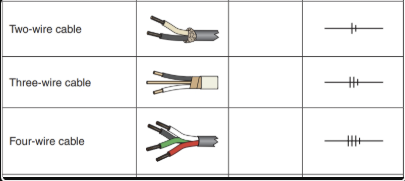
is a line with an arrow that shows where circuit wiring should return to the service panel. Hash marks on indicate the number of hot, neutral, and ground wires in cable. Full-hash marks indicate hot, and half-marks indicate neutral and ground wires. Dots may be used to indicate ground wires.
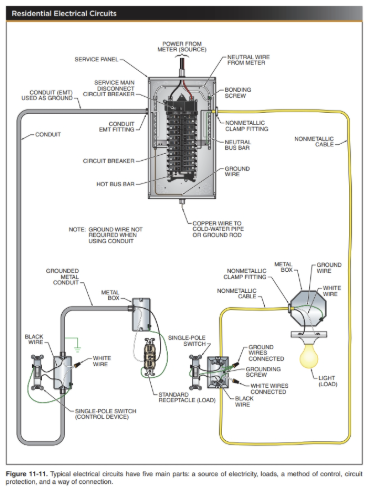
Electrical circuit
is an assembly of conductors (wires), electrical devices (switches and receptacles), and electrical components/loads (lights and motors) through which current flows.
Understand Figure 11-11
Typical electrical circuits have five main parts, which are represented on electrical diagrams and include the following: • a source of electricity (service panel) • loads that convert electrical energy into some other usable form of energy such as light, heat, or motion
• a method of controlling the flow of electricity (switch)
• circuit protection (fuses or circuit breakers) to ensure that the circuit operates safely within electrical limits
• a way of connection by conductors/ cables to attach individual devices and loads together
Manually controlled circuit
is any circuit that requires a person to initiate an action for the circuit to operate. For example, a manually controlled circuit may have a single-pole switch (S1) controlling a light in a fixture.
Automatically controlled circuit
is any circuit that uses a control device to initiate an action for a circuit to operate. For example, an electric motor on a sump pump can be turned on and off automatically by adding a control device such as a normally open (NO) float switch.
3-way switching (purpose only, not all the complicated wiring diagrams)
is a single-pole, double-throw (SPDT) electrical control device; commonly used to control lights from two switch locations. Four terminals can be identified: the common, traveler A, traveler B, and ground terminals.
4-way switching (purpose only, not all the complicated wiring diagrams)
is a double-pole, double-throw (DPDT) electrical control device. are used between two three-way switches to control a light from three switch locations.
Dimmer switches
is an electrical control device that is used to control light brightness by adjusting the voltage level applied to the light. can be used in rooms and other areas in which variable light level is de-sired.
Timer switches
is a programmable electrical control device that automatically turns off after an elapsed amount of time; has preset buttons that are each configured with a timing limit.
Motion sensor switches
is an electrical control device that automatically turns on or off based on the occupancy or vacancy of a room space.
Romex
Nonmetallic-sheathed (NM) cable is electrical cable that has a set of insulated electrical conductors held together and protected by a strong plastic jacket.
Typically contains two or three insulated wires (conductors) and may include a separate bare ground wire.
The wire size, number of conductors, and ground information are printed on the outer jacket of NM cable.

Solid vs. stranded wire
is an insulated conductor composed of several smaller wires twisted together. Meanwhile, is an insulated conductor composed of only one wire.
Conductor sizes
American Wire Gauge (AWG) is a US standard for copper and aluminum wire diameters.
The larger the AWG number assigned to a wire, the smaller the physical size of the wire or conductor.
A stranded wire occupies more space than a solid wire because the wire gauge is measured by summing the cross-sectional area of the strands.
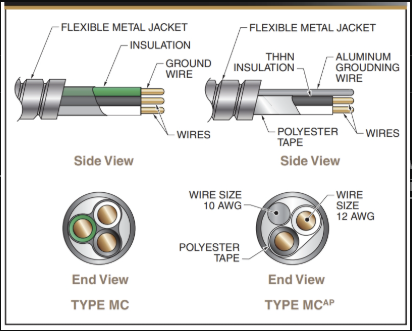
MC cable
is a cable that consists of two or more individually insulated wires and a separate grounding wire inside a flexible metal outer jacket; Metal Clad
Conduit - EMT
is light-gauge metallic tube used to route wires; often referred to as “thin-wall conduit” due to it having a wall thickness that is about 40% of the thickness of RMC.
Conduit - RMC (also IMC, which is not in your book)
is heavy-duty galvanized metallic tube used to route service entrance conductors.
Conduit - PVC
Polyvinyl chloride; is strong, lightweight plastic pipe used for indoor, outdoor, and underground instal-lations.

Compression connector/fitting
is a type of box fitting that firmly secures conduit to a box by utilizing a nut that compresses a tapered metal ring (ferrule) into the conduit. As the compression nut is tightened, the nut forces the ferrule into the conduit, locking the con-duit in position.

Set-screw connector/fitting
is a type of box
fitting that relies on the pressure of a screw against conduit to hold the conduit in place. Set-screw connectors are also reusable.

Electrical connections: solder
is the process of joining metals by using filler metal and heat to make a strong electrical and mechanical connection.
Electrical connections: tape
Many types of tape can be used to insulate exposed wire in electrical wiring connections. is a type of plastic tape that has good insulation properties and can insulate up to 600 V per wrap.
Electrical connections: wire nuts
are designed to hold several electrical wires firmly together and to provide an insulating cover for the connection.
Service entrance
is an assembly of the wires installed between the meter fitting (socket) and the disconnecting means (main breaker, fuse box, or breaker panel) inside a building.
Service head/weather head
is a weatherproof service point where overhead service drop conductors enter the service entrance riser pipe going to the meter socket.

Service panel (understand Figure 14-13)
is an electrical box designed to contain fuses or circuit breakers for protecting the individual circuits of a building from the distribution system.

Subpanel (see Figure 14-16)
is a panel supplied by the main service panel and distributes circuits to a specific area of a building.
UPS
uninterruptible power supply; is an electrical storage device that provides stable and reliable power during fluctu-ations or failures of the primary power source.
Generator
is an electromechanical device that converts mechanical energy into electrical energy by means of electromagnetic induction.
ATS
is a device that switches a load between two different sources of electric power. continuously monitors utility power for fluctuations or outages and can trigger a command to start a generator and bring it online.
Transformer (XFMR)
is an electric device that uses electromagnetism to change voltage from one level to another or to isolate one voltage from another. They are primarily used to step up or step down voltage.
Primary
coil (input side) of a transformer is the coil to which the voltage is connected.
Secondary
coil (output side) of a transformer is the coil in which the voltage is induced.
Step up
transformer is a transformer in which the secondary coil has more turns of wire than the primary coil. produces a higher voltage on the secondary coil than the voltage applied to the primary.
Step down
transformer is a transformer in which the secondary coil has fewer turns of wire than the primary coil. produces a lower voltage on the secondary coil than the voltage applied to the primary.
Transformer ratings
Paragraph on “Distribution Transformers”. Pay attention to the voltages.
step-down transformers that reduce voltage transmitted at high levels to usable residential, commercial, and industrial voltage levels.
normally rated from 1.5 kVA to 500 kVA and deliver a secondary volt-age of 115 V, 120 V, 208 V, 230 V, 240 V, 460 V, or 480 V.
Load (electrical)
Common voltages for electrical services and where they’re typically used - 120/240V, 1Φ, 3-wire (4 wires if you include ground
Common voltages for electrical services and where they’re typically used - 120/208V, 3Φ, 4-wire (5 wires if you include ground)
Common voltages for electrical services and where they’re typically used - 277/480V, 3Φ, 4-wire (5 wires if you include ground)
Incandescent lamp
Fluorescent lamp
LED lamp