NEUR30080 L10 SF striated muscle: mechanical properties
 Call Kai
 Learn
 Practice Test
 Spaced Repetition
 Match
 Flashcards
 Knowt Play
1/74

There's no tags or description
Looks like no tags are added yet.
75 Terms
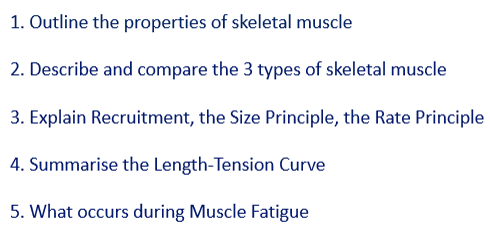
learning outcomes
functions of skeletal muscle
to move the body limb by creating motion
to provide strength by generating active force
to protect joints by absorbing shock
specific functions of connective tissues within muscle
provide gross structure to muscle
generate passive tension against stretch
to transmit force to the bone and across the joint
properties of skeletal muscle

tendon or fascia
viscoelasticity
non-contractility
tendon is like a tight-fitting wetsuit
note about tension and muscle length
increase in tension does not imply decrease in muscle length
mechanism of single fibre contraction
contraction refers to the turning on of the cross-bridge cycle
note: whether there is an accompanying change is muscle length depends on the external forces acting on the muscle
contraction: the thick and thin filaments do not shorten, they increase their overlap
activation of a muscle fibre: 3 types of contraction
isometric
isotonic concentric
isotonic eccentric
isometric contraction
the muscle generates tension but does not change length
e.g. wall sit
tension produces never exceeds load
isotonic concentric contraction
the muscle shortens, moving a load
isotonic eccentric contraction
the external load on the muscle causes the muscle to lengthen during the period of contractile activity
slow movement, ‘negatives’ in gym
types of muscle contraction image

isotonic mnemonic
isotonic - taking gin and tonic (moving)
activation of a muscle fibre - sarcomere level

which involves sarcomeres shortening and muscle remaining the same length?
isometric contraction
which involves sarcomeres shortening even more, shortening the entire muscle?
isotonic contraction
whole muscle contraction
the tension prod by whole muscle contraction depends on the amount of tension developed by each fibre and the number of active fibres in the muscle
movement around a joint requires 2 antagonistic groups of muscles
one flexes at the limb joint
other extends at the limb
this lever system of muscles and bones req muscle tensions far greater than the load in order to sustain a load in an isometric contraction
the lever system produces a shortening velocity at the end of the lever arm that is greater than the muscle-shortening velocity
antagonistic muscles example
biceps and triceps
types of skeletal muscle fibres: collection of fibres
muscle composed of heterogenous collection of different fibres
range of muscle fibre types facilitate range of muscle capacities
muscle fibre classification criteria
3 types of skeletal muscle fibres are classified based on 2 criteria:
how fast? (maximal shortening velocities)
how do they regenerate ATP? (main pathway)
3 types of muscle fibres
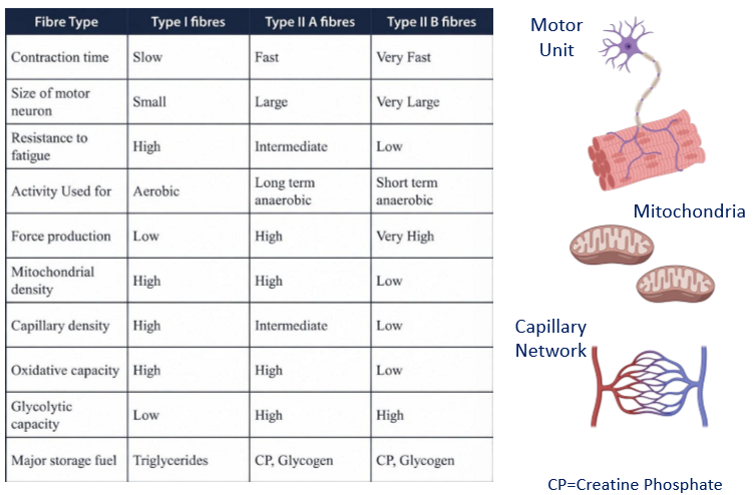
slow twitch (Type I) / slow oxidative
intermediate twitch (Type IIA) / fast oxidative
fast twitch (Type IIB) / fast glycolytic
proportions of fibres in muscle
most muscles contain varying proportions of each fibre type
muscles can adapt to changing demands by changing size or fibre type composition
types of muscle fibres image

types of muscle fibres: speed
maximal shortening velocity determines speed
different maximal shortening velocity due to different myosin enzymes with high/low ATPase activities - giving rise to fast/slow fibres
fast-glycolytic have larger avg diameter than oxidative - therefore produce more tension BUT fatigue more rapidly
motor unit and fibre types
all the muscle fibres in a single motor unit belong to same fibre type, and most muscles contain all 3 types
types of muscle fibres depending on requirement
no. of slow or fast twitch fibres in body varies - genetics
slow twitch: endurance sports
fast twitch: sprinting
can influence with training
muscle twitch of different muscle fibres graph

how are muscle fibres distinguished?
based on the time it takes for them to contract
Type I fibres: overview
slow oxidative (slow and low intensity contraction)
red (high myoglobin & rich capillary supply)
isoform of myosin with low ATPase activity (ATP split slowly)
thin fibres
numerous mitochondria
high aerobic enzymes (ATP prod)
slow to fatigue, sustained contraction possible
note: red muscles contain predominately, but not exclusively, red muscle cells
Type I fibres: applications
postural control: maintaining upright posture
endurance and stability: stabilisation of bones and joints
limitations: NOT suitable for powerful, fast or high-tension, explosive movements
Type IIA fibres: overview
fast twitch, oxidative-glycolytic
red/pink
numerous mitochondria
aerobic and anaerobic respiration (ATP prod)
rapid ATP prod vs TI
more fatigue resistant than TI
Type IIA fibres: applications
activities requiring moderate-to-high energy and endurance combined with speed
e.g. walking, mid-distance running, swimming
Type IIB fibres: overview
fast-twitch
white fibres (in white muscles)
thicker
less myoglobin
few mitochondria
high glycogen
high ATPase activity (rapid energy use)
anaerobic glycolysis (ATP prod)
fast, forceful contraction
fatigue quickly
Type IIB fibres: applications
rapid accelerations, short-lasting maximal contractions, quick and powerful movements
fatigue v quickly
muscle fibre types image

muscle fibres in athletes
fibre type varies in individuals, heavily dictates athletic predispositions
quadriceps femoris example:
sprinters: <20% slow-twitch TI, many fast-twitch white fibres TIIB
marathon runners: >95% slow-twitch TI
summary: types of skeletal muscle fibres

table summary: types of skeltal muscle fibres
muscle twitch
neuromuscular transmission lasts 1-2 ms
latent period: time between stimulus and beginning of muscle contraction
contraction phase: peak tension reached in myocyte after 50 ms
relaxation phase: Ca2+ actively transported back into SR

graded muscle response
for proper control of skeletal movement, there are variations in strength of muscle contraction in response to demand
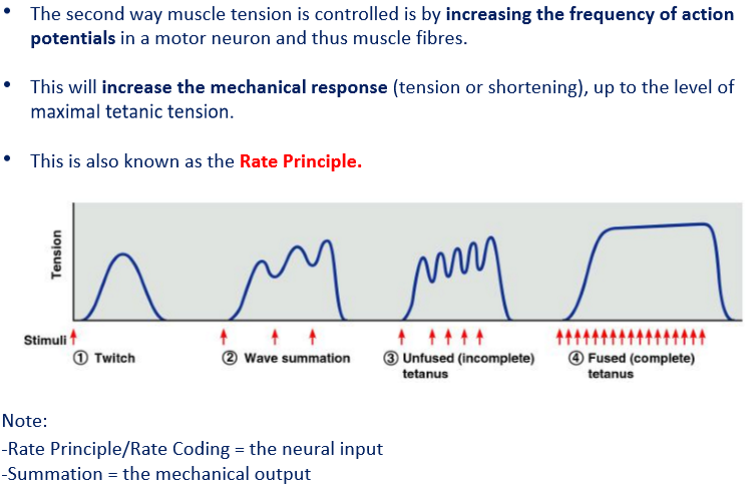
graded muscle response: the rate principle
frequency of stimulation - summation
graded muscle response: the size principle
number of motor neurons recruited - multiple fibre summation
rate principle/rate coding
the neural input
summation
the mechanical output
a twitch
smallest unit of muscle contraction, generates little force (is weak)
summation and tetanus
single AP - twitch lasts <100 ms
summation - 2nd, 3rd etc AP arrives before muscle fibre completely relaxed, force of contraction summates
incomplete tetanus - quick cycles of contraction w/ short relaxation
complete tetanus - frequency of stimuli so high that fibre cannot relax in between contractions, twitch fuses into oen sustained contraction
summation and tetanus: image

motor unit recruitment
muscle fibre/myocyte must be innervated by axon terminal of motor neuron to contract
motor unit = a single alpha1 or 2 motor neuron and all the muscle fibres/myocytes it innervates
the size of motor unit variable depending on muscle function
small motor units
smaller and fewer myocytes
for fine motor control of the muscle
extraocular eye muscles (eye movement)
approx. 6 myocytes per unit
larger motor units
high myocyte amount
simple, gross movements
e.g extending limbs
thigh and back muscles
single motor neuron innervates 1000s of muscle fibres
fibres per motor unit
muscles that produce delicate movements have small no. of fibres
large postural movements have much larger motor units
fast-glycolytic motor units have large-diameter fibres and tend to have large numbers of fibres per motor unit
large vs small motor unit image

motor unit function
AP from motor neuron - all fibres in motor unit contract as a group
strength of contraction depends on how many muscle fibres in the MU
multiple motor neurons stimulated at once to gen more force
size principle - smaller MUs recruited first, larger MUs recruited to larger stimuli
asynchronous activation of MUs
muscles maintaining body upright
NS alternates between diff motor units of similar size - reduce length of contraction time - fatigue
prolonged contraction - ATP depletion and dissipation of ion gradients necessary for contraction
MU recruitment: cross-innervation exp
when a slow motor neuron innervates a fast muscle, the muscle switches its properties to become slow-like (& vice versa)
muscle fibres are largely dictated by the pattern of neural stimulation they receive for their motor neurons

MU recruitment
recruited according to the ‘all or none’ principle
once recruited, the MU will contract to its fullest extent regardless of the strength of impulse causing the contractions
the order of recruitment - SMALLER MUs FIRST

recruitment definition
the process by which muscle tension is controlled primarily by increasing the number of active motor units in a muscle
increasing MU recruitment increases velocity of contraction

size principle image summary

rate principle image summary
skeletal muscle fibre APs image

isometric contraction graphs image

isometric contractions prod by multiple stimuli image

muscle fatigue during isometric tetanus image

length-tension curve image
shows myosin-actin overlap

length-tension relationship
the principle that a muscle’s ability to generate force depends on its resting length, which dictates the optimal amount of overlap between its actin and myosin filaments
tension
the pulling force gen. by actin and myosin cross-bridge formations
magnitude det. by stimulation freq. & initial resting length of muscle
maximal tension readily produced in body as CNS maintains resting muscle length near the optimum
isometric tension
produced at the optimal sarcomere length (L0)
stretching fibre beyond its optimal length or decreasing the fibre length below L0 decreases the tension gen
stress=length relationships in isometrically contracting muscle

muscle fatigue

mechanisms of muscle fatigue

causes of muscle fatigue

exercise of muscle to alter susceptibility of fatigue

muscle damage and repair

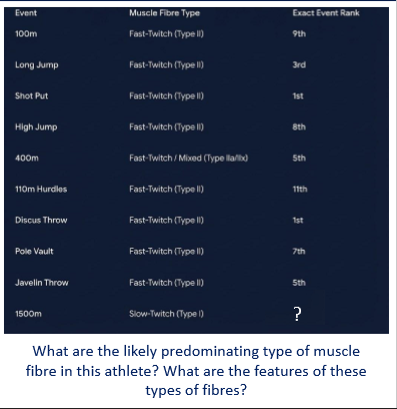
case-study: decathlete
came 18th place
learning outcomes