Cells
 Call Kai
 Learn
 Practice Test
 Spaced Repetition
 Match
 Flashcards
 Knowt Play
1/7

There's no tags or description
Looks like no tags are added yet.
8 Terms
Cell Theory
Cells are the basic unit of life.
All living organisms are made of cells.
Two main types:
Prokaryotic cells → simple, no nucleus (e.g., bacteria)
Eukaryotic cells → complex, with nucleus (plants & animals)
Cell Theory explained:
All living things are made of cells.
Cells are the basic unit of structure and function.
All cells come from pre‑existing cells.
What Are Organelles?
Organelles = specialised parts of the cells which perform a specific function
“little organs” inside the cell
Each organelle has a specialized structure and function, just like organs in the body.
Together, they keep the cell alive and functioning.
Found in the cytoplasm of eukaryotic cells.
Animal Cell (12 organelles)
Cell Membrane
Thin, flexible boundary
Controls entry/exit of substances, maintains homeostasis
Nucleus
Surrounded by nuclear envelope, contains DNA
Directs protein synthesis & cell division
Nucleolus
Dense region inside nucleus
Produces ribosomes (protein factories)
Nucleus membrane
Double membrane around nucleus
Protects DNA, controls movement in/out nucleus
Cytoplasm
Jelly-like fluid
Site of chemical reactions; suspends organelles
Mitochondria
Double membrane, inner folds (cristae)
Releases ATP via respiration
Ribosomes
Tiny particles (in cytoplasm or in ER)
Build proteins from amino acids
Endoplasmic Reticulum (ER)
Rough ER (with ribosomes)
Rough ER: helps protein transport
Smooth ER (no ribosomes)
Smooth ER: helps lipid (fat) synthesis
Golgi Apparatus
Stacks of flattened sacs
Packages and modifies proteins to export out cell
Lysosomes
Small sacs with enzymes
Breakdown wastes, pathogens, old organelles
Centrosome
Region near nucleus with centrioles (spindle fibres)
Organise spindle fibres during cell division
Vacuole
Small fluid-filled scas
Store water nutrients, wase

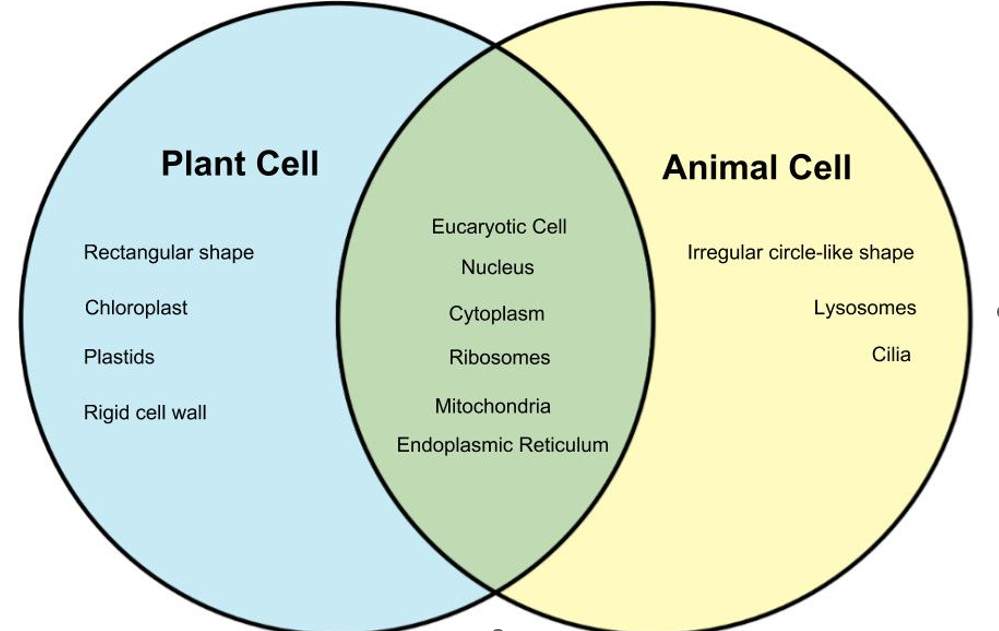
Comparing Animal to Plant Cells
Similarities: Both have nucleus, cytoplasm, mitochondria, ER, Golgi, ribosomes.
Differences:
Plant
Have cell membrane, cell wall, chloroplasts, large central vacuole
Do NOT have lysosomes or centrioles
Animal
Have cell membrane, lysosomes, centrioles, many smaller vacuoles
Do NOT have cell wall, no chloroplasts, small vacuoles
Plant cells often more regular/rectangular, animal cells more irregular/round.
Plant cell (8 Organelles)
Cell Wall
Rigid, made of cellulose
Provides strength & shape
Chloroplasts
Contain chlorophyll, double membrane
Photosynthesis, to make oxygen and glucose
Large Vacuole
Fluid-filled sac
Stores water, maintains turgor pressure → helps keep shape/structure, physiological functions and growth
Nucleus
Surrounded by nuclear envelope, contains DNA
Directs protein synthesis & cell division
Mitochondria
Double membrane, inner folds (cristae)
Releases ATP via respiration
Endoplasmic Reticulum (ER)
Rough ER (with ribosomes)
Rough ER: helps protein transport
Smooth ER (no ribosomes)
Smooth ER: helps lipid (fat) synthesis
Golgi Apparatus
Stacks of flattened sacs
Packages and modifies proteins to export out cell
Ribosomes
Tiny particles (in cytoplasm or in ER)
Build proteins from amino acids

Microscopy
Microscopy = using instruments to magnify and study cells and structures too small for the naked eye.
Two main types:
Light Microscopes → use visible light and lenses.
Electron Microscopes → use beams of electrons for much higher magnification.
Light microscope
Magnify up to ×1000.
Use glass lenses and light source.
Can view living cells.
Often used in schools and labs.
Stains (e.g., iodine, methylene blue) make structures visible.


Electron Microscopes
Magnify up to ×1,000,000
Use electrons instead of light
Two types:
Transmission Electron Microscope (TEM): shows internal ultrastructure
Scanning Electron Microscope (SEM): shows 3D surface detail
Cannot view living cells (samples must be fixed)
Images to right are of the smooth endoplasmic reticulum in each microscope
Electron microscopes have higher resolution than light microscopes
