Carbon & Energy Managment
 Call Kai
 Learn
 Practice Test
 Spaced Repetition
 Match
 Flashcards
 Knowt Play
1/50

There's no tags or description
Looks like no tags are added yet.
51 Terms
C vs CO2
C = carbon stored in vegetation and soil (Terrestrial/organic carbon)
CO2e is when we are talking about climate change
CO2 has more molecular mass (from oxygen)
1 ton C = 3.67 tons CO2e
11 ton CO2e = 3 ton C
CO2e
Carbon Dioxide equivilent
Global Warming Potential
Carbon Offset
Emission reduction outcome
Carbon sequestored (trees) , avoided (FF→RE), or destroyed
1 tonne CO2e reduced = 1 credit
Common tool to acheive net zero
Useful for hard to abate emissions
Emerged in the 1990s
many schemes (rules and certification systems)
Types of offset projects
Forestry → most common, nature based
Switching to renewables → also common
Agriculture
Carbon capture storage (technology based)
Fuel switch (petrol vs deisel)
Offset process from offset farmer perspective
Establish carbon project (need funding from loan or company)
Follow approved method (what is counted and when)
Monitor and third party verify
Carbon credits are issued
Transfer or sell credit (open market or agreement)
Emitting company retires credit
Afforestation
Establish forest where there’s no previous forest for a long time
Reforestation
Establish forest where there has been a previous forest
REDD+
Reducing Emissions for Deforestation and Degradation
Plus conservation, sustainable forest management and enhancement of carbon stocks
Protect Existing Trees
Can be difficult to quantify (requires data and modelling to compare BAU and with project scenario)
Offset Criticisms
Indulgence: Can be easier to pay for offset than change business structure (pay to pollute)
Additionality: Is it better than business as usual? →hard to quantify
Leakage
Permenance: How enduring are the savings (fires, trees not growing, climate change issues)
Indigenous rights and equity
Measurement: Are results accurate?
Leakage
Are savings being replaced a loss elsewhere?
Does preventing emissions in one place shift them somewhere else?
protect tree planting here but they hurt trees elsewhere
Vintage
What year emission reduction occured
Co-benefits
Benefits additional to the offset
Habitat, water quality
food, fibre, climate control, air and water quality, erosion protection, touring, water and nutrient cycling
Types of carbon markets
Compliance
Voluntary
Compliance carbon market
To meet legal obligations
Government makes rules
Emissions allowance traded
EU Emissiions Trading System
Voluntary carbon market
Support voluntary climate commitments
Companies choose to purchase
Uses independen crediting programs
World is mostly this
Clean Development Mechanism (CDM)
Annex 1 countries invest in renewable energy in non-annex 1 country
Non-annex 1 gets to develop
Annex 1 gets Certified Emissions Reductions Credit
Encourages pay to pollute
Part of Kyoto Protocol
Joint Implementation
Annex 1 country helping another annex 1 country
Fugitive Emissions and new technology
Private carbon standards
VCS
Gold Standard
American Carbon Registry
Climate Action Resources
Carbon Farming
process involved in producing a carbon offset
AKA carbon offsetting
ARR
Afforestation, Reforestation, and Restoration
Planet new trees
Carbon sequestration
Capturing atmospheric CO2 and storing its carbon
primarily in vegetation and soils
Elements of a good offset
Real → from real project activity
Measurable → using recognised methods
Permanant → endure over time
Additional → must be more than BAU scenario
Independantly verified
Unique → no double counting or reuse
Science of offsets
We dug out carbon and burned it
Turned it into a gas → expands
Carbon is now reacting to ecosystems, lifecycles, carbon cycles (bad)
We are trying to reverse this and put carbon back into non-reactive, solid state
Offsets are promises of future carbon storage
Carbon Stock
The amount of carbon in a system
Levels fluctuate in nature (dynamic) → things burn, die, grow
total carbon stored at maturity
Forest carbon
Are a massive carbon sink
Trees store carbon in wood, roots, and soil
As a tree grows it uses more carbon, but platueas/ sinoid curve
Faster growing trees store faster but not always as permenant
When it dies, the carbon either burns (into atmosphere) or is buried (into soil)
Tree can have 300-600 tons of carbon
Mountain
Significant carbon storage in soil
Formed from plate techtonics → caused ecosystem to change
Trees died → snow/ ice formed → dead trees preserved in soil (carbon)
If snow melts → carbon becomes exposed → reactive (bad)
Tundra
Primitive vegetation → lichens (moss)
Very carbon rich in permafrost
Mostly snowing and some periods of melt → plants grow and die
Creates layers of dead plants (carbon) and snow
CC is increasing the growing window → may thaw lots of carbon
Boreal Forest
Pine trees
One of biggest land carbon poils (soil + biomass)
Low biodiversity
Large biomass
Cold slows decomposition → carbon goes into system slower
Temperate Forest
High carbon storage but less permanent
High biodiversity
Rapid growth and decomposition
Highly flammable, store lots of carbon but is released
Carbon mostly in biomass
Temperate Grasslands
Few trees → low biomass
high soil carbon
Burn a lot
Grow fast and die fast
Annimals eat grass → we eat animals (carbon in lifecycle)
Savannah and Tropical Grasslands
High biodiversity
Above ground carbon is variable
Soild carbon higher
Agriculture
Carbon moves the fastests
Tropical Forests
High biodiversity
Lots of biomass (carbon) piles up on eachother and starts being stored
Biomass crushed by more biomass
Biomass decomposses less due to less oxygen reaching it
Deserts and Shrublands
Slow growing plants
Low biodiversity
Carbon is stored, but little grows to store carbon in the first place
Most carbon in soils
Blue carbon
Carbon captured by oceans and coastal ecosystems
Second largest carbon sink after atmosphere
Soil stores carbon
Carbon reacts well with salt → will stay in that env for a long time
Mangroves bring atmospheric carbon to salt
Peatlands store a lot of carbon and it doesn’t react
Credits
annual growth rate of forest
t C/ha/yr converted to CO2e
have to quantify carbon stock
Get retired by purchasing emitting company (taken out of circulation so it cannot be used again)
Protocol for Measuring Carbon in Forests
Set objective
Stratify area into classes (landcover, soil quality, rainfall)
Sample (randon, systematic, or clustered)
Estimate biomass volume (tree measurement and allometric equation
Convert to carbon and extrapolate (per ha)
Random sampling
1 tree, random places
Choose random areas
Accuracy depends on sample amounts
Sample 1 tree and extrapolate data on the area
Unbiased and simple
may miss variation
Strafied random sampling
1 tree, categorised places
Divide into classes (soil, land cover, rainfall)
Do a few samples in an area where you are expecting that sample
Need good photos or satelite imagery
More accurate
Cluster sampling
Radial sampling, random places
Sample groups → circles of trees
Provides more infore but you need more expertise and is harder to deal with
Good for large or hard to access areas
Stratified clusters
Radial sampling, categorised places
Areas are pre-categorised
Circle sampling
Good for big heterogeneous regions
Biomass
Mass of plant material
50% of dry biomass is carbon
Above ground (trees, grasses) + below ground
wet (includes water) and dry (oven dried)
Allometric equation
Tree biomass = b(DBH)a
Y=bXa
a and b are species specific constant
tree biomass is volume
How to calculate carbon from biomass (AGB)
ID species and weigh
Convert wet → biomass
Need DBH, species, and height
Below Ground Biomass
Roots and soil
Root to shoot ratio
around 30% of AGB
Soil carbon
Ancient
Most carbon in form of OM (humus not roots or microbes)
More carbon stored in soil than trees
Hard to measure → inconsistent, cant use satelite imagery
Earth observation
Global scale → satelite
Regional → landsat
Local → ground truthing
Will allow for monitoring of carbon in real time
Limitations of planting trees for offsets
Takes time and space
Expensive
Productivity varies
Companies often chose fast growing monocultures
Conflict between agricultural and forest land
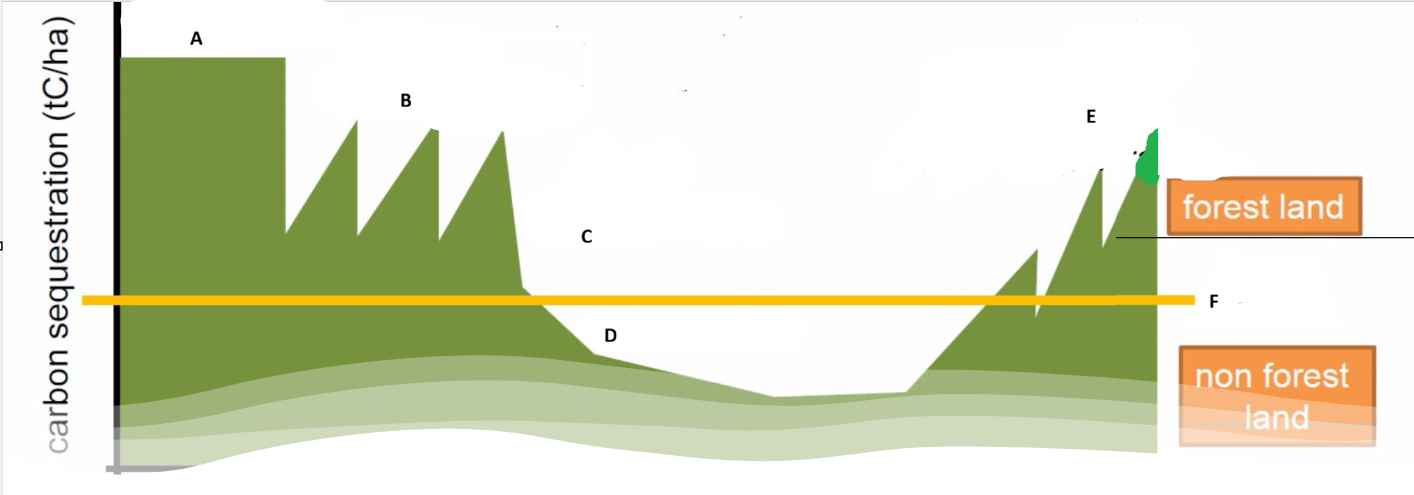
A = Conservation
B = Forest Management
C = Forest Degradation
D = Deforestation
E = Afforestation/ Reforestation/ Natural Regen
F = Forest Definition

O = Total carbon stored in the forest (t C)
Triangle = Sequestration (growth rate) in particular year tC/ha (offset sellable in particular year once converted to CO2e)
How to calculate carbon from biomass
start with biomass volume
Convert wet → dry biomass (55%)
Convert dry biomass → carbon (50%)
Convert carbon → CO2e (x3.67)
FullCAM
Forest growth modelling system
Australias forest carbon calculator
can use satellite imagery