thermodynamics and bioenergetics
 Call Kai
 Learn
 Practice Test
 Spaced Repetition
 Match
 Flashcards
 Knowt Play
1/38

There's no tags or description
Looks like no tags are added yet.
39 Terms
system
the part of the universe that is of interest
surroundings
the part of the universe that isn’t the surroundings
boundary
the “wall” between the system and the surroundings
process
a change in the state of a thermodynamic system, moving it from an initial equilibrium state to a final equilibrium state.
closed system
matter not transferred
energy is transferred
open system
matter is transferred
energy is transferred
isolated system
matter and energy are not trasnsferred
first law of thermodynamics
energy can neither be created or destroyed
energy is a state variable / function meaning
independent of the history of the system
enthalpy
sum of a thermodynamic system's internal energy and the product of its pressure and volume // total energy content of a system
enthalpy change
heat change of reaction
mechanical work / internal energy / enthalpy equation
∆H = ∆U + P∆V
∆H = enthalpy change
∆U = internal energy change
P∆V = mechanical work / energy, small in bio systems so:
∆H = ∆U
Second law of thermodynamics
∆Ssystem + ∆Ssurroundings = ∆SUniverse >0
Any spontaneous process must cause the entropy of the universe to increase
At equillibrium, Ssystem + Ssurroundings = maximal
The combined entropy of a system and surroundings increases in a spontaneous process
Entropy, S
state function
measures degree of disorder / randomness of a system
systems of molecules have a natural tendency towards randomisation
After a perturbation, a system moves to a new…
equilibrium state
Gibbs free energy, G
state function of the system that incorporates both energy and entropy changes:
G = H – TS
Condition for process to occur spontaneously at constant temperature and pressure:
∆Hsys – T∆Ssys < 0
cHsys = enthalpy change of system
T∆Ssy = temperature x enthalpy change of system
∆G at constant temperature and pressure equation
∆G = ∆H – T∆S
∆G = gibbs free energy change
∆H = enthalpy change
T∆S = temperature x entropy change
Under ____ conditions, a process is ____ – it can be made to go in either direction by ____ changes in conditions.
When a system is far from equilibrium, it will tend to move to equilibrium by an _____ process unless there is a ____ change in conditions.
equllibrium
reversible
small
irreverisble
major

G is at maximal
Values for X are unstable
small fluctuations in system will cause system to move away from that point
∆G
Difference between the free energies of reactants and products
extensive property: depends on amount of material in the system
∆G > 0
endergonic
forward proces energetically unfavourable
reverse process proceeds spontaneously
Keq > 1
∆G < 0
Keq > 1
exergonic
forward process is energetically favourable
forward process proceeds spontaneously
∆G = 0
Keq = 1
system is at equillibrium, there is no further change
dG/ dX = 0
To make a specific reaction proceed in the direction required by the organism: (2)
alter concentrations
couple reactions
Free energy and concentration reaction + derivative at equliibrium
∆G = ∆-Gº + RT ln ([products]moles / [reactants]moles)
equillbrium: ∆G = 0, [products]moles / [reactants]moles = Keq , so
∆Gº = –RT ln (Keq)
º in ∆Gº (4)
standard quantities
all at 1 M concentration
temperature = 298K
pressure = 1 atm
‘ in ∆G’
pH = 7
Keq
Equillbrium constant
[products]moles / [reactants]moles at equillbrium
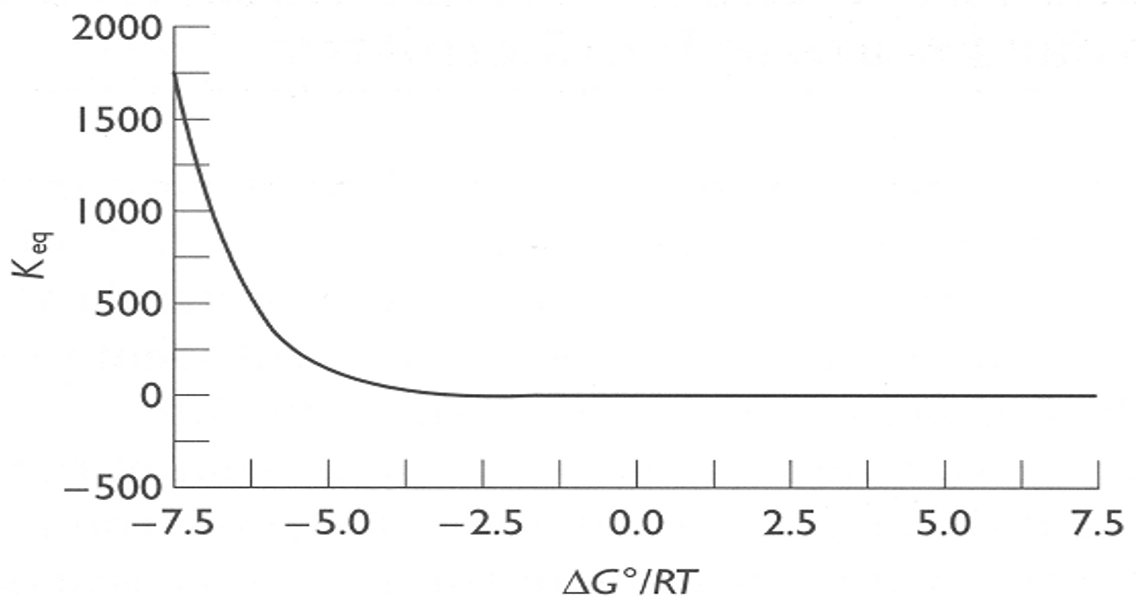
Draw relationship between ∆G0 and Keq
Thermodynamics vs Kinetics
Thermodynamics: if a reaction happens, what the result is
Kinetics: how fast
Thermodynamic basis of metabolic pathways
Coupling an endergonic reaction to an exergonic reaction with a more negative ∆G, so that the total ∆G is negative
Reactions in a metabolic cycle are coupled: next product of one reaction becomes the reactant for the next reaction in the cycle
∆G values are ____, while Eqm constants are ____
additive
multiplicative
ATP (2)
principal common intermediate in energy transformations in the cell
phosphate esters / nucleotide triphosphates = shuttles of free energy
What properties of ATP make it the major energy currency of biochemical processes? (4)
relatively negative ∆G of ATP hydrolisis
releases protions into a medium with low proton concentration
Thermodynamically unstable but kinetically unstable (high Ae), needs enzymes (kinases) to catalyse phosphoryl group transfer
so can regulate ATP energy release by regulating enzymes
Why does ATP hydrolysis have a negative ∆G
because of highly charged ATP polyphosphate group
relief of electrostatic repulsion when terminal phosphate bond is hydrolysed
inorganic phosphate undergoes stabilisation as a resonance hybrid
resonance hybrid
accurate structure for a molecule or ion; it is an average of the theoretical (or hypothetical) contributing structures.
Net flow of phosphate is always from ___ with ___ energy to ____ with ___ energy, which become energised and do some form of cellular ____
donors
high
acceptors
low
work
scale of phosphate transfer potentials (2)
Ranking of phosphorylated compounds according to their values of ∆Gºʹ for hydrolysis.
Each compound can drive phosphorylation of compounds lower on the scale is a suitable coupling mechanism is available